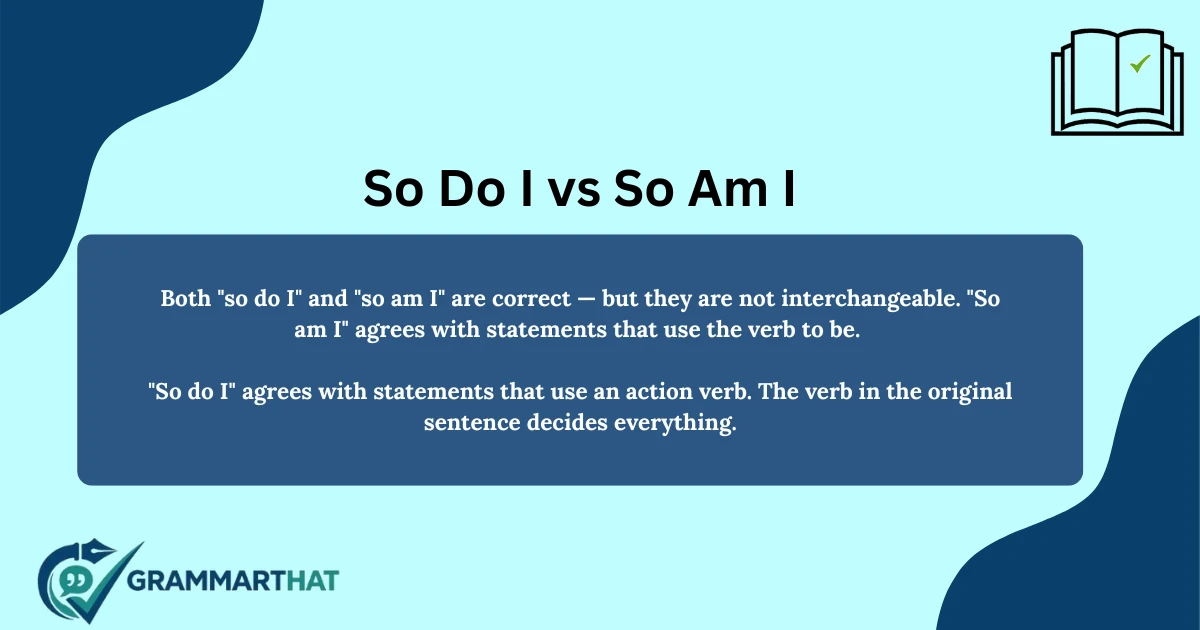
Both “so do I” and “so am I” are correct — but they are not interchangeable.
“So am I” agrees with statements that use the verb to be, while “so do I” agrees with statements that use an action verb. The verb in the original sentence determines which response is correct.
Get this rule right and you will sound like a natural, fluent English speaker in everyday conversation.
What Is the Difference Between “So Am I” and “So Do I”?
Both phrases express agreement with a positive statement. They mean “me too” or “I feel or do the same thing.”
The difference is purely about verb matching — you mirror the type of verb the other person used.
So Do I vs So Am I Reference Table
When to Use “So Am I”
Use “so am I” when the original statement uses the verb “to be” — am, is, or are.
These sentences typically describe a state, condition, feeling, or quality — not an action.
Conversation Examples
- Person A: “I am so tired.” Person B: “So am I.” (= I am tired too.)
- Person A: “I am really excited about the trip.” Person B: “So am I.”
- Person A: “I’m nervous about the interview.” Person B: “So am I.”
In every case, Person A uses “am” — so Person B mirrors it with “am” in the response. The verb always matches.
When to Use “So Do I”
Use “so do I” when the original statement contains an action verb — like love, eat, work, enjoy, play, think, or drink.
These sentences describe habits, preferences, routines, or actions — not states of being.
Conversation Examples
- Person A: “I love spicy food.” Person B: “So do I.” (= I love it too.)
- Person A: “I drink coffee every morning.” Person B: “So do I.”
- Person A: “I enjoy long walks on weekends.” Person B: “So do I.”
Here, Person A does not use am, is, or are — they use an action verb. So the response uses “do” to match.
The Verb Matching Rule — The Core Principle
The entire “so am I vs so do I” question comes down to one principle: mirror the auxiliary or main verb.
In English, short agreement responses work by replacing the full verb phrase with just the auxiliary. You never repeat the whole sentence — you echo the structure.
Beyond “Am” and “Do” — Other Agreement Forms
“So am I” and “so do I” cover the most common cases. But English has a fuller system of auxiliary verb agreement.
The rule always stays the same — match the auxiliary verb in the original sentence.
This is what competitors rarely cover — the “so am I / so do I” pattern is part of a wider agreement structure in English. Once you understand verb matching, all of these forms click into place naturally.
Negative Agreement — “Neither Am I” and “Neither Do I”
When you want to agree with a negative statement, the structure flips.
Instead of so, use “neither” — and the same verb matching rule applies.
- “I am not ready.” → “Neither am I.”
- “I don’t like loud music.” → “Neither do I.”
- “I can’t swim.” → “Neither can I.”
In casual American English speech, “me neither” is also widely used as a natural informal alternative.
Common Mistakes With “So Am I” and “So Do I”
The most frequent error is using “so am I” for action verbs — often because am feels more natural or formal. Trust the verb in the original sentence every time.
FAQs — So Do I vs So Am I
What is the difference between “so am I” and “so do I”?
“So am I” agrees with statements using the verb to be — states, feelings, and conditions. “So do I” agrees with statements using action verbs — habits, preferences, and routines. The verb in the original statement determines which response is correct.
When do I say “so am I”?
Say “so am I” when the other person’s sentence uses am, is, or are. For example: “I am tired.” → “So am I.”
When do I say “so do I”?
Say “so do I” when the other person’s sentence uses an action verb — like like, enjoy, work, eat, or drink. For example: “I love coffee.” → “So do I.”
Can I just say “me too” instead of “so am I” or “so do I”?
Yes. “Me too” is a perfectly natural, informal alternative in everyday American English conversation. Both responses carry the same meaning — “me too” is simply more casual.
What is the negative form of “so do I” and “so am I”?
The negative equivalents are “neither do I” and “neither am I.” Use neither instead of so when agreeing with a negative statement. In casual speech, “me neither” works as a simple informal alternative.
Conclusion
“So am I” and “so do I” both express agreement — but the verb in the original sentence decides which one fits. State or feeling with “to be”? Use so am I. Action verb? Use so do I.
Remember the verb matching rule — echo the auxiliary in the original sentence — and every agreement response in English becomes simple, natural, and accurate every time.

Hi, I’m the voice behind GrammarThat.com. I make grammar simple and easy to understand, from basic rules to advanced writing tips. Clear explanations. Practical examples. No confusion.