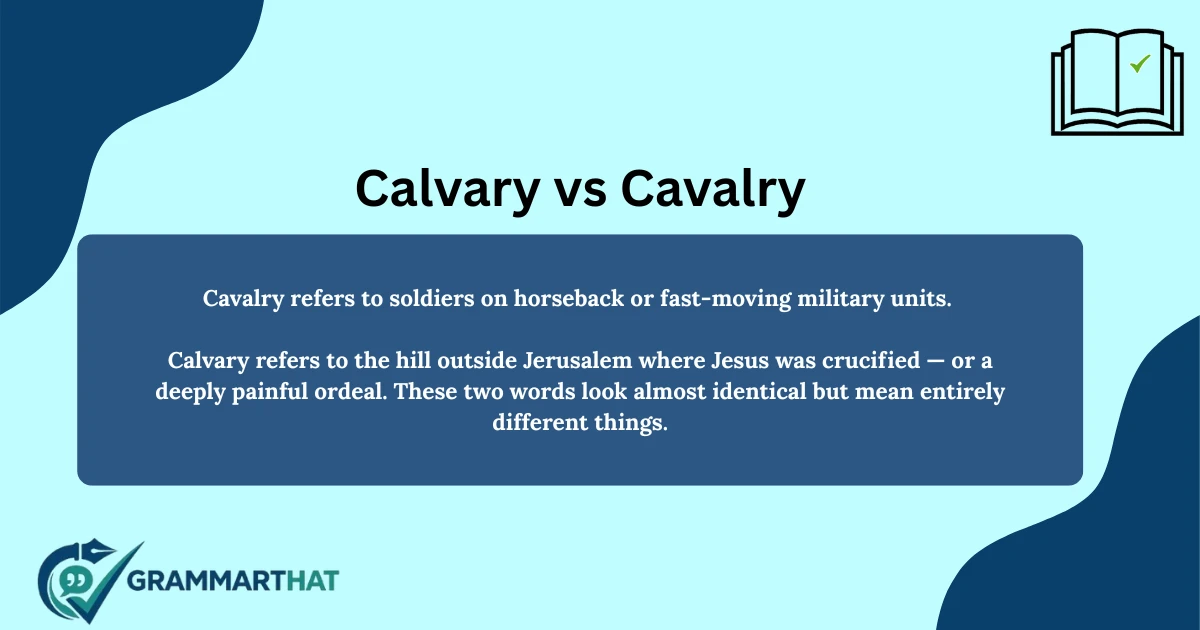
Cavalry and Calvary look almost identical — but they refer to completely different things.
Cavalry refers to soldiers on horseback or modern fast-moving military units, while Calvary is the hill outside Jerusalem where Jesus was crucified and can also mean a profound experience of suffering. One belongs to military history. The other belongs to religious history and symbolism.
Mixing them up is one of the most common spelling errors in English — and it changes your meaning completely.
What Does Cavalry Mean?
Cavalry is a military term. It originally described soldiers who fought on horseback. In modern usage, it refers to highly mobile armored or air assault units that move fast and strike quickly.
The word comes from the Latin caballus, meaning horse — and the connection to speed and movement has stayed at the core of its meaning ever since.
Examples of “Cavalry” Used Correctly
- ✅ “The cavalry charged across the open field.”
- ✅ “The general called in the cavalry to reinforce the left flank.”
- ✅ “Modern cavalry units use armored vehicles instead of horses.”
- ✅ “In old Westerns, the cavalry always seemed to arrive just in time.”
Cavalry lives in the world of military strategy, warfare, and combat history.
What Does Calvary Mean?
Calvary is primarily a religious and historical term. It refers to the site just outside ancient Jerusalem — also called Golgotha — where Jesus Christ was crucified according to Christian scripture.
Beyond its religious meaning, calvary (lowercase) is also used in everyday English to describe a deeply painful, agonizing experience — a suffering that feels heavy and prolonged.
Examples of “Calvary” Used Correctly
- ✅ “Pilgrims travel to Calvary to honor the site of the crucifixion.”
- ✅ “The sculpture depicted the Calvary scene with striking detail.”
- ✅ “Getting through the legal process was a true calvary for the family.” (figurative use)
Calvary lives in the world of religion, history, and deep personal suffering.
Calvary vs Cavalry — Side-by-Side Comparison
How to Tell Them Apart — Memory Tricks
Both words are pronounced differently — but they are close enough to cause real confusion in writing. Two simple tricks keep them separate permanently.
The “CAV” Trick for Cavalry
Cavalry starts with CAV — the same root as cavalier and cavalcade, both of which relate to horseback riding and grand processions.
If you think of a cavalier — a dashing horseman — you will always remember that cavalry belongs to the military world.
The “L” Trick for Calvary
Calvary has an L right after the C. Associate that L with the Lord — the religious context of the word. Or link it to loss and life, both central themes of the crucifixion story.
The L in Calvary = Lord, Loss, Life. That one letter keeps the meaning clear.
Why This Confusion Is So Common
The two words differ by just two transposed letters — AL in Calvary vs AV in Cavalry. In fast writing or casual typing, it is easy to swap them without noticing.
Spellcheckers rarely catch this error because both words are real, correctly spelled English words. The mistake is one of meaning — not spelling.
This makes careful proofreading essential whenever either word appears in your writing.
Real-World Usage in American English
Cavalry appears regularly in:
- Military history books and documentaries
- News coverage of armed forces
- Video games, films, and historical fiction
- The common phrase “waiting for the cavalry” — meaning waiting for backup or rescue
Calvary appears regularly in:
- Religious texts, sermons, and theological writing
- Church and chapel names (many are called Calvary Chapel)
- Figurative expressions describing severe personal hardship
The figurative use of calvary — meaning a harrowing ordeal — is more common in British and European English than in American English. In the US, the word is most widely recognized in its religious sense.
Common Mistakes to Avoid
FAQs — Calvary vs Cavalry
What is the difference between calvary and cavalry?
Cavalry is a military unit of soldiers — originally on horseback, now in armored or air assault roles. Calvary is the hill in Jerusalem where Jesus was crucified, or a figurative term for a deeply painful experience.
How do you pronounce cavalry and calvary?
Cavalry is pronounced CAV-ul-ree. Calvary is pronounced CAL-vuh-ree. The syllable order is reversed — cav-al vs cal-var.
Why do people confuse calvary and cavalry?
Because they share the same letters in a slightly different order. The words look nearly identical in print, and spellcheck does not flag either as an error. The confusion is purely about meaning and context, not spelling.
Is “waiting for the cavalry” a common phrase?
Yes. “Waiting for the cavalry” is a widely used idiom in American English meaning waiting for reinforcements, help, or a rescue. It always uses cavalry — never calvary.
Should “Calvary” be capitalized?
Yes, when referring to the specific historical and religious site outside Jerusalem. Use lowercase calvary only when using it figuratively to describe a painful ordeal.
Conclusion
Cavalry is military — soldiers, horses, armor, and speed. Calvary is sacred — the site of the crucifixion and, figuratively, a heavy personal suffering. Two letters separate them in spelling, but worlds separate them in meaning.
Remember CAV for cavalry and L for Lord in Calvary — and you will never swap these two words again.

Hi, I’m the voice behind GrammarThat.com. I make grammar simple and easy to understand, from basic rules to advanced writing tips. Clear explanations. Practical examples. No confusion.