“Too fast” is the correct phrase when describing excessive speed. “To fast” is only correct when fast is used as a verb meaning to abstain from food.
One tiny spelling difference — one extra letter “o” — changes the entire meaning of the sentence.
This guide explains the difference between to fast and too fast, when each is correct, and how to never mix them up again.
What Does “Too Fast” Mean?
“Too fast” uses “too” as an adverb meaning “excessively” or “more than what is appropriate.” It describes something happening at a speed or pace that is beyond what is acceptable, safe, or desired.
“Too” always signals excess — too much, too loud, too heavy, too fast. It modifies the adjective or adverb that follows it.
Example: “The car was going too fast around the corner.”
Common uses:
- Describing unsafe or excessive speed
- Expressing that something is happening more quickly than desired
- Warning about pace in sports, driving, or daily activity
- Describing situations moving faster than expected
“Too Fast” in Different Contexts
Related expressions using “too”:
- Too soon — earlier than appropriate
- Too much — more than needed
- Too quickly — at an excessive rate
- Way too fast — significantly more than appropriate
What Does “To Fast” Mean?
“To fast” uses “to” as an infinitive marker — the word that comes before a verb to form the infinitive. Here, fast is the verb meaning to voluntarily abstain from food for a period of time.
This usage is completely correct — but only in this specific context where fast is functioning as a verb.
Example: “The doctor advised her to fast for 12 hours before the blood test.”
Common uses:
- Religious or spiritual practices
- Medical preparation before procedures
- Intermittent fasting for health reasons
- Describing intentional abstinence from food
“To Fast” in Different Contexts
Related forms of fast as a verb:
- Fasting — “She has been fasting since yesterday.”
- Fasted — “He fasted for three days.”
- Fast (noun) — “She broke her fast at sunset.”
The Key Difference Between To Fast vs Too Fast
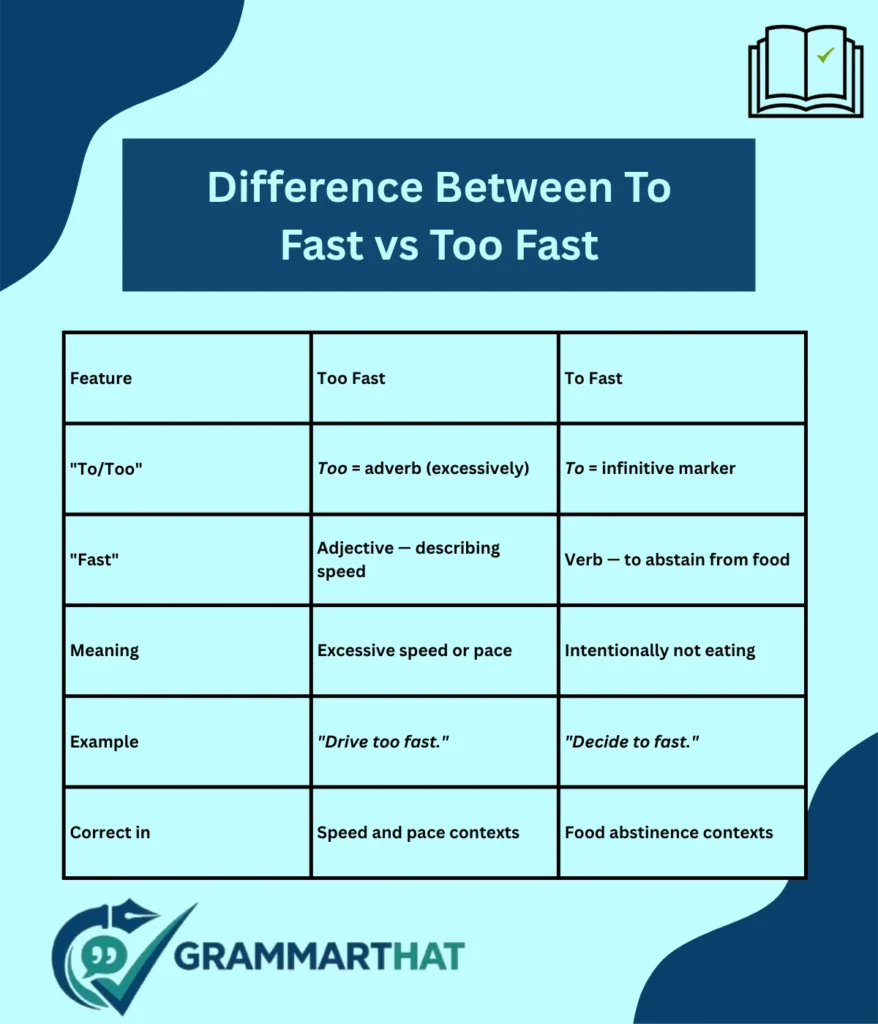
One Letter — Two Completely Different Meanings
The Word “Too” Always Signals Excess
Whenever you see or use “too” — it is always expressing that something is more than it should be:
- Too fast — more speed than appropriate
- Too slow — less pace than needed
- Too much — more quantity than wanted
- Too late — more time has passed than ideal
If you are expressing excess or intensity — too (with two o’s) is always the right choice.
“To” Is Never About Speed
“To” before fast only works when fast is a verb. You cannot use “to” to describe excessive speed — ever.
When to Use To Fast vs Too Fast
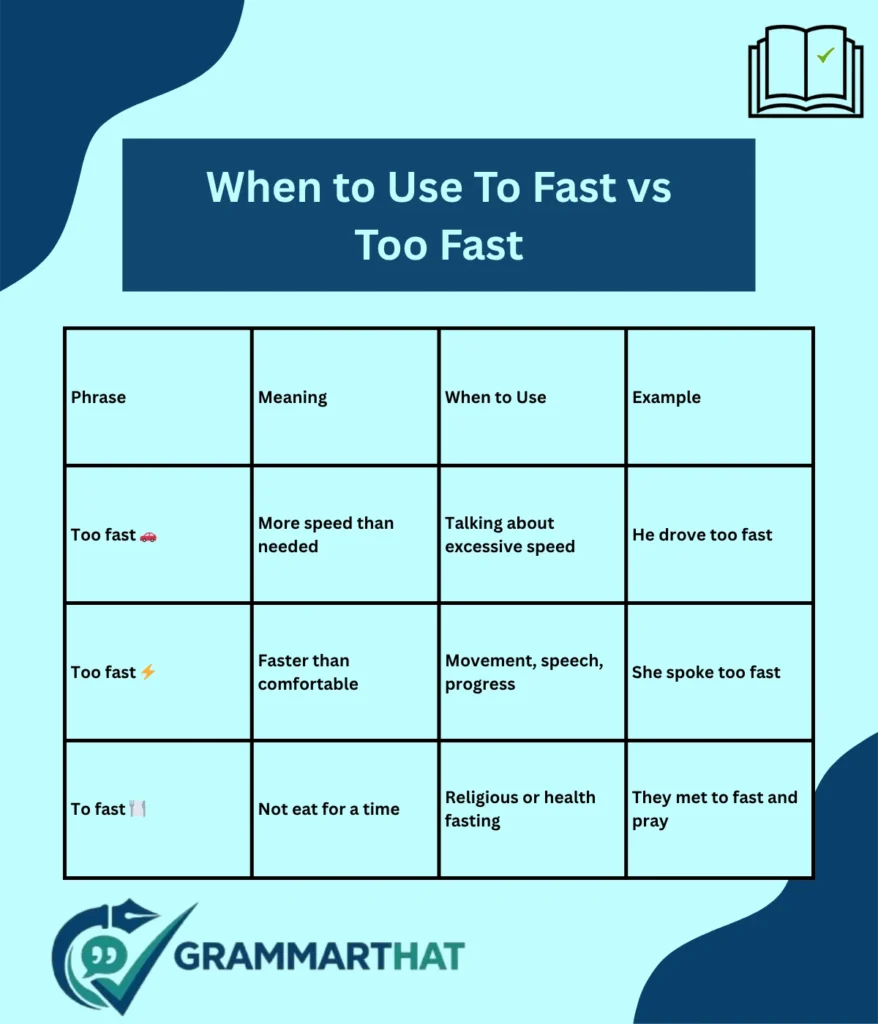
Use “Too Fast” When:
- Describing excessive speed or pace
- Warning about something happening more quickly than desired
- Talking about driving, movement, speech, or progress
- Expressing that a situation is moving beyond a comfortable rate
Examples:
- “The roller coaster was moving too fast for her comfort.”
- “He spoke too fast during the presentation.”
Use “To Fast” When:
- Fast is functioning as a verb — meaning to abstain from food
- Talking about religious, medical, or health-related food abstinence
- The sentence structure requires an infinitive (to + verb)
Examples:
- “Her nutritionist recommended her to fast twice a week.”
- “They gathered to fast and pray together.”
Is It “Way Too Fast” or “Way To Fast”?
“Way too fast” is always correct. “Way” here acts as an intensifier — meaning much more than — and it always pairs with “too,” not “to.”
- ✅ “You are driving way too fast.”
- ❌ “You are driving way to fast.”
Is It “Too Fast” or “Too Quickly”?
Both “too fast” and “too quickly” are grammatically correct and nearly interchangeable in most contexts.
“Too Fast” vs “Too Quickly”
Both convey the same meaning — excessive speed or pace. “Too fast” is more natural in casual conversation.
Common Mistakes to Avoid
Memory trick: “Too” has an extra “o” — think of that extra letter as extra speed or extra excess. When something has too much of anything — use the word with the extra “o.” No extra speed, no extra “o” — just “to” before a verb.
FAQs — To Fast or Too Fast
Which is correct, too fast or to fast?
“Too fast” is correct when describing excessive speed. “To fast” is only correct when fast is a verb meaning to abstain from food. In almost every everyday context, “too fast” is the phrase you need.
When should I use to or too?
Use “too” when expressing excess or intensity — too fast, too loud, too much. Use “to” as a preposition or infinitive marker before a verb — to run, to fast, to think.
Is it too fast or too quickly?
Both are correct. “Too fast” is more common in casual speech. “Too quickly” is slightly more formal. Either works in most sentences without changing the meaning.
Is it way to fast or way too fast?
“Way too fast” is always correct. “Way to fast” is always wrong. “Way” is an intensifier that pairs exclusively with “too” — never with the preposition “to.”
Conclusion
The difference between “to fast” and “too fast” comes down to one extra letter — but that letter changes everything. “Too fast” describes excessive speed or pace in virtually every everyday context. “To fast” only appears when fast is a verb describing food abstinence.
When you are talking about speed, movement, or pace — “too fast” is always your answer. Remember the extra “o” in “too” stands for extra — extra speed, extra intensity, extra emphasis. Keep that in mind and you will never mix these two up again.

Hi, I’m the voice behind GrammarThat.com. I make grammar simple and easy to understand, from basic rules to advanced writing tips. Clear explanations. Practical examples. No confusion.