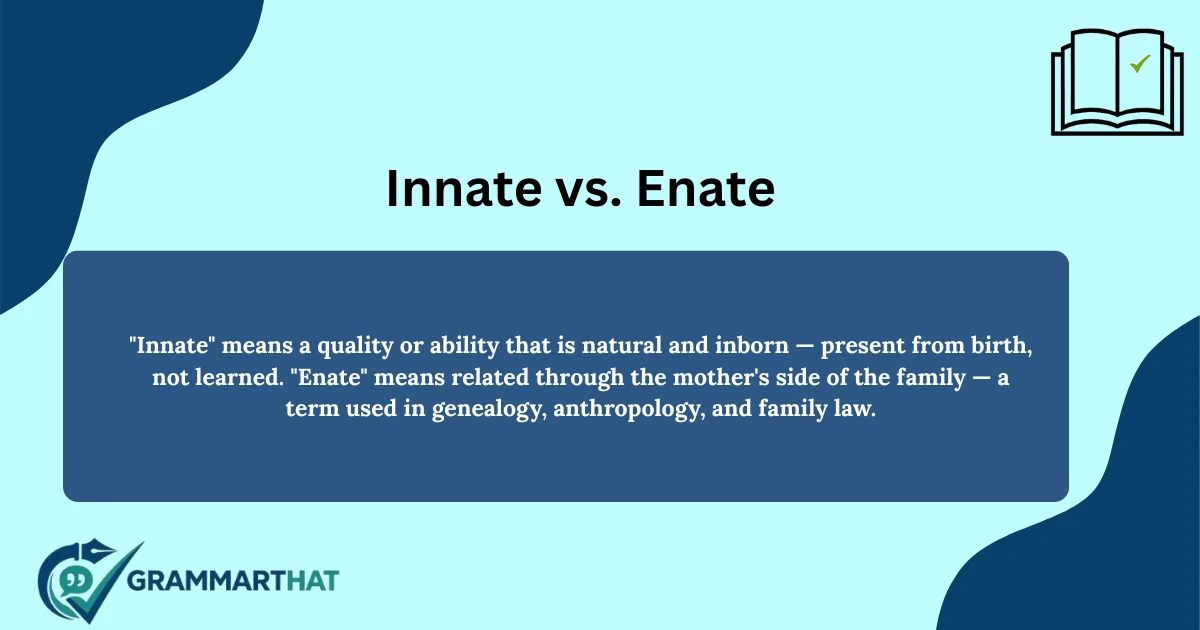
Innate refers to qualities present from birth, while enate describes relationships traced through the mother’s side of the family. They are real words with completely different meanings and are not interchangeable.
These are two completely different words with completely different meanings. They are not regional variants, not interchangeable spellings, and not related to each other in any way.
What Does “Innate” Mean?

“Innate” is an adjective meaning existing naturally from birth — a quality, ability, or characteristic that is inborn, inherent, and not acquired through learning or experience.
Example: “She had an innate talent for reading people — something no course could ever teach.”
Common uses of “innate” in everyday writing:
- “Children show an innate curiosity about the world from the earliest months of life.”
- “His innate sense of rhythm was evident before he ever took a music lesson.”
“Innate” in Different Writing Contexts
Synonyms for “innate”: inborn, inherent, intrinsic, natural, instinctive, native, congenital, built-in.
What Does “Enate” Mean?

“Enate” is both an adjective and a noun — used in genealogy, anthropology, family law, and kinship studies to describe a person related to another through the mother’s side of the family — through female connections exclusively.
Example: “Her grandmother’s siblings are considered enate relatives — connected entirely through the maternal line.”
Common uses of “enate” in formal writing:
- “In matrilineal societies, property and status pass through the enate line.”
- “Genealogists classify cousins as enate when the connection runs entirely through female ancestors.”
“Enate” in Different Formal Contexts
Synonyms for “enate”: maternal relative, matrilineal relation. Opposite: agnate — a relative connected through the father’s side or through male lineage exclusively.
Innate vs. Enate — Key Differences
These words are not regional variants like mold/mould or stylistic alternatives like canceled/cancelled. They are two completely separate words that happen to look similar. Confusing them produces sentences that are factually and semantically incorrect.
Innate vs Enate — Meaning, Origin, and Usage at a Glance
The Nature vs. Nurture Connection — Only “Innate” Applies
The nature vs. nurture debate is one of the most widely discussed concepts in psychology, education, and popular science — and “innate” sits at the heart of it.
When researchers, writers, and educators discuss whether traits like intelligence, creativity, emotional sensitivity, or language ability are built in or developed — they are asking whether those traits are innate. This is one of the most common and important uses of the word in both academic and everyday contexts.
“Enate” has no role in this discussion. It describes who your relatives are — not what you are born with.
Memory Tip
The simplest way to remember the difference:
- Innate — think inner. Something innate lives inside you from birth.
- Enate — think maternal estate. An enate relative is connected through your mother’s side — like an inheritance that travels through female ancestry.
“Enate” in Genealogy, Anthropology, and Legal Writing
- “In matrilineal kinship systems, enate relatives hold priority in inheritance claims.”
- “The genealogist identified seventeen enate ancestors across five generations of maternal lineage.”
Same Ending, Two Words — How One Wrong Letter Changes Everything
Correct use of “innate”: “She had an innate ability to calm people in difficult situations.”
Correct use of “enate”: “The disputed inheritance was claimed by an enate relative on the maternal side.”
Incorrect swap: ~~”She had an enate ability to calm people.”~~ — This says her ability is related to her mother’s family line — which is meaningless in this context.
One wrong word. The sentence becomes nonsense.
Frequently Asked Questions
Is it innate or enate?
It depends entirely on what you are describing. Use “innate” when describing a quality, ability, or characteristic that is natural and present from birth.” Use “enate” when describing a family member related through the mother’s side — “an enate relative,” “the enate line of descent.”
What is the meaning of enate?
“Enate” means related through the mother’s side of the family — connected exclusively through female or maternal ancestry.
How do you spell enate?
“Enate” is spelled E-N-A-T-E. It is not spelled innate, inate, or enate with any additional letters. Because it looks similar to “innate” — which is far more commonly used — the two are frequently confused.
What is the opposite of innate?
The opposite of “innate” is acquired, learned, or developed — describing traits, skills, or knowledge that are gained through experience, education, or environment rather than present from birth. In the nature vs. nurture debate, anything on the nurture side — shaped by upbringing, culture, or practice — is the opposite of innate.
Conclusion
“Innate” and “enate” are two completely different words that simply happen to look alike. “Innate” describes a quality that is natural, inborn, and present from birth. “Enate” describes a family relationship traced through the mother’s side. Use “innate” when you are talking about what someone is born with. Use “enate” when you are talking about maternal family connections in a genealogical or legal context.

Hi, I’m the voice behind GrammarThat.com. I make grammar simple and easy to understand, from basic rules to advanced writing tips. Clear explanations. Practical examples. No confusion.
8 thoughts on “Innate vs. Enate Homophones: Spelling & Definition”