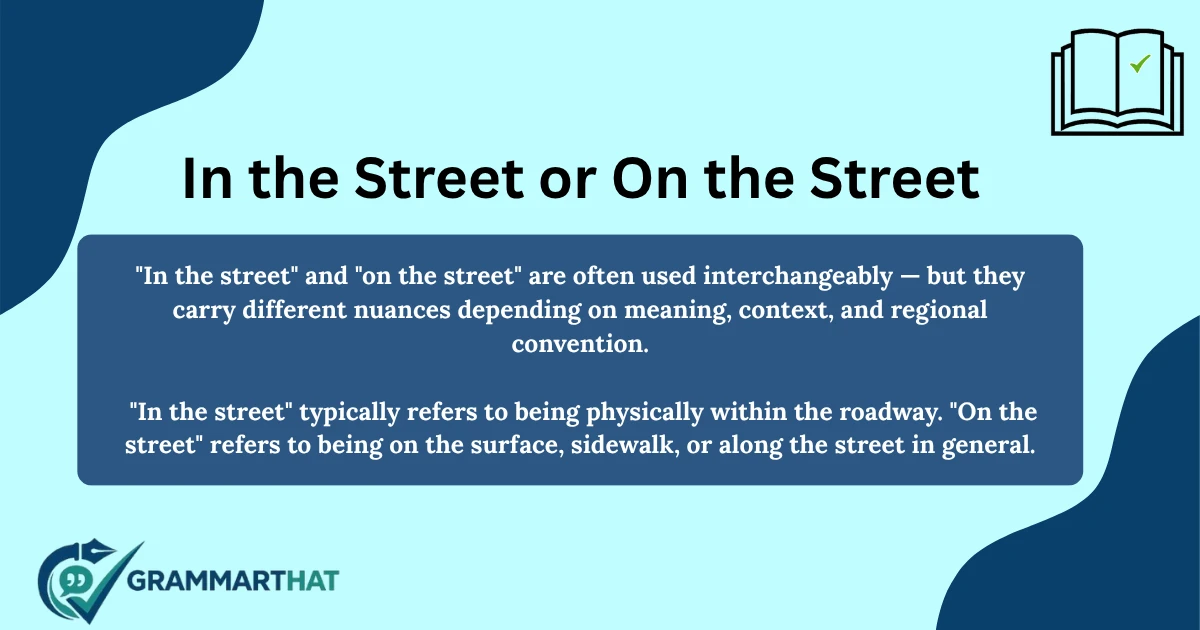
“In the street” and “on the street” are often used interchangeably — but they carry different nuances depending on meaning, context, and regional convention.
“In the street” typically refers to being physically within the roadway. “On the street” refers to being on the surface, sidewalk, or along the street in general.
This guide breaks down the difference between in the street and on the street, when each is natural, and which one to use in specific situations.
What Does “In the Street” Mean?
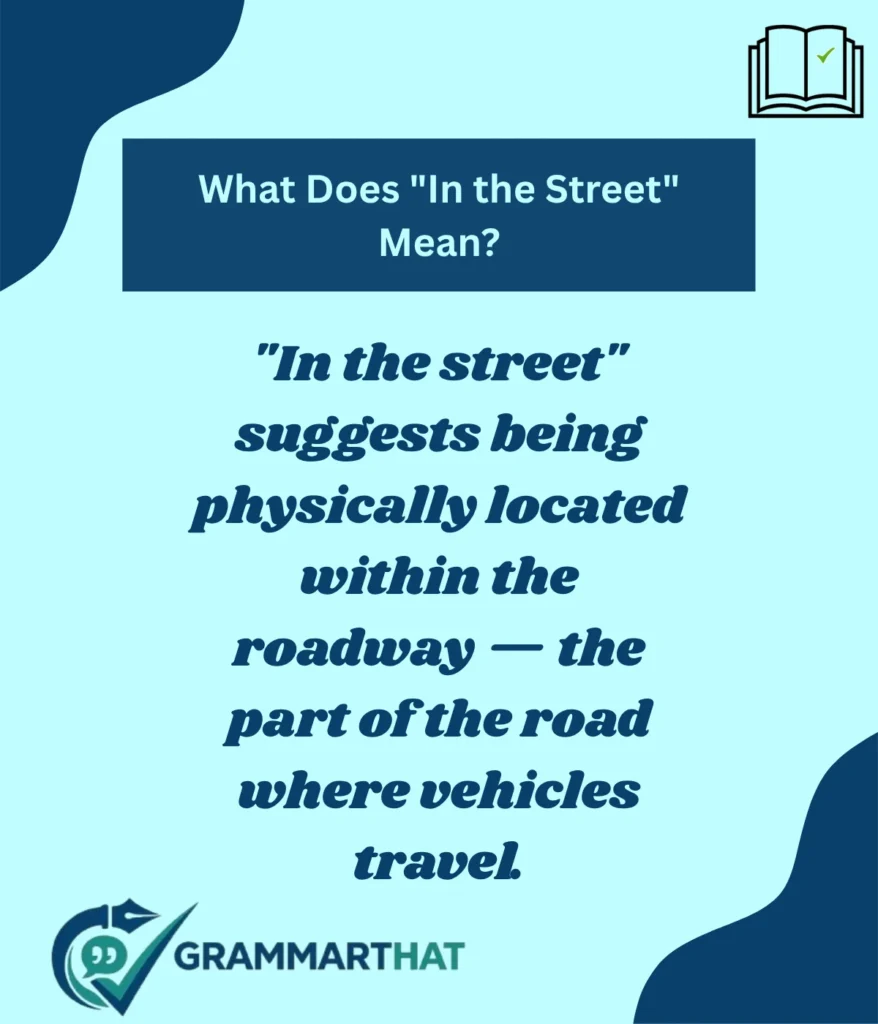
“In the street” suggests being physically located within the roadway — the part of the road where vehicles travel. It often implies presence in the actual driving surface rather than the sidewalk or surrounding area.
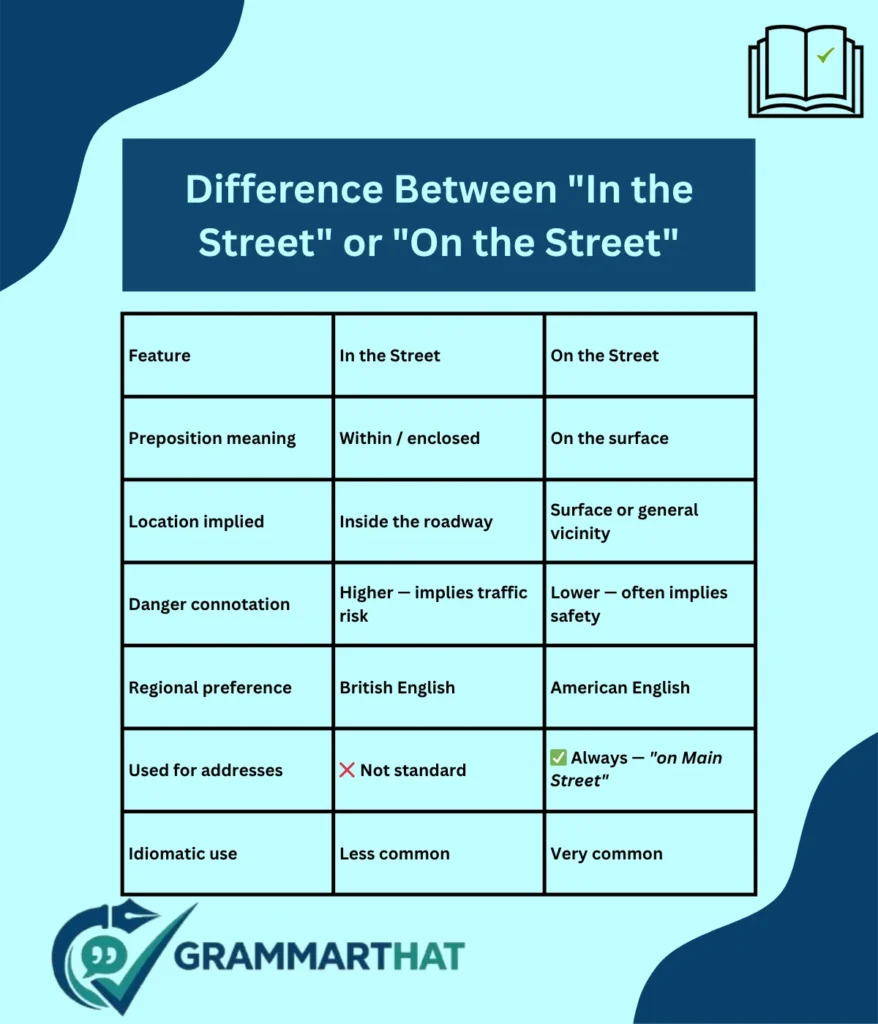
It carries a slight connotation of being in the path of traffic — which makes it feel more immediate, physical, and sometimes dangerous in tone.
Example: “The children were playing in the street when the car turned the corner.”
This phrasing places the children in the actual road — not on the sidewalk beside it.
Common uses:
- Describing someone or something physically in the roadway
- Activities happening in the middle of the road
- Situations involving potential traffic danger
- British English preference for general street location
“In the Street” in Different Contexts
What Does “On the Street” Mean?
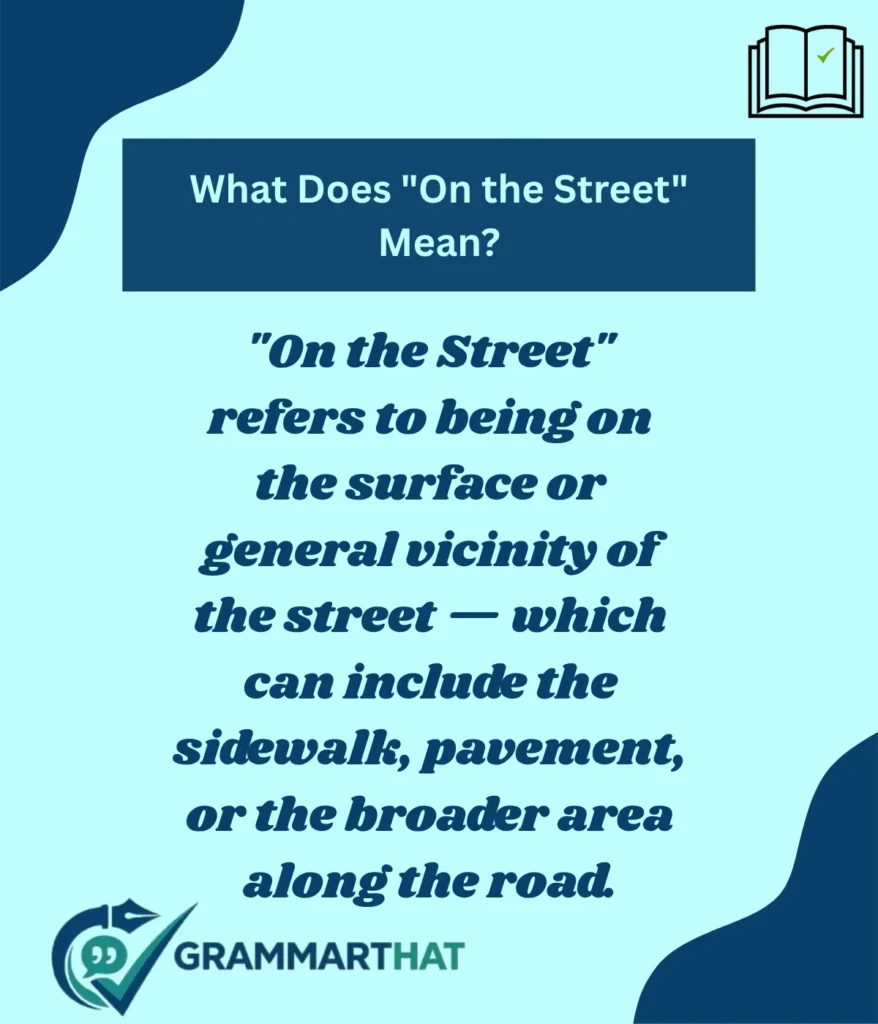
“On the Street” refers to being on the surface or general vicinity of the street — which can include the sidewalk, pavement, or the broader area along the road. It is broader and more flexible than “in the street.”
It is the preferred form in American English and appears in a wide range of idiomatic, geographical, and everyday expressions.
Example: “I saw a car parked on the street outside the building.”
Here the car is on the street’s surface — not necessarily in the middle of traffic lanes.
Common uses:
- Describing addresses and locations along a road
- Living or working in a particular street area
- Idiomatic expressions about everyday life
- General American English preference
“On the Street” in Different Contexts
In the Street or On the Street Comparison Table
The Key Difference Between “In the Street” or “On the Street”
Location Precision — Inside vs On the Surface
The core distinction mirrors the general difference between in and on as prepositions:
- In = enclosed within, inside of, or surrounded by something
- On = resting on the surface of something
Applied to streets:
- In the street → you are within the roadway — surrounded by the road on either side
- On the street → you are on the surface — the broader area including sidewalks and surroundings
The Address Rule — Always “On”
When giving or referencing a street address, the correct preposition is always “on” — never “in.”
- “I live on Maple Street.” ✅
- “The office is on Fifth Avenue.” ✅
- “I live in Maple Street.” ❌
This rule applies universally — regardless of regional preference. “On” is the standard preposition for all address references in English.
Idiomatic Expressions — Both Use “On”
Several important English idioms use “on the street” specifically:
None of these idioms use “in the street” — they all use “on.”
When to Use “In the Street” or “On the Street”
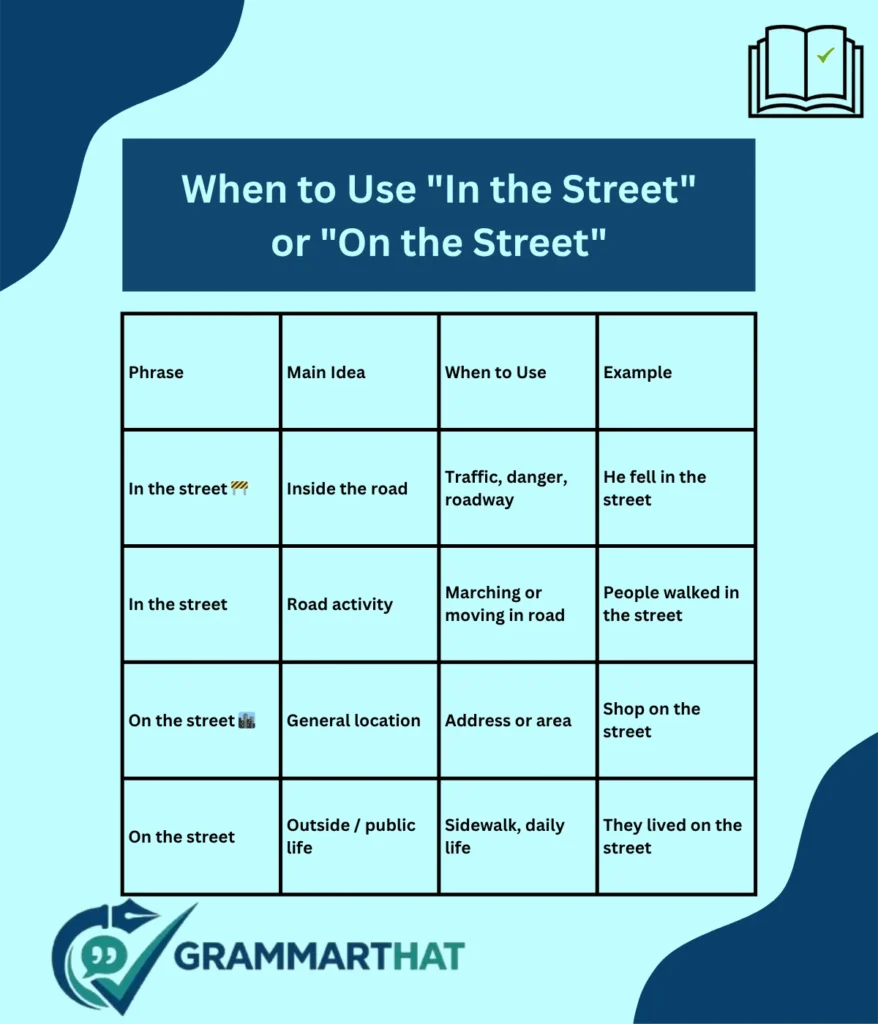
Use “In the Street” When:
- Describing something physically within the roadway — in the driving lane
- The context involves traffic, danger, or being in the actual road surface
- Writing for a British English audience or following British conventions
- Describing activities happening in the road rather than on the sidewalk
Examples:
- “A cyclist fell in the street during the morning commute.”
- “Protesters marched in the street for hours.”
Use “On the Street” When:
- Giving or describing a street address or location
- Referring to living, working, or existing in a street area generally
- Using idiomatic expressions about daily life or homelessness
- Writing for an American English audience
- The location is the sidewalk or general street area — not the roadway itself
Examples:
- “The best coffee shop on this street opens at 7 AM.”
- “After the recession, many families ended up on the street.”
Common Mistakes to Avoid
Memory trick:
- In the street → think “inside the road” — you are in the actual lane where cars drive
- On the street → think “on the surface” — you are on the pavement, sidewalk, or along the road
- Address? → always on — “on Main Street” — no exceptions
FAQs — In the Street or On the Street
Can “in the street” and “on the street” mean the same thing?
Yes — in many contexts they are interchangeable and both are understood. The difference is subtle: “in the street” emphasizes physical presence in the roadway, while “on the street” covers the broader surface and surrounding area.
Why do Americans prefer “on the street”?
American English conventionally uses “on” for street surfaces and locations — the same way it uses “on the floor” rather than “in the floor.” British English historically used “in” more freely for street locations, but “on” is increasingly common globally.
Is “at the street” ever correct?
“At the street” is rarely used and sounds awkward in most contexts. It might appear in very specific directional phrases — “turn left at the street” — but it is not standard for describing location. Use “in the street” or “on the street” depending on your meaning.
Can I say “on the streets” in plural form?
Yes — “on the streets” is completely correct and commonly used. It often refers to street life in general or homelessness: “She grew up on the streets of Chicago.” The plural adds a sense of extended or broader street presence.
Which is more formal: “in the street” or “on the street”?
Neither is significantly more formal than the other. “On the street” tends to appear more in formal American writing, especially for addresses and locations. “In the street” carries a slightly more physical, immediate tone that suits descriptive or narrative writing.
Conclusion
Both “in the street” and “on the street” are correct — but they work best in different situations. “In the street” places someone or something physically within the roadway — with a slightly more immediate, sometimes dangerous implication. “On the street” covers the surface, sidewalk, and general vicinity — and is the standard choice for addresses, idioms, and American English.
When giving an address — always use “on.” When describing activity in the actual road — “in” works naturally. For everything else, let context and your audience guide the choice. Master that distinction and both phrases will always land correctly in your writing.

Hi, I’m the voice behind GrammarThat.com. I make grammar simple and easy to understand, from basic rules to advanced writing tips. Clear explanations. Practical examples. No confusion.