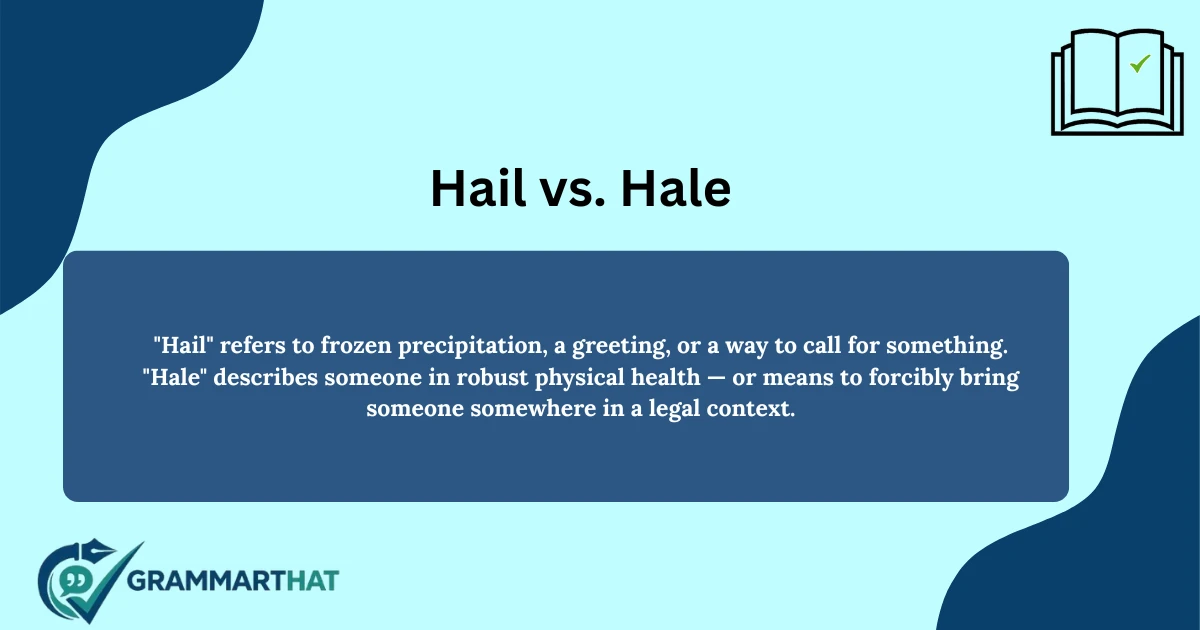
Hail and hale sound the same but have different meanings. Hail relates to weather, greetings, or calling, while hale describes being healthy, strong, or vigorous.
Same pronunciation. Completely different meanings. Swapping them is not a regional preference — it is a factual error that changes what your sentence actually says.
What Does “Hail” Mean?

“Hail” is one of the most versatile words in English — functioning as a noun, verb, and interjection across three completely distinct meanings: frozen weather, a greeting or call, and a statement of origin.
Example: “The storm brought heavy hail that shattered several car windshields.”
Common uses of “hail” as weather:
- “Golf ball-sized hail caused significant damage across the county.”
- “The hailstorm lasted only four minutes but destroyed the entire crop.”
Common uses of “hail” as a greeting or call:
- “She stepped outside to hail a cab in the pouring rain.”
- “Hail to the chief — the traditional salute to the U.S. president.”
Common uses of “hail” as origin:
- “He hails from a small town in rural Mississippi.”
- “The chef hails from Lyon — the culinary capital of France.”
“Hail” Across Different Contexts
In every context — weather, greetings, origins, or calls — “hail” is a word of action, acknowledgment, and atmosphere.
What Does “Hale” Mean?

“Hale” is a much narrower word than “hail” — used almost exclusively in two specific contexts: describing robust physical health and, in legal writing, meaning to forcibly compel someone to appear somewhere.
Example: “Even at eighty-two, he remained hale and active — hiking every morning without fail.”
Common uses of “hale” describing health:
- “She returned from her mountain retreat looking hale and full of energy.”
- “The doctor described his eighty-year-old patient as remarkably hale.”
Common uses of “hale” in legal writing:
- “The witness was haled into court after ignoring two previous subpoenas.”
- “He was haled before the committee to answer for his conduct.”
“Hale” Across Different Contexts
In everyday modern English, “hale” appears most often in the phrase “hale and hearty.” Outside of that phrase and legal contexts, it is rarely used — which is exactly why writers sometimes reach for the wrong word.
Hail vs. Hale — Key Differences
The difference between “hail” and “hale” is not regional and not stylistic. These are two entirely different words with different origins, different meanings, and different grammatical roles. Confusing them produces sentences that are factually incorrect.
Hail vs. Hale Meaning at a Glance
The “Hale and Hearty” Rule
“Hale and hearty” is the most common context where writers encounter the word “hale” — and the most common place the error occurs. Many writers instinctively write “hail and hearty” because “hail” is the far more familiar word.
It is always “hale and hearty.” Never “hail and hearty.”
The phrase means someone — particularly an older person — who is in strong, vigorous, and full physical health. The “hale” in this phrase connects directly to its Old English root hal — meaning whole and undivided in body. “Hearty” reinforces the same idea — full of heart and vitality.
The Legal Use — Only “Hale” Applies
In legal writing, the verb “hale” means to forcibly compel or drag someone to appear before a court, committee, or authority. It always appears in the construction “haled into” — never “hailed into.”
Correct: “The executive was haled into court by federal prosecutors.”
Incorrect: “The executive was hailed into court by federal prosecutors.” — This would mean the executive was greeted or praised by prosecutors — the opposite of what the sentence intends.
In legal contexts, one wrong letter produces a sentence with the exact opposite meaning.
Same Sound, Two Words — How One Letter Changes Everything
Using “hail” correctly: “She raised her arm to hail a passing taxi on Fifth Avenue.”
Using “hale” correctly: “Despite being eighty years old, she appeared hale and completely sharp.”
Using “hail” incorrectly in a legal context: ~~”He was hailed into court.”~~ — This says he was greeted or praised by the court. That is not what happened.
Using “hale” correctly in a legal context: “He was haled into court.” — He was forcibly compelled to appear.
Same sound. Completely different meaning. One letter is the only thing standing between accuracy and error.
FAQs
Is it hailstorm or hale storm?
Always “hailstorm” — written as one word or as “hail storm.” The word “hale” has nothing to do with weather. “Hale” describes physical health or legal compulsion. Frozen precipitation falling from the sky is always “hail” — and the storm that brings it is always a “hailstorm.”
Do you hale or hail a cab?
Always “hail a cab.” You hail a taxi by raising your hand or calling out to attract the driver’s attention. “Hale” is never used for calling vehicles — it belongs exclusively to health descriptions and legal contexts.
What is the difference between hale and hail?
“Hail” refers to frozen ice pellets, a greeting or salute, a way to call for something, or a statement of where someone originates. “Hale” describes robust physical health — most commonly in the phrase “hale and hearty” — or means to forcibly compel someone to appear before a court in legal writing.
Is it hale or hail for ice rain?
Always “hail.” Frozen precipitation — ice pellets that fall from storm clouds — is always “hail.” The storm that produces it is a “hailstorm.” “Hale” has no weather meaning whatsoever. If you see ice falling from the sky, it is “hail” — every single time.
Conclusion
“Hail” and “hale” sound exactly the same — but they mean entirely different things and are never interchangeable. Use “hail” for frozen weather, greetings, calling a vehicle, and stating where someone originates. Use “hale” for strong physical health — especially in the phrase “hale and hearty” — and for legal contexts where someone is compelled to appear before an authority.

Hi, I’m the voice behind GrammarThat.com. I make grammar simple and easy to understand, from basic rules to advanced writing tips. Clear explanations. Practical examples. No confusion.