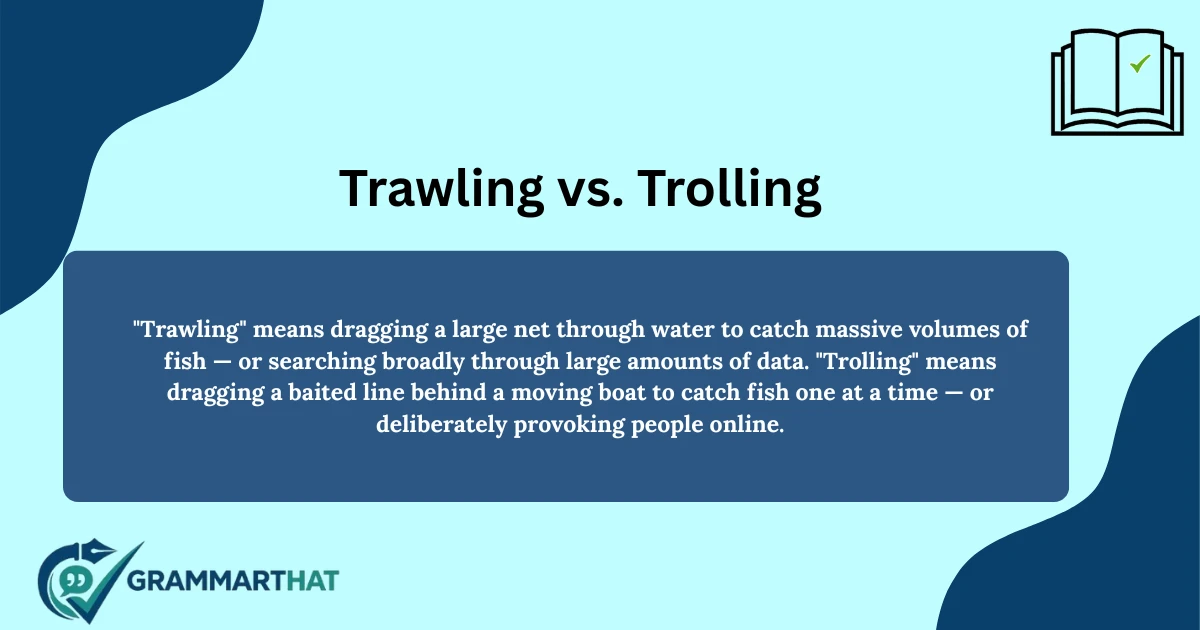
Trawling means dragging a net or searching through large amounts of information, while trolling means fishing with a line or provoking others online. One focuses on gathering; the other focuses on baiting.
Same pronunciation origin. Completely different meanings. Confusing them is a meaningful error in both fishing and digital writing contexts.
What Does “Trawling” Mean?

“Trawling” is a method of fishing that involves dragging a large, heavy net called a trawl through the ocean — either behind a boat or along the seafloor — to capture high volumes of fish and seafood in a single sweep.
Example: “The commercial vessel spent three days trawling the North Atlantic before returning to port with its catch.”
Common uses of “trawling” in fishing:
- “Bottom trawling drags weighted nets across the ocean floor.”
- “The vessel was trawling for cod in international waters.”
Common uses of “trawling” as a metaphor:
- “She spent hours trawling through thousands of emails looking for the contract.”
- “He found the job listing after trawling through dozens of recruitment websites.”
“Trawling” in Different Contexts
In every context — fishing or figurative — “trawling” describes casting a wide net to gather as much as possible from a broad area.
What Does “Trolling” Mean?

“Trolling” is a method of fishing that involves dragging baited lines with hooks or lures behind a slow-moving boat — targeting specific fish species one at a time with precision and patience.
Example: “They spent the morning trolling for king salmon along the coastline.”
Common uses of “trolling” in fishing:
- “Trolling for chinook salmon requires the right depth and lure speed.”
- “They were trolling the river mouth at dawn when the first strike came.”
Common uses of “trolling” online:
- “He was trolling the comments section just to start arguments.”
- “Do not feed the troll — ignoring them is always more effective.”
“Trolling” Across Different Contexts
In every context — fishing or digital — “trolling” describes a targeted, deliberate action designed to provoke a specific reaction or catch a specific target.
Trawling vs. Trolling — Key Differences
The difference between “trawling” and “trolling” is not regional like mold/mould or stylistic like spoiled/spoilt. These are two different words with two different meanings — and confusing them produces factually incorrect writing.
Method and Scale
“Trawling” is about volume and breadth. A single trawling operation can bring up thousands of pounds of seafood in one net. The approach is industrial, broad, and indiscriminate.
“Trolling” is about precision and patience. Lines are dragged slowly behind a boat and fish are caught one at a time — individually, selectively, and deliberately.
Trawling vs. Trolling
Environmental Impact — A Critical Distinction
Trawling — especially bottom trawling — is one of the most environmentally destructive fishing methods on the planet. Heavy nets dragged across the seafloor destroy coral reefs, seagrass beds, and marine habitats that took centuries to develop.
Trolling is considered one of the most sustainable commercial fishing methods available. Fish are caught individually on hook-and-line gear — allowing non-target species to be released alive and unharmed. Alaska troll-caught salmon is widely recognized as a premium, environmentally responsible product for exactly this reason.
The Online Meaning — Only “Trolling” Applies
In digital communication, “trolling” has become one of the most widely recognized internet terms of the 21st century. It refers to deliberately posting inflammatory, offensive, or provocative content online — not to inform or discuss, but purely to upset, manipulate, or destabilize.
“Trawling” has no equivalent online meaning in common usage. You trawl through data — but you troll people online. The two metaphorical uses never overlap.
Digital Context: Trawling vs. Trolling
Same Structure, Two Words — How the Meaning Completely Changes
Fishing context — trawling: “The vessel spent three days trawling the North Sea and returned with forty tons of mixed catch.”
Fishing context — trolling: “The charter boat spent three days trolling the coastline and landed twelve king salmon.”
Same activity. Same ocean. Completely different method, scale, environmental impact, and result. One word drags a net. The other drags a line.
See More:
FAQs — Trawling vs. Trolling
Does the U.S. allow bottom trawling?
Yes — with restrictions. Bottom trawling is legal in U.S. federal waters under NOAA regulation, but large areas of the Pacific Coast and other sensitive marine zones are fully closed to it. Environmental pressure continues to push for broader bans.
Is salmon caught by trawling?
Some salmon is — but troll-caught salmon is considered far superior in quality and sustainability. Each fish is individually hooked, immediately bled and iced, and handled with care — producing better flavor, texture, and market value than net-caught alternatives.
Why is trawling not illegal?
Trawling remains legal because of economic dependency and global food supply demands. Millions of livelihoods and a significant share of the world’s seafood supply depend on it. Most governments regulate it through catch limits and marine protected areas rather than outright bans.
Conclusion
“Trawling” and “trolling” sound similar — but they describe fundamentally different actions, at different scales, with different consequences. Trawl when you are dragging a wide net — through water or through data. Troll when you are dragging a single line — after a specific fish or a specific reaction online.

Hi, I’m the voice behind GrammarThat.com. I make grammar simple and easy to understand, from basic rules to advanced writing tips. Clear explanations. Practical examples. No confusion.