Proved and proven are both correct forms of the verb prove — but they serve different grammatical roles and reflect different regional preferences.
Proved is the standard past tense and past participle in British English, while proven is widely used as a past participle in American English and functions universally as an adjective. Knowing when to use each one makes your writing more precise and regionally appropriate.
This guide breaks down the difference between proved and proven, their grammatical functions, and the fixed phrases where proven is always the right choice.
What Does Proved Mean?
Proved is the simple past tense and past participle of the verb prove. It follows the standard English pattern of adding -d to a verb ending in e to form the past tense — prove → proved.
Example (simple past tense): “She proved her point beyond any reasonable doubt.”
Example (past participle with have): “They have proved their theory with extensive data.”
Core functions of proved:
Proved as Simple Past Tense
Used to describe a completed action of proving something in the past:
- “The experiment proved the hypothesis incorrect.”
- “He proved his innocence in court.”
- “The results proved far more significant than expected.”
Proved as Past Participle
Used with have, has, or had to form perfect tenses:
- “Scientists have proved the connection between the two variables.”
- “She had proved herself capable long before the promotion.”
- “The evidence has proved conclusive.”
Regional preference: Proved is the preferred form in British, Australian, and most Commonwealth English for both the simple past and the past participle. Most British style guides recommend proved as the standard verb form in both functions.
What Does Proven Mean?
Proven is primarily used in two distinct ways — as an adjective universally, and as a past participle commonly in American English.
Proven as an Adjective — Universal
As an adjective, proven describes a noun — indicating that something has been demonstrated, tested, or established as reliable or effective. This adjectival use is accepted in all varieties of English worldwide.
Example: “This is a proven technique for improving workplace productivity.”
Proven as a Past Participle — American English
In American English, proven is widely and naturally used as the past participle of prove — functioning identically to proved in perfect tense constructions.
Example: “She has proven herself to be one of the most effective managers in the company.”
This use is fully accepted in American English and is not considered incorrect. However, in British English, proved is strongly preferred in this role.
The Key Difference — Function and Region
A Simple Way to Think About It
- Proved → always the verb (past tense and past participle)
- Proven → primarily the adjective — and the past participle in American English
Ask: “Is it describing a noun or functioning as a verb?”
- Describing a noun → proven (“a proven method”)
- Functioning as a verb → proved (universal) or proven (American)
Fixed Phrases Where Proven Is Always Correct
Regardless of regional preference — there are established, fixed phrases where proven is the universally accepted and expected form:
“Innocent Until Proven Guilty”
The cornerstone phrase of criminal justice in common law systems always uses proven:
“In our legal system, every defendant is innocent until proven guilty.”
Using proved here — “innocent until proved guilty” — sounds unnatural and is rarely seen in legal or everyday use even in British English.
The Scottish Verdict of “Not Proven”
Scottish law has three possible jury verdicts: Guilty, Not Guilty, and the unique Not Proven — a verdict indicating insufficient evidence for conviction without declaring innocence. This fixed legal term always uses proven.
These examples illustrate how proven has carved out specific, fixed positions in English even in contexts where proved would otherwise dominate.
When to Use Proved vs Proven
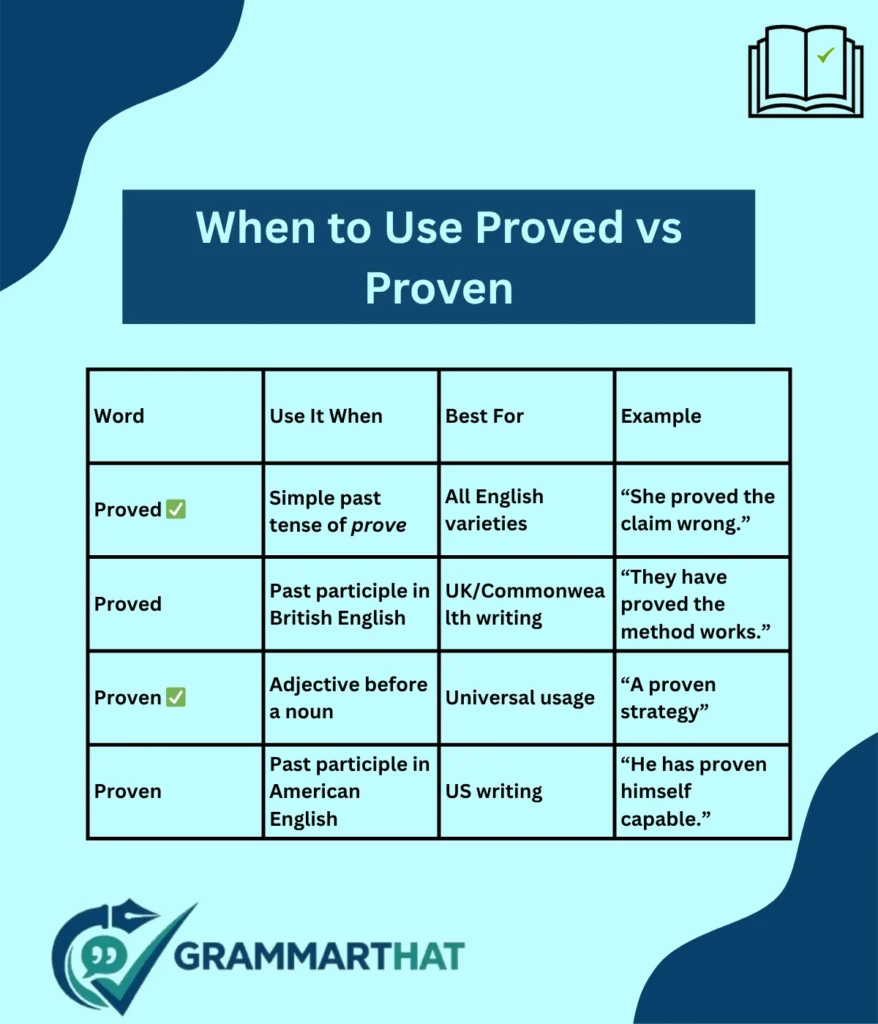
Always Use “Proved” When:
- Writing the simple past tense of prove — “She proved it.”
- Using the past participle in British or Commonwealth English
- Writing for an audience or publication that follows British style
Examples:
- “The research team proved the hypothesis through repeated trials.”
- “They have proved the effectiveness of the new treatment.”
Use “Proven” When:
- Using it as an adjective before a noun — universally correct
- Using the past participle in American English contexts
- Using fixed phrases like “innocent until proven guilty”
Examples:
- “The company has a proven track record of delivering results.”
- “She has proven herself capable of leading the team.” (American English)
- “The defendant is innocent until proven guilty.”
Common Mistakes to Avoid
Memory trick:
- Proved → verb action → “She proved it — past tense, done”
- Proven → adjective → “a proven track record” — it modifies a noun
- For American English → both work as past participle; use whichever sounds natural
- For British English → always proved as the verb past participle
Read More:
FAQs — Proved vs Proven
Is it correct to say “proved” or “proven”?
Both are correct — their use depends on function and regional preference. Proved is the standard simple past tense everywhere. Proven is the universal adjective form and the common American past participle. In British English, proved is preferred for the past participle.
Is it “must be proved” or “must be proven”?
Both are grammatically acceptable. “Must be proved” is preferred in British English. “Must be proven” is equally standard in American English. In legal contexts — particularly the phrase “innocent until proven guilty” — proven is the universal standard.
What is an example of proved?
“Proved” as simple past: “The scientist proved her hypothesis through careful experimentation.” As past participle: “The theory has proved remarkably accurate over the decades.”
Is it “proved out” or “proven out”?
“Proved out” is the traditionally correct form — meaning something was demonstrated or validated through testing. “Proven out” is increasingly common in American English. Both are understood, but “proved out” is more widely accepted in formal writing. Example: “The concept proved out in real-world trials.”
Conclusion
Proved and proven are two forms of the same verb with distinct but overlapping roles. Proved is the standard past tense and British-preferred past participle. Proven is the universal adjective and American-accepted past participle — plus the fixed form in phrases like “innocent until proven guilty.”
Choose proved for formal British writing and simple past tense everywhere. Choose proven when modifying a noun as an adjective or when writing in American English. Get both right and your writing will always be grammatically accurate and regionally appropriate.

Hi, I’m the voice behind GrammarThat.com. I make grammar simple and easy to understand, from basic rules to advanced writing tips. Clear explanations. Practical examples. No confusion.