Gases is the standard, preferred spelling for the plural noun, while gasses is the third-person singular present tense of the verb to gas.
The distinction is simple: gases is what you write about in chemistry, while gasses is what someone does at the fuel pump.
This guide breaks down the difference between gases and gasses, when each is correct, and why gases is almost always the right choice.
What Does Gases Mean?
Gases is the plural noun form of gas — referring to multiple types, samples, or quantities of gas as a state of matter or chemical substance.
Example: “Oxygen and nitrogen are the most abundant gases in Earth’s atmosphere.”
Gas as a noun has two related meanings — and gases is the plural of both:
Gases — State of Matter
In physics and chemistry, a gas is one of the four fundamental states of matter — a substance that has no fixed shape or volume and expands to fill its container.
- “Noble gases include helium, neon, and argon.”
- “Greenhouse gases trap heat in the atmosphere.”
- “The reaction produced several gases that were collected and analyzed.”
Gases — Colloquial for Gasoline
In informal American English, gas is short for gasoline — and gases can appear as its plural in casual contexts, though gallons of gas or fuel are more common.
Common Scientific and Technical Uses of “Gases”
Related forms:
- Gas (singular noun) — “A gas at room temperature”
- Gases (plural noun) — “Multiple gases were detected”
- Gaseous (adjective) — “A gaseous substance”
What Does Gasses Mean?
Gasses is the third-person singular present tense of the verb to gas — used when describing the action of supplying gas (fuel), exposing something to a gas, or in informal speech, talking excessively.
Example: “He always gasses up his car the night before a long trip.”
Gasses — To Supply With Fuel
The most common everyday use — filling a vehicle with gasoline:
- “She gasses up the truck every Sunday.”
- “He gasses the lawnmower before starting the yard.”
Gasses — To Expose to Gas
In technical or historical contexts, gasses can mean to treat or expose something to a gas:
- “The fumigation process gasses the structure to eliminate pests.”
Gasses — Informal / Slang
In informal British English, gasses can mean talks excessively or incessantly:
- “He gasses on for hours if you let him.”
Related Verb Forms: Gas
Gases vs Gasses — The Key Difference
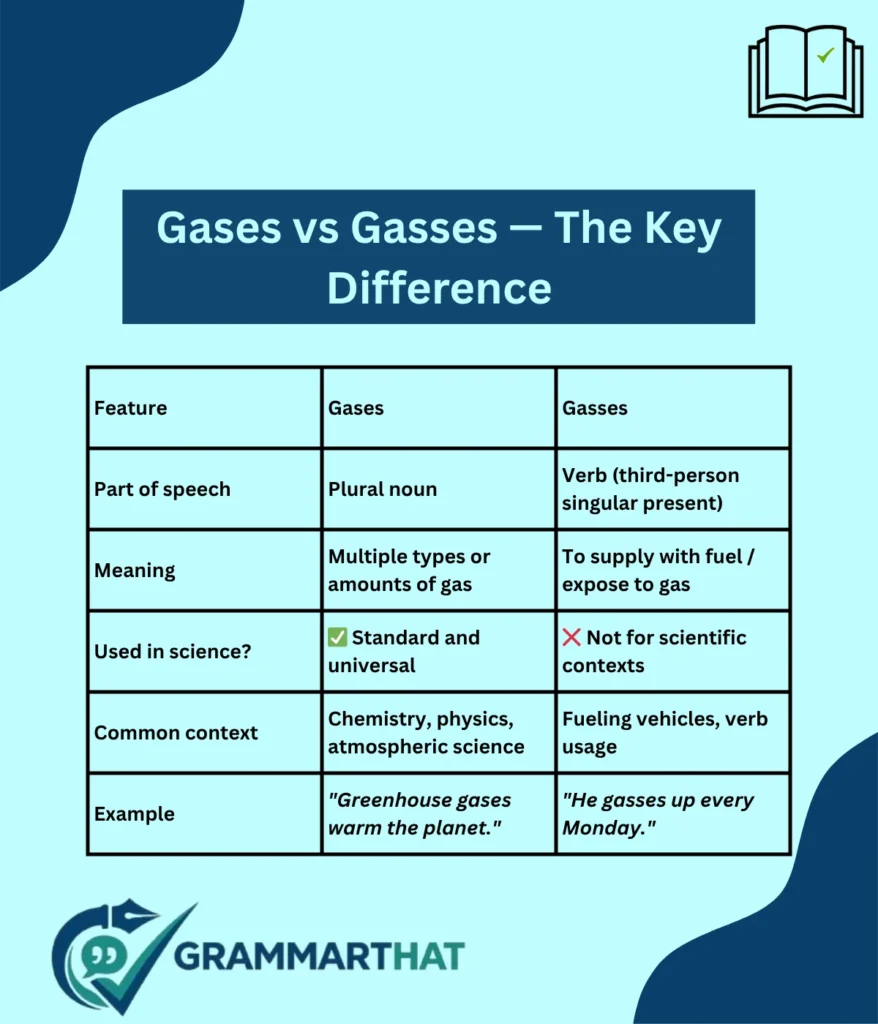
Gases vs Gasses
Is “Gasses” Ever the Plural Noun?
Some older dictionaries list gasses as an alternative plural noun spelling — but this is now largely considered non-standard. Modern scientific writing, academic publications, and style guides consistently use gases as the plural noun.
In any professional, academic, or scientific context — gases is always the correct plural. The only widely accepted standard use of gasses is as the third-person verb form.
How to Choose — The Simple Test
Ask yourself one question: Is this a noun or a verb?
- Noun (referring to the substances) → gases
- Verb (someone is performing an action) → gasses
Common Mistakes to Avoid
Memory trick:
- Gases → one s → the state of matter → quiet, invisible, drifting through space
- Gasses → double s → action happening → someone actively gassing up a car
- Noun with no action → gases. Someone doing something → gasses.
FAQs — Gases or Gasses
Is it gases or gasses?
Gases is correct for the plural noun — referring to multiple types or quantities of gas. Gasses is correct as a verb — describing the action of supplying fuel or exposing something to a gas. In scientific and professional writing, always use gases for the noun.
What is the difference between gases and gasses?
Gases is the standard plural noun form of gas. Gasses is the third-person singular present tense of the verb to gas. Example: “Several gases were detected” (noun) vs. “She gasses up the car” (verb).
Which is the correct plural of gas?
Gases is the correct and universally preferred plural of gas in standard English. While gasses appears in some older sources as an alternative plural, modern dictionaries and style guides consistently recommend gases for the noun plural.
Which gas is released during flatulence?
Flatulence primarily releases a mixture of gases — including nitrogen, hydrogen, carbon dioxide, oxygen, and small amounts of methane and hydrogen sulfide. The sulfur-containing compounds, despite being present in tiny quantities, are responsible for the characteristic odor.
Conclusion
Gases is the correct plural noun — the form to use in every scientific, professional, and academic context when referring to multiple gas substances or states. Gasses is the verb form — correct only when describing someone performing the action of fueling a vehicle or exposing something to gas.
The noun vs verb test resolves every case instantly. Plural noun → gases. Third-person verb → gasses. Get that distinction right and you will always choose the correct spelling with complete confidence.

Hi, I’m the voice behind GrammarThat.com. I make grammar simple and easy to understand, from basic rules to advanced writing tips. Clear explanations. Practical examples. No confusion.