Tortuous and torturous look almost identical — but they describe completely different experiences.
Tortuous means full of twists, bends, or complex indirectness, while torturous means causing intense pain, suffering, or agonizing difficulty. One word describes a winding path. The other describes a painful ordeal.
This guide breaks down the difference between tortuous and torturous, how each is pronounced, and how to use both with complete confidence.
What Does Tortuous Mean?
Tortuous is an adjective meaning full of twists, turns, or complex, indirect detail. It describes something that bends repeatedly — either literally (a winding road or river) or figuratively (a complicated argument or negotiation).
It comes from the Latin tortuosus — meaning “full of twists” — from tortus, meaning “twisted.”
Pronunciation: TOR-choo-us (three syllables — rhymes with orchard in its middle sound)
Example: “We drove up the tortuous mountain road, switching back and forth for miles.”
Two main uses of tortuous:
Tortuous — Literal Physical Meaning
Describing paths, roads, rivers, or structures that wind and twist repeatedly:
- “The tortuous coastal path wound along the cliff edge for several miles.”
- “Surgeons must navigate the tortuous anatomy of the inner ear with precision.”
- “The river follows a tortuous route through the valley before reaching the sea.”
Tortuous — Figurative / Abstract Meaning
Describing arguments, processes, narratives, or negotiations that are unnecessarily complex, indirect, or convoluted:
- “The lawyer’s tortuous argument left even the judge looking confused.”
- “The peace negotiations followed a tortuous path before an agreement was reached.”
- “His tortuous reasoning made a simple point almost impossible to follow.”
Tortuous in Different Contexts
Synonyms: winding, twisting, meandering, convoluted, circuitous, labyrinthine
What Does Torturous Mean?
Torturous is an adjective meaning causing intense pain, suffering, or agonizing difficulty. It is directly related to the word torture — and if an experience is torturous, it feels like torture in its pain or prolonged discomfort.
It comes from torture + -ous — the suffix meaning “characterized by.”
Pronunciation: TOR-chur-us (three syllables — the middle syllable sounds like “chur,” as in the word torturer)
Example: “Waiting for my medical test results was a torturous experience that lasted three agonizing days.”
Two main uses of torturous:
Torturous — Physical Pain or Suffering
Describing physical experiences that are extremely painful or grueling:
- “The marathon runners endured torturous heat during the final miles.”
- “Recovery from the surgery was torturous — every movement caused sharp pain.”
- “The soldiers faced torturous conditions in the desert heat.”
Torturous — Prolonged Mental or Emotional Anguish
Describing experiences that feel like mental torture — prolonged, agonizing, and deeply uncomfortable:
- “Sitting through the four-hour meeting was absolutely torturous.”
- “The silence between them was torturous — neither knew what to say.”
- “Waiting for the exam results was a torturous two-week ordeal.”
Torturous in Different Contexts
Synonyms: agonizing, excruciating, painful, grueling, harrowing, unbearable
The Key Difference Between Tortuous vs Torturous
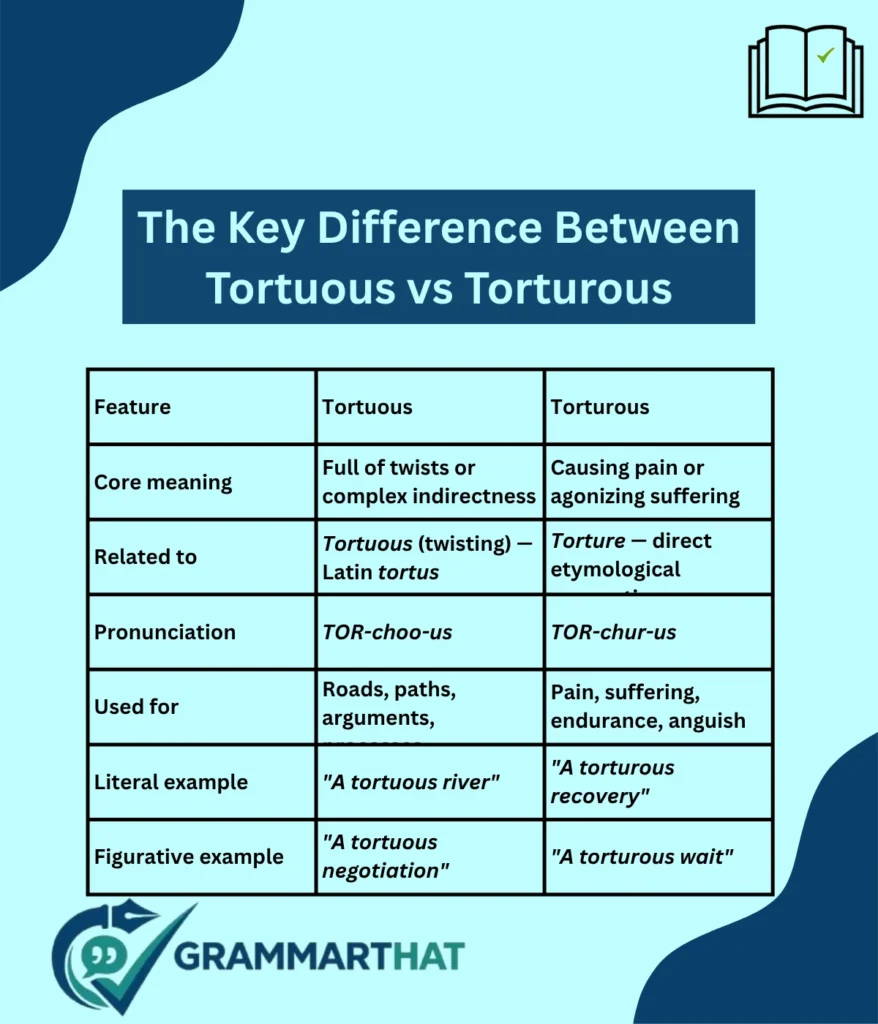
Twisting vs Painful — The Core Distinction
Pronunciation Is Your First Clue
Say both words aloud and the difference becomes immediately clear:
- Tortuous → TOR-choo-us — no “chur” sound — no pain implied
- Torturous → TOR-chur-us — the “chur” from torture is right there in the middle
Hearing the word torture inside torturous is the fastest way to remember which word means pain.
The Memory Trick That Works
Torturous contains the word torture — visible and audible right inside it:
tor-tur-ous → tor-ture → If it causes suffering, use torturous
Tortuous does not contain torture — it contains tortuous from Latin tortus (twisted):
tor-t-uous → If it twists and winds, use tortuous
Ask one question: “Is this about pain — or about twisting?”
- Pain / suffering → torturous
- Twisting / complexity → tortuous
Common Mistakes to Avoid
Can a Person Be Described as Tortuous?
Yes — a person can be described as tortuous in the figurative sense. It means the person communicates or behaves in an unnecessarily complex, indirect, or devious way — not that they are physically winding.
Example: “He was a tortuous negotiator — nothing was ever straightforward with him.”
This use describes someone’s style or manner as convoluted and indirect — not their physical appearance. It is a legitimate and well-established figurative use of the adjective.
What Does Tortious Mean?
Tortious is a completely separate legal term — not related to either tortuous or torturous. It means relating to a tort — a civil wrong that causes harm and creates legal liability.
Tortuous vs Torturous vs Tortious
All three look similar — but only context makes it clear which one is intended.
FAQs — Tortuous vs Torturous
What is the difference between tortuous and torturous?
Tortuous means full of twists, bends, or complex indirectness — used for roads, rivers, arguments, and convoluted processes. Torturous means causing intense pain, suffering, or agonizing difficulty — directly related to the word torture.
Can a person be described as tortuous?
Yes — a person described as tortuous is someone who communicates or behaves in an unnecessarily indirect, complex, or devious way. It describes their manner rather than their physical form. Example: “She was a tortuous speaker — every simple point became a labyrinth.”
What does tortious mean?
Tortious is a legal term meaning “relating to a tort” — a civil wrong that creates legal liability. It has nothing to do with tortuous (twisting) or torturous (painful), despite the visual similarity.
Is there a word “torturous”?
Yes — torturous is a fully recognized English word listed in all major dictionaries including Merriam-Webster and Oxford. It means causing intense pain, suffering, or prolonged agony — directly derived from the word torture.
Conclusion
Tortuous and torturous are two of English’s most easily confused pairs — similar spelling, similar sound, completely different meanings. Tortuous belongs with winding roads, convoluted arguments, and complex processes. Torturous belongs with pain, suffering, and agonizing experiences.
The memory trick is built right into the word — hear torture inside torturous and you will never confuse them again. Twisting → tortuous. Painful → torturous. Simple, clear, and permanently fixed.

Hi, I’m the voice behind GrammarThat.com. I make grammar simple and easy to understand, from basic rules to advanced writing tips. Clear explanations. Practical examples. No confusion.