Impatient and inpatient look almost identical — just one letter apart — but they belong to completely different worlds.
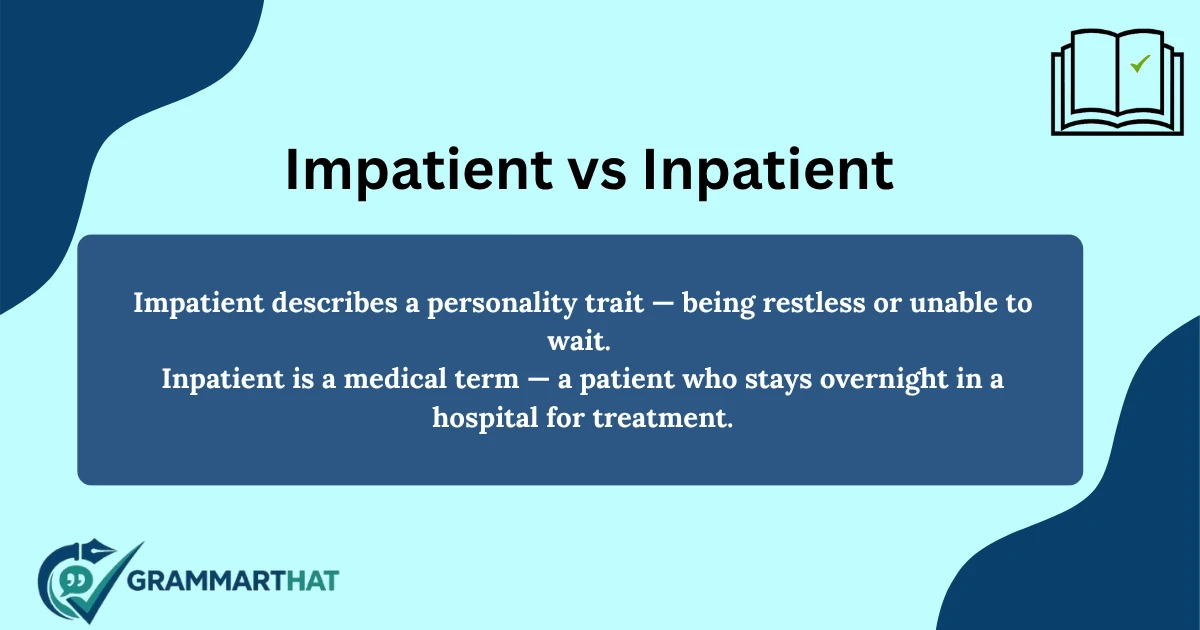
Impatient describes a personality trait — being restless or unable to wait. Inpatient is a medical term — a patient who stays overnight in a hospital for treatment.
This guide breaks down the difference between impatient and inpatient clearly, with real examples and easy memory tricks to keep them apart.
What Does Impatient Mean?

Impatient is an adjective that describes someone who is restless, easily annoyed by delays, or unable to wait calmly. It is the opposite of patient — the prefix im- meaning “not.”
It describes a feeling or personality trait — not a medical condition or hospital status.
Example: “He was too impatient to wait in the long line at the pharmacy.”
Common uses:
- Describing someone frustrated by delays
- Expressing eagerness or restlessness
- Showing someone is annoyed or intolerant of waiting
Related Word Forms: Impatient
Synonyms: restless, eager, anxious, irritable, fidgety, intolerant, antsy
Common Expressions With Impatient
- “Growing impatient” — becoming increasingly frustrated with a delay
- “Impatient for results” — eagerly waiting for an outcome
- “Impatient with someone” — easily annoyed by a person’s behavior
What Does Inpatient Mean?

Inpatient is a noun and adjective used in medical contexts. It refers to a patient who is admitted to a hospital and stays overnight — or longer — for treatment, surgery, observation, or recovery.
The prefix in- here means “inside” — as in inside the hospital facility.
Example: “After the complex surgery, she was admitted as an inpatient for three days.”
Common uses:
- Describing a hospitalized patient staying overnight
- Referring to medical care that requires a hospital stay
- Distinguishing hospital-based care from outpatient visits
Related Word Forms: Inpatient
Synonyms: hospitalized patient, admitted patient, residential patient
Inpatient vs Outpatient — A Key Medical Distinction
This distinction matters enormously in healthcare — it affects insurance coverage, billing codes, and the level of care a patient receives.
The Key Difference Between Impatient vs Inpatient

One Is Emotional — The Other Is Medical
This single distinction ends all confusion:
Impatient = an emotional state — restless, frustrated, unable to wait Inpatient = a medical status — admitted and staying inside a hospital
They have nothing to do with each other — different meanings, different fields, different contexts.
The Prefix Is the Key
Both words contain a form of the word patient — but the prefixes point in completely different directions:
- Im- in impatient = “not” — not patient, not calm, not willing to wait
- In- in inpatient = “inside” — inside the hospital as a registered patient
One letter — m vs n — separates a personality trait from a medical classification.
When to Use Impatient vs Inpatient

Use “Impatient” When:
- Describing someone who is frustrated or restless
- Talking about emotional states or personality characteristics
- Expressing that someone dislikes waiting or delays
- Writing about eagerness or urgency
Examples:
- “The children grew impatient waiting for the show to start.”
- “She was impatient with the slow customer service.”
Use “Inpatient” When:
- Referring to a hospital patient staying overnight
- Describing medical care requiring a facility stay
- Writing healthcare, insurance, or clinical documentation
- Distinguishing between hospital-based and same-day care
Examples:
- “The doctor recommended inpatient treatment for the severe infection.”
- “He was an inpatient at the rehabilitation center for two weeks.”
Common Mistakes to Avoid
Memory tricks:
- Impatient — the “im” sounds like “I’m” — “I’m not patient right now”
- Inpatient — the “in” means inside — the patient is inside the hospital
- Ask yourself: “Is this about feelings or a hospital stay?” Feelings → impatient. Hospital → inpatient.
FAQs — Impatient vs Inpatient
What is the difference between inpatient and impatient?
Inpatient is a medical term for a patient admitted to a hospital overnight. Impatient is an adjective describing someone who is restless or unable to wait. They sound similar but mean completely different things.
What is the difference between inpatient and outpatient?
An inpatient stays in the hospital overnight for treatment or recovery. An outpatient receives treatment and goes home the same day without being formally admitted.
What is the difference between patience and impatience?
Patience is the ability to wait calmly without frustration. Impatience is the inability to wait — characterized by restlessness, irritability, or eagerness to move faster.
What does impatient mean in a hospital?
In a hospital context, impatient still means restless or frustrated — it is not a medical term. If someone says a patient is impatient, they mean the person is anxious or frustrated — not that they are a type of hospital admission.
Does the word impatient exist?
Yes. Impatient is a fully standard English adjective found in all major dictionaries including Merriam-Webster and Cambridge. It means lacking patience or being easily annoyed by delays.
What is meant by inpatient?
Inpatient refers to a patient who is formally admitted to a hospital and receives care while staying overnight or for an extended period — as opposed to an outpatient who is treated and released the same day.
Conclusion
Impatient and inpatient may look nearly identical on paper — but they live in entirely different worlds. Impatient is about emotion — the restless, frustrated feeling of not wanting to wait. Inpatient is about medicine — a patient who is formally admitted and staying inside a hospital.
One letter changes everything here. Remember im- means “not patient” and in- means “inside the hospital” — and you will never mix these two words up again in your writing or communication.

Hi, I’m the voice behind GrammarThat.com. I make grammar simple and easy to understand, from basic rules to advanced writing tips. Clear explanations. Practical examples. No confusion.