Heard, herd, and hurd all sound similar — but only two of them are real English words.
Heard is the past tense of hear. Herd is a group of animals. Hurd is simply a misspelling — it does not exist in standard English dictionaries.
This guide breaks down the difference between heard, herd, and hurd clearly, with real examples and simple memory tricks to keep them straight.
What Does Heard Mean?
Heard is the past tense and past participle of the verb hear. It means you perceived a sound with your ears, received information, or listened to something in the past.
It is pronounced /hɜːrd/ — rhyming with “bird” and “word.”
Example: “I heard the news on the radio this morning.”
Common uses:
- Describing sounds perceived in the past
- Confirming you received information
- Expressing that something was listened to
Related Word Forms: Hear
Synonyms: listened, perceived, caught, detected, picked up
“Heard” in Common Expressions
Heard also appears in several everyday phrases:
- “I heard through the grapevine” — received informal information
- “Make your voice heard” — ensure your opinion is expressed
- “Heard loud and clear” — fully understood
- “I’ve never heard of it” — unfamiliar with something
What Does Herd Mean?
Herd functions as both a noun and a verb — and both uses relate to groups and movement.
As a noun, a herd is a large group of animals — especially cattle, elephants, buffalo, or horses — that live or travel together.
As a verb, to herd means to gather, move, or guide a group of animals or people in a particular direction.
It is also pronounced /hɜːrd/ — exactly the same as heard. This makes them true homophones — words that sound identical but carry completely different meanings.
Example (noun): “A herd of elephants crossed the dry riverbed.”
Example (verb): “The farmer herded the cattle into the barn before the storm.”
Animals Commonly Associated With Herd
Note: A group of sheep is technically called a flock — not a herd. And a group of deer is a herd — not a heard, which is a very common spelling mistake.
Synonyms (noun): flock, pack, drove, mob, group Synonyms (verb): gather, shepherd, drive, guide, round up
What Does Hurd Mean?
Hurd is not a standard English word. It does not appear in any major dictionary — not Merriam-Webster, not Cambridge, not Oxford.
It is almost always a typo or misspelling of either:
- Heard — past tense of hear
- Herd — group of animals
- Hurt — to cause pain or injury
How it typically appears
If you ever type hurd — stop and ask yourself which of the three correct words you actually meant. The answer is always one of them.
The Key Difference Between Heard vs Herd vs Hurd
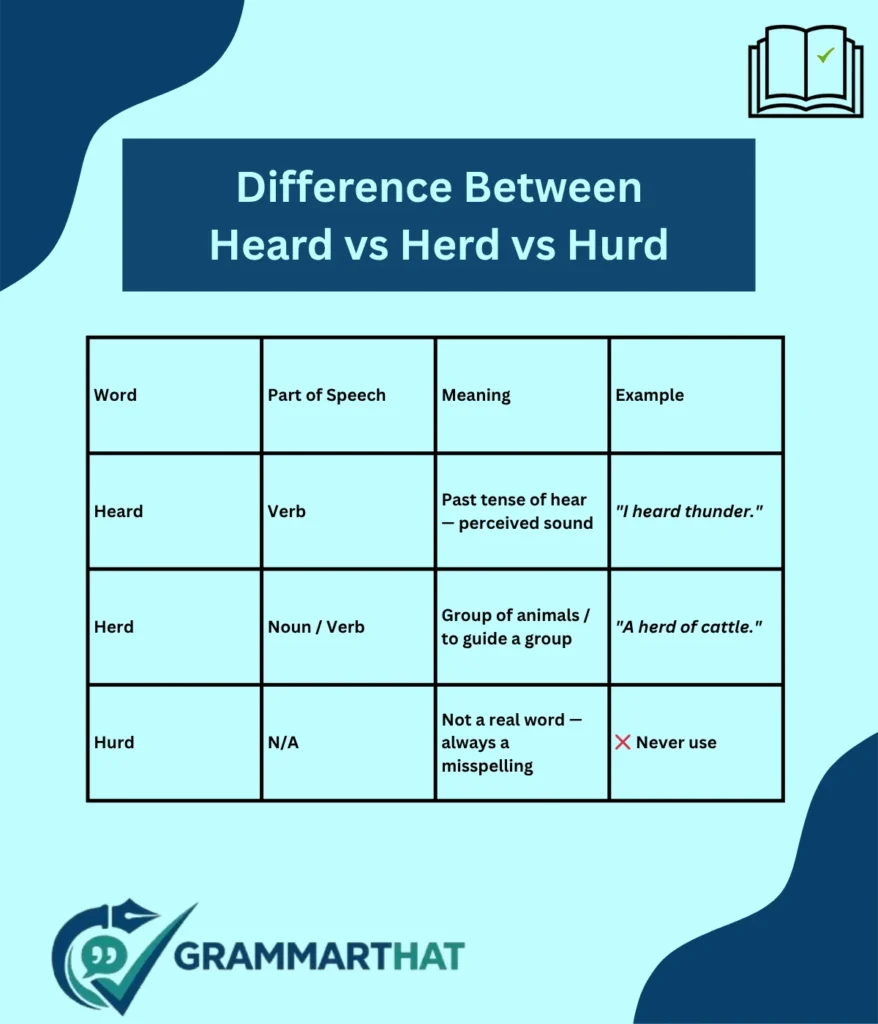
A Simple Side-by-Side Breakdown
They Sound Identical — Context Is Everything
Since heard and herd are perfect homophones, the only way to tell them apart is by meaning and context.
Ask yourself:
- Are you talking about sound or listening? → Heard
- Are you talking about animals or a group? → Herd
- Did you type hurd? → Go back and correct it
When to Use Heard, Herd, and Hurd
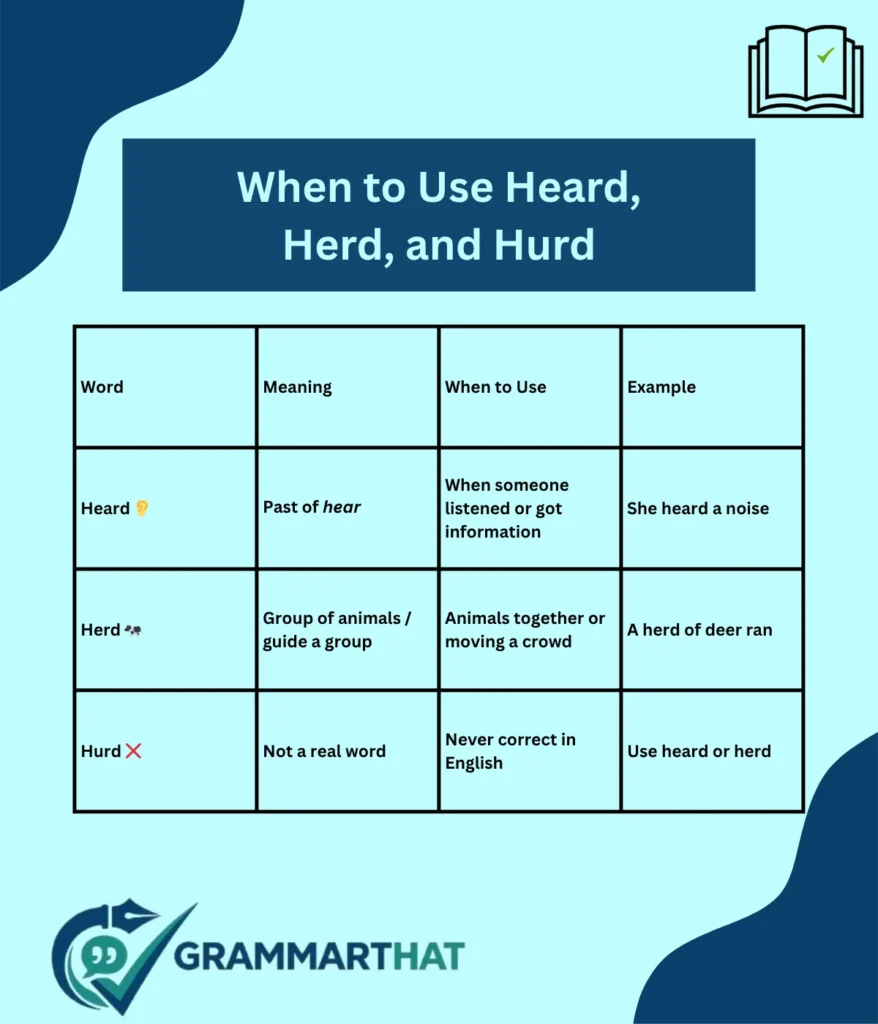
Use “Heard” When:
- Describing something listened to or perceived in the past
- Confirming you received news or information
- Using hear in any past tense construction
Examples:
- “Have you heard the latest news?”
- “She heard footsteps behind her.”
Use “Herd” When:
- Referring to a group of animals living or moving together
- Describing the act of moving or guiding a group
- Talking about crowds being directed somewhere
Examples:
- “A herd of deer grazed quietly in the meadow.”
- “Teachers tried to herd students back into the classroom.”
Never Use “Hurd”
Hurd is always wrong. There is no context in standard English where hurd is the correct spelling. Always replace it with heard, herd, or hurt depending on what you mean.
Common Mistakes to Avoid
Memory tricks:
- Heard contains the word “ear” — h-ear-d — perfect for a word about listening
- Herd contains “her” — think of a herder managing animals
- Hurd — if you typed this, it is always wrong — pick again
FAQs — Heard vs Herd vs Hurd
What is the difference between heard and herd?
Heard is the past tense of hear — meaning you perceived a sound. Herd is a noun for a group of animals or a verb meaning to guide them. They sound identical but mean completely different things.
What is the meaning of the word hurd?
Hurd has no meaning in standard English. It is not a real word — it is a misspelling of heard, herd, or sometimes hurt.
What does “heard” mean in slang?
In casual and slang usage, “heard” means “understood” or “acknowledged.” Example: “Meet me at 6.” — “Heard.” It signals agreement or confirmation.
How do you spell heard as in herd of cattle?
The correct spelling for a group of cattle is herd — H-E-R-D. Heard is only the past tense of the verb hear.
Is a group of deer called a heard?
No. A group of deer is called a herd — spelled H-E-R-D. Writing “heard” in this context is a very common spelling mistake.
Is heard grammatically correct?
Yes. Heard is the grammatically correct past tense and past participle of the verb hear. Example: “I heard that song yesterday.” and “I have heard it before.”
Conclusion
Heard, herd, and hurd may sound alike — but only two of them belong in your writing. Heard is what you do with your ears in the past. Herd is a group of animals or the act of guiding them. Hurd is never correct — full stop.
The easiest way to remember the difference: find the word “ear” hiding inside h-ear-d — that is your signal it belongs to listening. And herd belongs to animals and movement. Keep those two anchors in mind and you will never mix them up again.

Hi, I’m the voice behind GrammarThat.com. I make grammar simple and easy to understand, from basic rules to advanced writing tips. Clear explanations. Practical examples. No confusion.