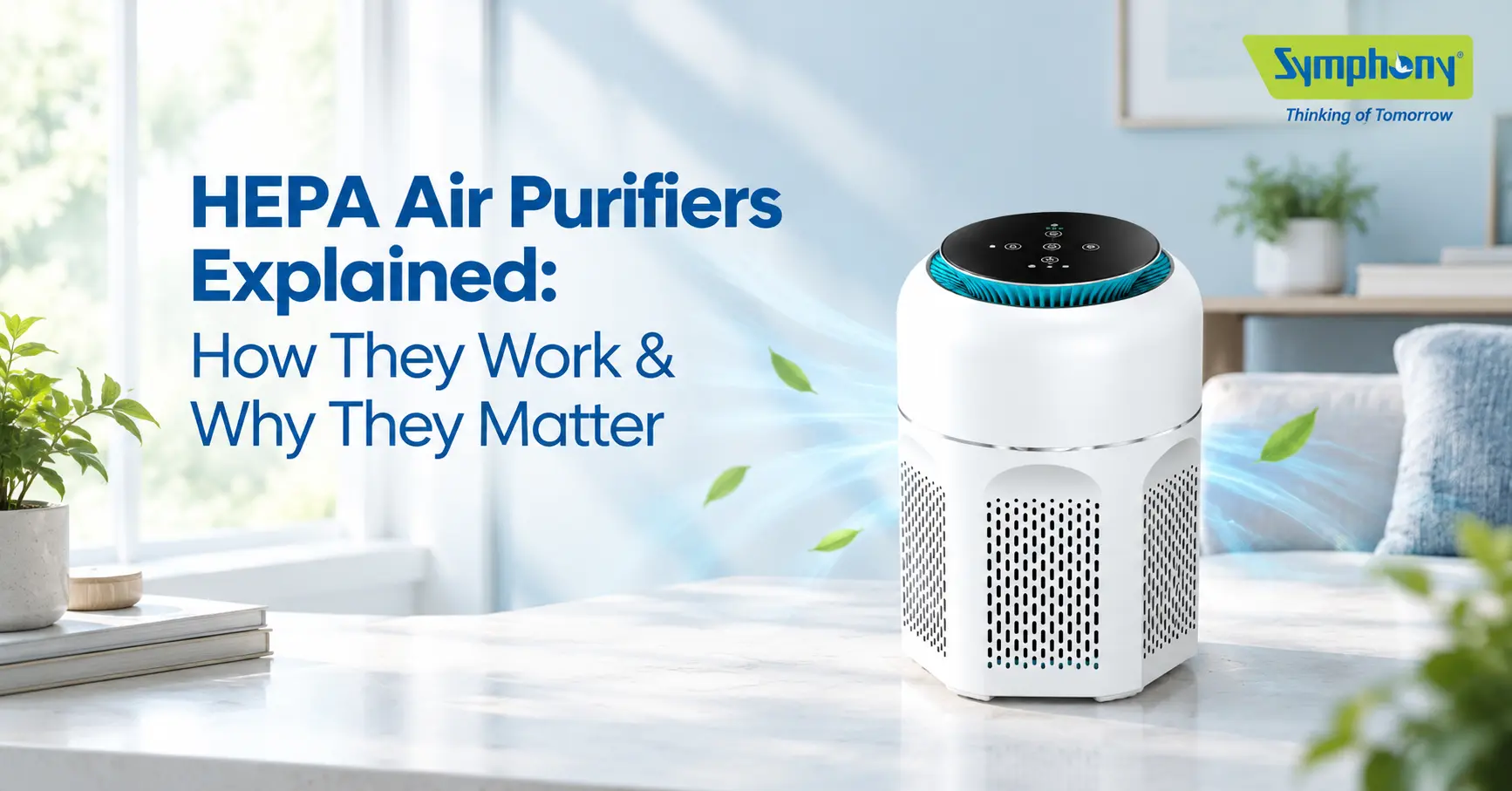
The good thing about HEPA air purifiers is that they assist in cleaning indoor air by not allowing pollen, smoke particles, fine dust, and other airborne pollutants to escape.
It utilizes a special filter that enables it to capture at least 99.9% of particles. It measures 0.3 microns under a standard test environment.
It makes a HEPA room air purifier useful for homes where dust and poor air quality are concerns.
Symphony offers models such as SilenzAir CORE and SilenzAir PET MAX with H13 HEPA filtration. CORE is appropriate for compact rooms. On the other hand, PET MAX is intended for larger spaces and homes that have pets.
Let us see how these purifiers work and what makes them so important.
What is the Working Process of a HEPA Room Air Purifier?
Ever observed dust and air particles floating when the sun’s rays directly fall into your room?
Have you ever noticed dust and particles floating in the air when your room is filled with afternoon sunlight?
These are the particles that we can actually see. There are many other particles present indoors that are too small to be noticed with our eyes.
A HEPA filtration air purifier is designed to collect such particles before releasing the filtered air back into the room.
But how does this happen?
The purifier draws air through a fan. This air first enters a prefilter where larger dust particles and hair get collected. It then passes through the HEPA filter that traps much finer particles such as pollen and household dust.
The air coming out of the purifier has fewer airborne particles. However, this process continues only when the device is operating.
The room size should also be taken into consideration.
List down the Pollutants That HEPA Air Purifiers Get Rid Of.
We generally notice dust when it accumulates on furniture or the floor. But there are several other particles that remain present in the air without being visible to us.
Contemplate hard over what happens when you cook food in the kitchen. Frying releases fine particles that may spread to your living room or bedroom. Similarly, pollen can enter your house through open windows.
In homes where people have pets, tiny flakes of animal skin may also become airborne.
A HEPA air purifier can assist in accumulating such particles as they go via its filter. But the pollution level that you can get rid of is contingent upon the cleaning capacity of the air purifier and how long it functions.
Can HEPA Filters Get Rid of Unpleasant Smells?
In case you own a pet, your concern might be the unpleasant smell that sometimes remains in the room irrespective of regular cleaning of the room. However, can a HEPA filter alone manage this issue?
Not completely. HEPA filters are meant to collect airborne particles rather than gases responsible for many household odours. This particular reason makes certain purifiers consist of an activated carbon filter.
Symphony’s SilenzAir PET MAX is one such model. It integrates activated carbon with HEPA filtration to assist in decreasing the number of airborne particles and unpleasant odours.
Therefore, while looking for the best home purifier, pay attention to the type of filters provided rather than choosing a model only because it mentions HEPA technology.
Which HEPA Air Purifier Is Suitable for Your Room?
Ever verified the coverage of rooms mentioned in the air purifier specifications? Many people pay attention to the price and filtration features. But the size of the room where you wish to install the equipment is equally important.
Remember, an air purifier perfect for a compact room might not give effective results for a larger room.
What are the things that can Affect Your Sleep for a Bedroom Air Purifier?
Wish to keep the air purifier in your bedroom and use it during nights? If that is the case, find out the level of sound it produces when it functions.
You may find it inconvenient to sleep in case the purifier makes lots of noise when used at full throttle fan speed.
Wish to make effective utilization of an air purifier for bedroom space? Scrutinize the noise levels and room coverage as per the recommendation by the manufacturer.
Also, check the cost of replacement filters. This will give you a fair idea about the expenses you can expect after buying a bedroom air purifier.
How to Select the Appropriate Air Purifier for the Living Room?
Take a look closely at the coverage area recommended by its manufacturer and its Clean Air Delivery Rate (CADR).
CADR highlights the extent of filtered air delivered by the purifier for a specific duration.
In case you are looking to get an air purifier for large rooms, get your detective shoes and start by comparing the cleaning capacity of different models rather than relying solely on the product’s price.
Conclusion
Contemplating hard about getting an air purifier? If so, ascertain your expectations from the equipment. Is dust the main reason to get it, or do you want to decrease pollen and other fine particles in the indoor spaces of your house?
A HEPA air purifier can help with these concerns. However, do not assume that every model available in the market will function equally well in your room.
A prime example of that is that a small air purifier may be enough for a small bedroom. However, what in case you want to utilize the same equipment in your large living space? If so, its cleaning capacity may not be sufficient.
You can take a closer look at Symphony’s SilenzAir CORE and PET MAX models. Examine their filtration features and recommended room coverage before selecting one.
Also, ascertain how much you may have to spend on replacement filters. This is an expense that should not be overlooked while making the purchase.
Remember, an air purifier is not ideal for getting rid of the dust already there on your furniture. However, you still need to keep your house clean by doing regular dusting.
Opt for a purifier that aligns with the needs of your room instead of getting one only because it has multiple features present in it.
Also Read
- Innate vs. Enate Homophones: Spelling & Definition
- NSFW Meaning in Text: Usage, Examples & More
- Inclosed vs Enclosed: What’s the Real Difference?