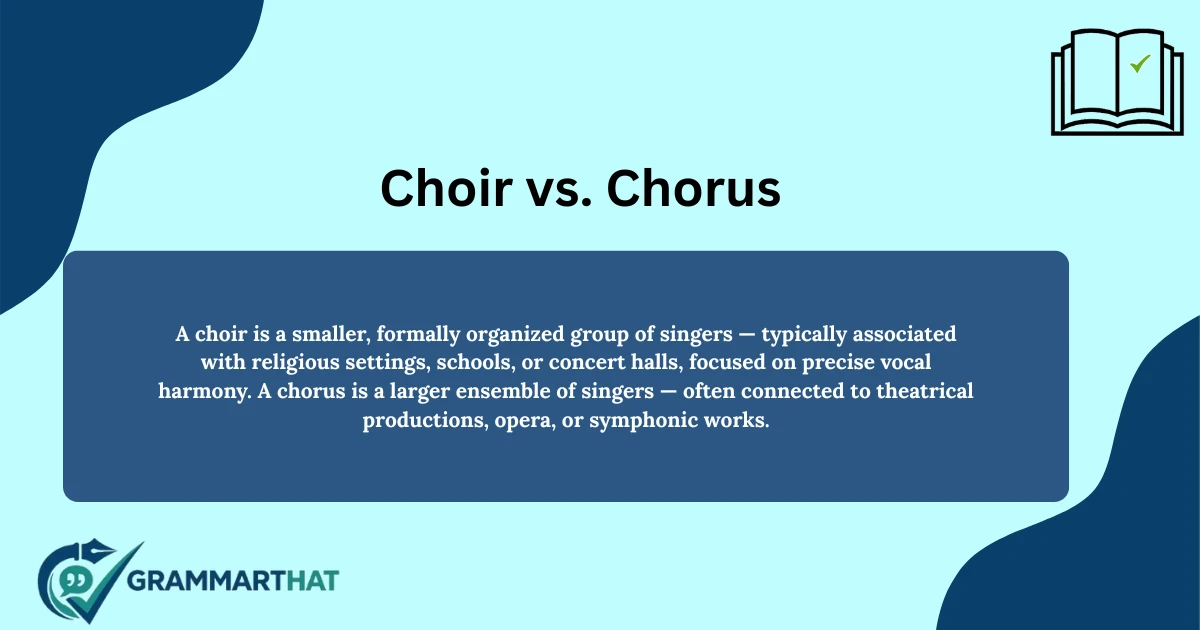
Choir usually refers to a formally organized vocal group in churches, schools, or concerts, while chorus often means a larger singing ensemble in theater or opera and can also refer to a song’s repeated refrain.
What Does “Choir” Mean?
A choir is a formally organized group of singers — typically between a handful and around fifty voices — that performs vocal music with an emphasis on precision, harmony, and unified tone. The word also refers to the specific architectural section of a church where singers perform.
Example: “The cathedral choir rehearsed every Thursday evening before Sunday’s service.”
Common uses of “choir” in religious and formal contexts:
- “She has sung with the same church choir for twenty-three consecutive years.”
- “The school choir competed in the regional festival and placed second overall.”
Common uses of “choir” in secular and concert settings:
- “The symphony invited a professional choir to perform alongside the orchestra.”
- “The university choir toured three countries over the summer.”
“Choir” in Different Contexts
In every context, “choir” signals a group defined by vocal precision, formal organization, and typically — though not exclusively — a connection to religious or classical music traditions.
What Does “Chorus” Mean?
“Chorus” carries two distinct and important meanings in English — a large singing ensemble connected to theatrical or symphonic performance, and the repeated refrain section of a song that alternates with verses.
Example as an ensemble: “The opera’s final act featured the full chorus of eighty voices filling the auditorium.”*
Common uses of “chorus” as a performing ensemble:
- “The symphonic chorus prepared for six months before the premiere.”
- “A chorus line of singers and dancers opened the second act of the musical.”
Common uses of “chorus” as a song section:
- “By the second chorus, the entire crowd was singing along without prompting.”
- “The chorus drops after a two-minute build — and it is worth the wait.”
“Chorus” in Different Contexts
In every performance context, “chorus” signals scale, spectacle, and theatrical tradition. In song structure, it signals the repeating, memorable core of a piece of music.
Choir vs. Chorus — Key Differences
The difference between “choir” and “chorus” is not regional like mold/mould or tonal like dreamed/dreamt. It is a difference of historical origin, institutional context, size, and musical purpose — and using the wrong word in a professional musical context signals unfamiliarity with how the field uses its own vocabulary.
Setting and Institutional Affiliation
This is the most reliable practical distinction between the two words.
“Choir” is the standard word for singing groups affiliated with:
- Religious institutions — church choirs, cathedral choirs, chapel choirs
- Schools and universities — school choirs, university choirs, choral societies
“Chorus” is the standard word for singing groups affiliated with:
- Opera companies — the opera chorus, resident chorus
- Musical theater productions — the chorus of a Broadway show
Choir vs Chorus — Correct Usage
Size — A General but Not Absolute Distinction
Choirs typically range from a handful of voices to around fifty members — though professional and cathedral choirs vary considerably. A chamber choir may have as few as eight singers. A large choral society may have several hundred.
Choruses in theatrical and operatic settings frequently involve far larger numbers — opera choruses of eighty or more singers are common, and symphonic choruses for major works like Mahler’s Symphony of a Thousand can involve hundreds of voices.
Repertoire and Performance Style
Choirs emphasize:
- A cappella performance — singing without instrumental accompaniment
- Classical and sacred repertoire — motets, anthems, masses, requiems
- Choral society tradition — oratorio, cantata, and large choral works
Choruses emphasize:
- Theatrical integration — singing as part of a larger dramatic production
- Scale and impact — volume, spectacle, and dramatic effect
- Diverse repertoire — from opera to musical theater to popular styles
The Musical Meaning of “Chorus”
In song structure, “chorus” refers to the repeated, melodically memorable section of a song that alternates with verses. This meaning is entirely separate from the performing ensemble meaning — and is one of the most widely used terms in popular music, songwriting, and music education.
Song Structure: Verse, Chorus, Bridge & Pre-Chorus
A choir never refers to a section of a song. “Chorus” does — and this dual meaning makes it the more versatile of the two words in musical writing.
Same Musical World, Two Different Words — How Context Determines the Choice
Religious setting: “The choir sang the introit as the congregation entered the cathedral.”
Theatrical setting: “The chorus sang the opening number as the audience took their seats.”
Same act — a group of singers performing as an audience arrives. But the word choice signals the entire institutional and artistic context instantly. “Choir” places you in a cathedral. “Chorus” places you in a theater.
What Is the Difference Between a Choir and a Chorale?
This question comes up regularly — and the distinction is worth addressing clearly.
A chorale originally referred to a type of harmonized hymn tune developed in the German Lutheran tradition — most famously the chorales of Johann Sebastian Bach. The word describes a specific musical form, not just a group of singers.
Choir vs Chorus vs Chorale — Key Distinctions
Frequently Asked Questions
Is a choir smaller than a chorus?
Generally — but not always. Choirs typically range from a small chamber ensemble of eight to ten voices up to around fifty members in larger choral societies. Choruses in operatic and symphonic settings frequently involve eighty to several hundred singers.
Does singing lower cortisol?
Research consistently suggests that it does. Multiple studies — including research published in the Journal of Music Therapy and work conducted at the University of Gothenburg — have found that group singing reduces cortisol levels (the body’s primary stress hormone), lowers heart rate, and promotes the release of oxytocin and endorphins.
What is the difference between a choir and a chorale?
A chorale originally referred to a harmonized hymn tune — specifically in the German Lutheran tradition developed and refined by Johann Sebastian Bach. A choir is the broader and more widely used term for any formally organized singing group.
Conclusion
“Choir” and “chorus” both describe groups of singers. Use “choir” for religious, school, community, and concert singing groups where formal vocal precision and classical tradition define the ensemble. Use “chorus” for theatrical, operatic, and symphonic ensembles where scale and dramatic context shape the performance — and for the repeated refrain section of any song.

Hi, I’m the voice behind GrammarThat.com. I make grammar simple and easy to understand, from basic rules to advanced writing tips. Clear explanations. Practical examples. No confusion.