Innate vs. Enate Homophones: Spelling & Definition

Innate and enate are both real words, but they belong to completely different fields and are not interchangeable.

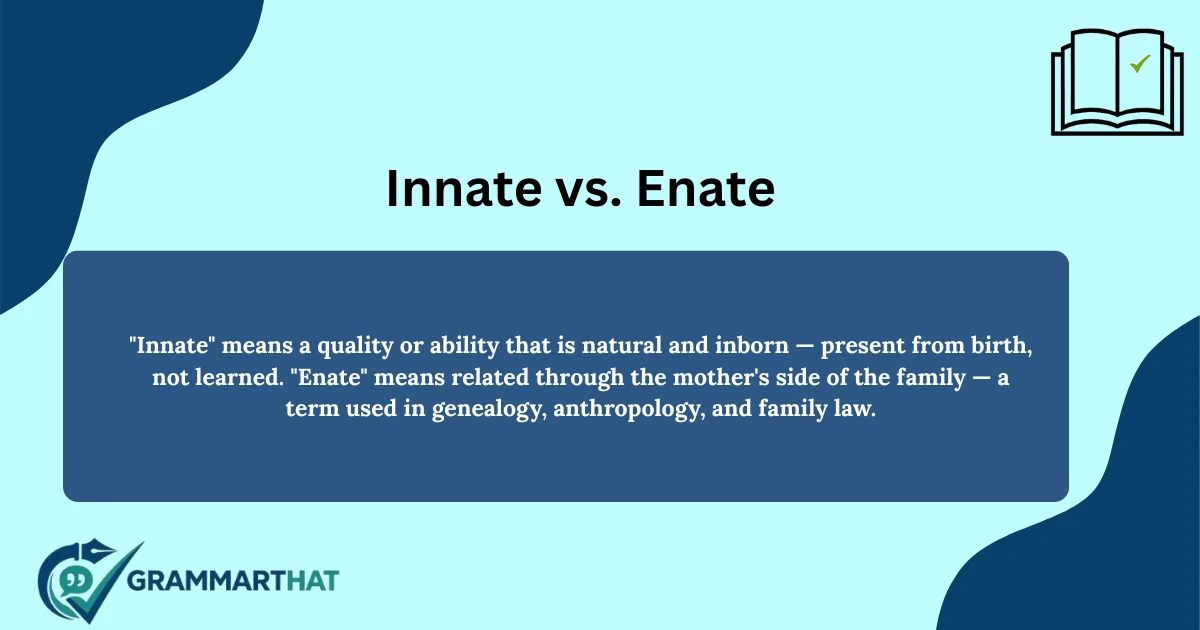
Innate describes qualities or abilities that are present from birth and not acquired through learning, while enate refers to relationships traced through the mother’s side of the family. One word concerns natural traits. The other concerns maternal lineage.

These are two completely different words with completely different meanings. They are not regional variants, not interchangeable spellings, and not related to each other in any way.

What Do “Innate” and “Enate” Actually Mean?

Both words end in “-nate” and both appear in formal and academic writing — which is exactly why writers confuse them. But their meanings, origins, and usage contexts share nothing in common.

What Does “Innate” Mean?

what-does-innate-mean

“Innate” is an adjective meaning existing naturally from birth — a quality, ability, or characteristic that is inborn, inherent, and not acquired through learning or experience.

Example: “She had an innate talent for reading people — something no course could ever teach.”

The word traces back to Latin innatus — the past participle of innasci, meaning “to be born in” or “to arise from within.” It entered English in the 15th century through Late Latin and Middle French — and has remained in steady use ever since across philosophy, psychology, biology, and everyday writing.

Common uses of “innate” in everyday writing:

  • “Children show an innate curiosity about the world from the earliest months of life.”
  • “His innate sense of rhythm was evident before he ever took a music lesson.”
  • “Some researchers argue that a capacity for empathy is innate — not purely socialized.”

“Innate” in Different Writing Contexts

ContextExample
Psychology“Innate temperament shapes how children respond to stress from birth.”
Biology“Bees navigate using an innate magnetic compass system.”
Philosophy“Descartes believed certain ideas were innate to the rational mind.”
Education“Innate ability alone does not determine academic success — effort matters equally.”
Business“She brought an innate instinct for negotiation that made her invaluable.”
Everyday language“He had an innate kindness that everyone around him noticed immediately.”

Synonyms for “innate”: inborn, inherent, intrinsic, natural, instinctive, native, congenital, built-in.

In every context — scientific, philosophical, professional, or conversational — “innate” describes a quality that was there from the beginning. It was not taught, developed, or acquired. It simply is.

What Does “Enate” Mean?

what-does-enate-mean

“Enate” is both an adjective and a noun — used in genealogy, anthropology, family law, and kinship studies to describe a person related to another through the mother’s side of the family — through female connections exclusively.

Example: “Her grandmother’s siblings are considered enate relatives — connected entirely through the maternal line.”

The word traces back to Latin enatus — the past participle of enasci, meaning “to be born from” or “to spring from.” In classical Roman law and later in formal kinship terminology, the enate line referred to relationships traced exclusively through mothers, daughters, and female ancestry.

“Enate” is the direct opposite of “agnate” — which refers to relatives connected through the father’s side or through male connections exclusively. Together, these two terms form the foundation of kinship classification systems used in anthropology, genealogy, and inheritance law.

Common uses of “enate” in formal writing:

  • “In matrilineal societies, property and status pass through the enate line.”
  • “The legal claim was disputed because the heir was an enate relative — not an agnate one.”
  • “Genealogists classify cousins as enate when the connection runs entirely through female ancestors.”

“Enate” in Different Formal Contexts

ContextExample
Genealogy“Tracing enate ancestry requires following the maternal line through each generation.”
Anthropology“Many indigenous kinship systems prioritize enate relationships over agnate ones.”
Family law“The enate heir had a strong legal claim under the matrilineal inheritance code.”
Academic writing“Enate and agnate classifications remain central to kinship theory.”
Historical research“Enate relatives held significant social authority in several ancient Mediterranean cultures.”

Synonyms for “enate”: maternal relative, matrilineal relation. Opposite: agnate — a relative connected through the father’s side or through male lineage exclusively.

In every context where “enate” appears, it is a technical term describing a specific type of family relationship — not a quality, personality trait, or human characteristic.

Innate vs. Enate — Key Differences That Actually Matter

These words are not regional variants like mold/mould or stylistic alternatives like canceled/cancelled. They are two completely separate words that happen to look similar. Confusing them produces sentences that are factually and semantically incorrect.

Innate vs Enate — Meaning, Origin, and Usage at a Glance

FeatureInnateEnate
MeaningInborn, natural, present from birthRelated through the mother’s side
Part of speechAdjectiveAdjective and noun
Latin rootInnatus — born withinEnatus — born from
Primary fieldPsychology, biology, philosophy, everyday useGenealogy, anthropology, family law
Common in everyday speechYes — very widely usedNo — specialist and academic term
OppositeAcquired, learned, developedAgnate — paternal line relative
Describes a person’s qualitiesYesNo — describes family relationships only
Describes family relationshipsNoYes — exclusively

The Nature vs. Nurture Connection — Only “Innate” Applies

The nature vs. nurture debate is one of the most widely discussed concepts in psychology, education, and popular science — and “innate” sits at the heart of it.

When researchers, writers, and educators discuss whether traits like intelligence, creativity, emotional sensitivity, or language ability are built in or developed — they are asking whether those traits are innate. This is one of the most common and important uses of the word in both academic and everyday contexts.

“Enate” has no role in this discussion. It describes who your relatives are — not what you are born with.

Memory Tip: How to Keep Them Straight

The simplest way to remember the difference:

Innate — think inner. Something innate lives inside you from birth.

Enate — think maternal estate. An enate relative is connected through your mother’s side — like an inheritance that travels through female ancestry.

Side-by-Side Examples: Innate vs. Enate in Real Sentences

These parallel sentences show exactly how both words work — and how different the meaning becomes the moment you swap one for the other.

“Innate” in Psychology, Biology, and Everyday Writing

  • “Research suggests that human beings have an innate capacity for language — hardwired before birth.”
  • “Her innate confidence in social situations made her a natural leader from an early age.”
  • “The study found that certain innate temperament traits remain stable from infancy through adulthood.”
  • “Dogs have an innate instinct to protect their owners — present regardless of training.”
  • “His innate mathematical ability allowed him to solve complex problems intuitively.”

“Enate” in Genealogy, Anthropology, and Legal Writing

  • “In matrilineal kinship systems, enate relatives hold priority in inheritance claims.”
  • “The genealogist identified seventeen enate ancestors across five generations of maternal lineage.”
  • “The anthropologist documented how enate and agnate relationships were treated differently under tribal law.”
  • “Her enate aunt — connected through her mother’s sister — was named in the original will.”
  • “Distinguishing enate from agnate relatives was essential to resolving the disputed estate.”

Same Ending, Two Words — How One Wrong Letter Changes Everything

Correct use of “innate”: “She had an innate ability to calm people in difficult situations.”

Correct use of “enate”: “The disputed inheritance was claimed by an enate relative on the maternal side.”

Incorrect swap: ~~”She had an enate ability to calm people.”~~ — This says her ability is related to her mother’s family line — which is meaningless in this context.

Incorrect swap: ~~”The inheritance was claimed by an innate relative.”~~ — This says the relative is inborn or natural — which makes no grammatical or logical sense.

One wrong word. The sentence becomes nonsense.

Common Mistakes Writers Make with “Innate” and “Enate”

Common MistakeIncorrect ✗Correct ✓
Using “enate” when describing a natural talent“She had an enate gift for music.”“She had an innate gift for music.”
Using “innate” to describe a family relationship“He was an innate relative on her mother’s side.”“He was an enate relative on her mother’s side.”
Confusing “enate” with “innate” due to similar endings“The child displayed enate curiosity.”“The child displayed innate curiosity.”
Using “enate” in everyday conversation“That’s just her enate personality.”“That’s just her innate personality.”
Assuming both words are spelling variantsTreating innate/enate like canceled/cancelledThese are two completely different words — not variants of the same word

Frequently Asked Questions

Is it innate or enate?

It depends entirely on what you are describing. Use “innate” when describing a quality, ability, or characteristic that is natural and present from birth — “an innate talent,” “an innate sense of direction.” Use “enate” when describing a family member related through the mother’s side — “an enate relative,” “the enate line of descent.” They are not interchangeable under any circumstances.

What is the meaning of enate?

“Enate” means related through the mother’s side of the family — connected exclusively through female or maternal ancestry. It is used primarily in genealogy, anthropology, and family law to classify relatives whose connection runs through the maternal line. Its direct opposite is “agnate” — a relative connected through the father’s side or through male lineage.

How do you spell enate?

“Enate” is spelled E-N-A-T-E. It is not spelled innate, inate, or enate with any additional letters. Because it looks similar to “innate” — which is far more commonly used — the two are frequently confused. The key distinction is the opening letter: “innate” begins with inn- and “enate” begins with en-.

What is the opposite of innate?

The opposite of “innate” is acquired, learned, or developed — describing traits, skills, or knowledge that are gained through experience, education, or environment rather than present from birth. In the nature vs. nurture debate, anything on the nurture side — shaped by upbringing, culture, or practice — is the opposite of innate.

Conclusion

“Innate” and “enate” are two completely different words that simply happen to look alike. “Innate” describes a quality that is natural, inborn, and present from birth. “Enate” describes a family relationship traced through the mother’s side.

Use “innate” when you are talking about what someone is born with. Use “enate” when you are talking about maternal family connections in a genealogical or legal context. There is no overlap, no interchangeability, and no regional variation — just two distinct words that deserve to be used correctly.

Leave a Comment