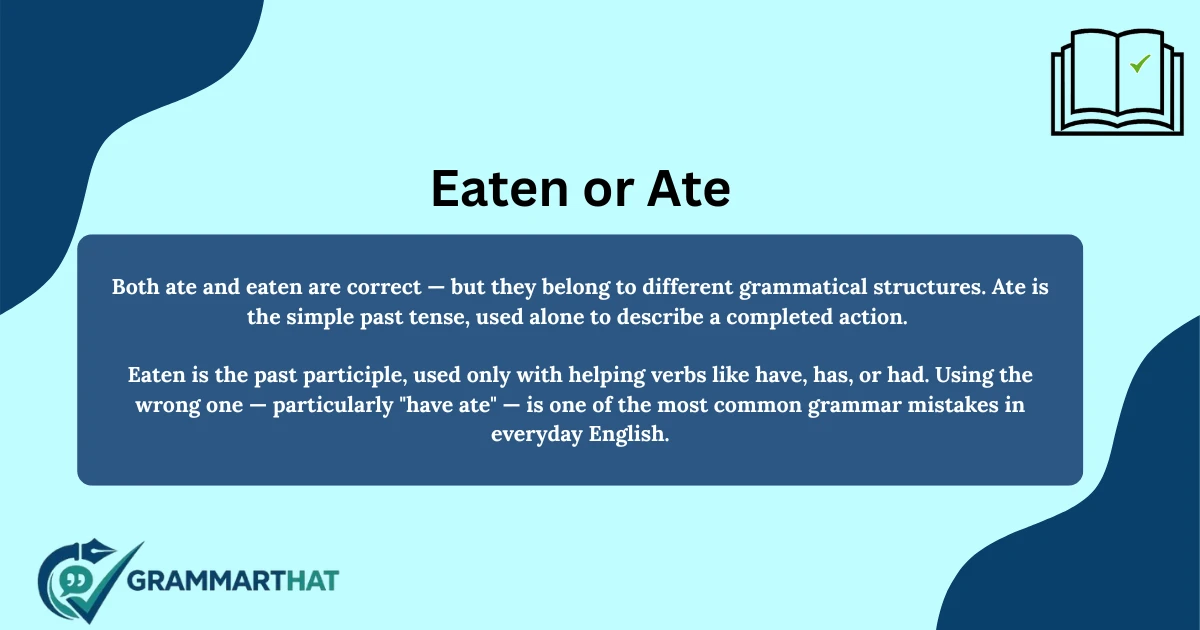
Both ate and eaten are correct — but they belong to different grammatical structures.
Ate is the simple past tense used alone to describe a completed action, while eaten is the past participle used only with helping verbs like have, has, or had. Using the wrong one — especially “have ate” — is one of the most common grammar mistakes in everyday English.
This guide breaks down exactly when to use eaten vs ate and the one golden rule that eliminates the most common error.
What Does Ate Mean?
Ate is the simple past tense of the irregular verb eat. It describes a completed eating action that happened at a specific or implied time in the past — with no helping verb needed.
Example: “I ate breakfast at 8 AM.”
Ate stands entirely on its own. It does not need have, has, or had before it. Adding a helping verb before ate is always a grammatical error.
Common Uses of “Ate”
More examples:
- “I ate three apples before the game.”
- “The children ate quickly and ran outside.”
- “She ate nothing all day.”
Irregular Verb Forms of “Eat”
What Does Eaten Mean?
Eaten is the past participle of eat — and it is never used alone in a sentence. Eaten always requires a helping verb — specifically have, has, had, or been — to form perfect tenses or passive constructions.
Example: “I have already eaten.”
Eaten with have/has/had creates the perfect tenses — which indicate that an action is completed, with a connection to the present or to another time:
Present Perfect — Have/Has + Eaten
Describes an action completed at an unspecified time before now — with present relevance:
- “I have eaten at that restaurant before.” → past experience, relevant now
- “She has eaten nothing today.” → recent situation affecting the present
- “Have you eaten yet?” → checking present status based on past action
Past Perfect — Had + Eaten
Describes an action completed before another past event:
- “She had eaten before we arrived.” → her eating happened earlier than our arrival
- “By noon, he had eaten twice.” → completed before noon
- “They had eaten all the food when I got there.” → fully eaten before I arrived
Passive Voice — Been + Eaten
Describes something being consumed — focus on the object rather than the actor:
- “The cake has been eaten.”
- “All the food was eaten within minutes.”
The Golden Rule — Never “Have Ate”
This is the single most important rule in this entire guide:
Never use “have ate,” “has ate,” or “had ate.”
These constructions are always grammatically incorrect. The helping verbs have, has, and had must always be followed by the past participle — and the past participle of eat is eaten, not ate.
This error is extremely common in casual speech — but in standard writing and formal contexts, it is always incorrect.
Ate vs Eaten — The Key Difference
The Helping Verb Test
The fastest way to choose between ate and eaten:
Is there a helping verb (have, has, had, been) before the word?
- Yes → use eaten
- No → use ate
“I ___ lunch.” → No helping verb → ate ✅ “I have ___ lunch.” → Helping verb have present → eaten ✅
When to Use Ate vs Eaten

Use “Ate” When:
- Describing a completed past action with no helping verb
- The sentence includes a specific time reference (“at noon,” “last night,” “this morning”)
- The action is simply a finished past event
Examples:
- “We ate at my favorite restaurant yesterday.”
- “The dog ate the entire bowl of food in under a minute.”
- “I ate too much at the party.”
Use “Eaten” When:
- The sentence includes have, has, had, or been before it
- Forming present perfect (unspecified time, present relevance)
- Forming past perfect (action before another past event)
- Using passive voice (something was consumed)
Examples:
- “I have eaten here before and loved it.”
- “By the time they arrived, all the food had been eaten.”
- “Has she eaten anything today?”
Common Mistakes to Avoid
Memory trick:
- Ate → alone, past, done → “I ate dinner at 7.” — finished, specific, no helper needed
- Eaten → always has a helper → think “have/has/had eaten” as a fixed unit that always stays together
- If you see have, has, or had → the next word must be eaten — never ate
FAQs — Eaten or Ate
Should you say “ate” or “eaten”?
It depends on the structure of your sentence. Use “ate” alone for simple past tense: “I ate lunch.” Use “eaten” with a helping verb: “I have eaten lunch.” The presence or absence of have/has/had before the word determines which form to use.
When to use “ate”?
Use “ate” when describing a completed past eating action that stands alone — without any helping verb. It typically pairs with a specific or implied time: “She ate dinner at 7.” / “They ate everything.” / “I ate a huge breakfast this morning.”
How do I say “I ate”?
“I ate” is the correct simple past tense statement — meaning you consumed food at some point in the past. Example: “I ate a sandwich for lunch.” If you want to use a helping verb, you must change to: “I have eaten” — never “I have ate.”
How can I use “ate” in a sentence?
“Ate” as simple past tense: “She ate the last piece of cake.” / “We ate outside because the weather was perfect.” / “He ate quickly and left the table.” — always standalone, always past, never with have/has/had.
Conclusion
Ate and eaten are both correct forms of eat — but they serve different grammatical functions. Ate is the simple past tense, used alone for completed actions. Eaten is the past participle, used only with helping verbs like have, has, and had.
The golden rule never changes: “have ate” is always wrong. Whenever a helping verb precedes, the word must be eaten. Apply that one rule and every sentence involving eat in the past tense will always be grammatically correct.

Hi, I’m the voice behind GrammarThat.com. I make grammar simple and easy to understand, from basic rules to advanced writing tips. Clear explanations. Practical examples. No confusion.