Thus far and so far mean exactly the same thing — “up to this point” or “until now.”
The only real difference between them is formality. “So far” is the natural, everyday choice, while “Thus far” is the polished, professional version used in formal writing and academic contexts.
This guide breaks down the difference between thus far and so far, when to use each, and one important case where only so far works.
What Does “So Far” Mean?
“So far” is an adverbial phrase meaning “up to this point in time” or “until now.” It is the standard, widely used expression in everyday speech and informal writing — comfortable, natural, and universally understood.
Example: “We have only finished two chapters so far.” (= Up to this point, only two chapters are done.)
Common uses of “so far”:
- Casual conversation and everyday texting
- Informal emails and workplace chat
- Describing progress on tasks or projects in non-formal contexts
- Physical distance (a use thus far cannot share)
Examples across different contexts:
What Does “Thus Far” Mean?
“Thus far” carries the exact same temporal meaning — “up to this point” or “until now” — but in a noticeably more formal and elevated register. It is the version you reach for when the writing demands polish, precision, and professional tone.
Example: “The company’s quarterly revenue has exceeded expectations thus far.” (= Up to this point, revenue has been above expectations.)
Common uses of “thus far”:
- Formal business reports and presentations
- Academic essays and research papers
- Legal and government documents
- Any professional writing where tone matters
Examples across different formal contexts:
The Key Difference — Formality and Register
The One Case Where Only “So Far” Works
“So far” has a secondary meaning that “thus far” cannot replace — describing literal physical distance or the degree to which something has physically extended.
Correct: “We walked so far today that my legs were aching.”
Incorrect: “We walked thus far today that my legs were aching.” ❌
Thus far only refers to time or progress — not physical distance or extent. When the meaning involves how far something physically traveled or extended — so far is the only correct choice.
When to Use Thus Far vs So Far
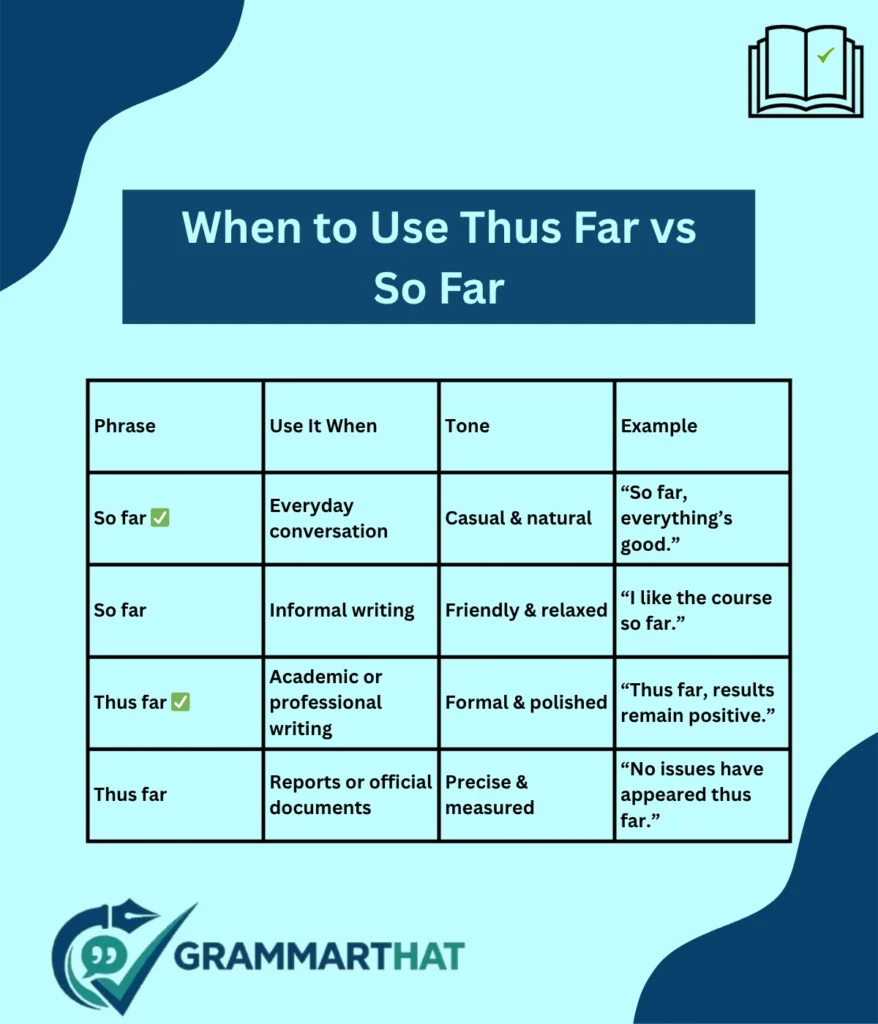
Use “So Far” When:
- Talking or texting in everyday casual conversation
- Writing informal emails or workplace chat
- Describing physical distance or physical extent
- The context is relaxed and conversational
- You want the expression to sound completely natural
Examples:
- “How is the new job going so far?”
- “So far, I’m really enjoying the book.”
- “They ran so far the track disappeared behind them.”
Use “Thus Far” When:
- Writing academic papers, essays, or research reports
- Producing formal business correspondence or presentations
- Drafting legal, governmental, or official documents
- The writing requires a polished, measured tone
- You want to signal professional precision and care
Examples:
- “The trial results have been inconclusive thus far.”
- “No major obstacles have emerged thus far in the review process.”
- “Thus far, the data supports our initial assumptions.”
Common Mistakes to Avoid
Memory trick:
- So far → short, simple, everyday — like the word “so” itself
- Thus far → formal, elevated, scholarly — “thus” is the giveaway that formality is required
- Ask: “Is this casual or formal writing?” Casual → so far. Formal → thus far.
- Ask: “Am I talking about physical distance?” Yes → so far only
FAQs — Thus Far vs So Far
Should I say “thus far” or “so far”?
It depends on your context. Use “so far” in everyday conversation, casual emails, and informal writing. Use “thus far” in formal reports, academic essays, business presentations, and any professional writing where an elevated tone is appropriate.
What does it mean when someone says “thus far”?
“Thus far” means “up to this point” or “until now.” When someone uses it, they are typically speaking or writing in a formal or professional context and referring to the current state of progress, findings, or events up to the present moment.
What does “thus far” mean?
“Thus far” means “up to this point in time” or “until now.” It is the formal equivalent of “so far” — used in academic, legal, business, and professional writing to describe what has happened or been accomplished up to the current moment.
How to use “thus far” in a sentence?
Use “thus far” at the beginning, middle, or end of a formal sentence to describe what has happened up to the present point. Examples: “Thus far, no issues have been reported.” / “The investigation has yielded no conclusions thus far.” / “Results thus far suggest the treatment is effective.”
Conclusion
Thus far and so far mean the same thing — but they live in different worlds. “So far” is the natural, versatile, everyday choice that works in casual speech, informal writing, and any sentence describing physical distance. “Thus far” is the formal, polished alternative reserved for academic, professional, and official contexts where precise, elevated language signals competence and care.
Choose the one that matches the formality of your audience — and remember that only so far can describe how far something physically traveled. Get that distinction right and both phrases will always serve you perfectly.

Hi, I’m the voice behind GrammarThat.com. I make grammar simple and easy to understand, from basic rules to advanced writing tips. Clear explanations. Practical examples. No confusion.