Input is the only correct spelling. Imput is not a recognized English word — it is almost always a phonetic misspelling caused by the way input sounds when spoken quickly.
This guide clears up the confusion completely.
What Does Input Mean?
Input is both a noun and a verb — one of the most commonly used words in everyday English, technology, and professional communication.
As a noun — it refers to data, information, advice, or contribution brought into a system, process, or discussion.
Example: “We need your input before the final decision is made.”
As a verb — it means to enter or supply data into a system, device, or process.
Example: “Please input your password to continue.”
Three core uses of input:
Input as Contribution or Advice
Refers to someone’s ideas, opinions, or feedback shared in a discussion or decision-making process.
- “The manager valued everyone’s input during the meeting.”
- “Your input on this project would be greatly appreciated.”
Input as Data Entry
Refers to entering information into a computer, system, or form.
- “Input your details into the registration form.”
- “The system processes whatever data is input by the user.”
Input as a Technical or Scientific Term
Refers to signals, energy, or resources entering a system.
- “The device converts electrical input into mechanical output.”
- “Reduce the input voltage before connecting the circuit.”
Input Word Forms at a Glance
Synonyms (noun): contribution, feedback, advice, data, information Synonyms (verb): enter, key in, submit, type, feed
What Does Imput Mean?
Imput is not a standard English word. It does not appear in Merriam-Webster, Cambridge, or Oxford as a recognized term. In virtually every case — imput is a misspelling of input.
Why People Write “Imput”
The mistake is almost entirely phonetic. When input is spoken at natural speed, the n sound shifts slightly toward m before the p — a linguistic process called assimilation. The mouth naturally prepares for the p sound by moving the n toward m.
So “input” can sound like “imput” in fast, casual speech — leading writers to spell what they hear rather than the correct form.
The Linguistic Explanation
This is the same reason people sometimes mispronounce or misspell “input” — the ear hears one thing while the correct spelling is another.
Imput or Impute — An Important Distinction
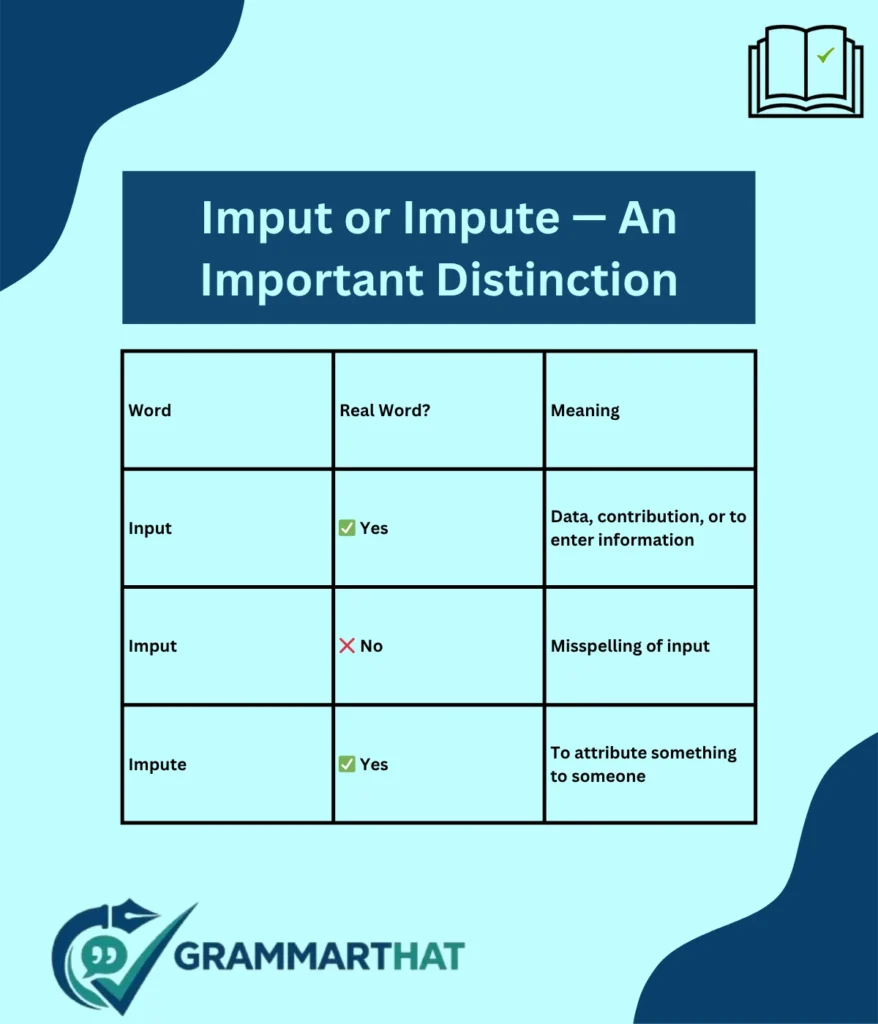
Imput (misspelling) should not be confused with impute — which is a real, standard English word with a completely different meaning.
Impute means to attribute something — usually something negative — to someone. It is used in formal, legal, and academic writing.
Example: “It would be unfair to impute bad motives to her actions.”
Imput or Impute or Input Comparison Table
Past Tense of Input — Input or Inputted?
Both input and inputted are accepted as past tense forms — though usage varies by context:
- Input (past tense) — common in technical and American English: “She input the data yesterday.”
- Inputted (past tense) — slightly more formal and explicit: “He inputted all the records manually.”
Neither is wrong. Choose the one that sounds more natural in your context and stay consistent throughout your writing.
When to Use Input Correctly
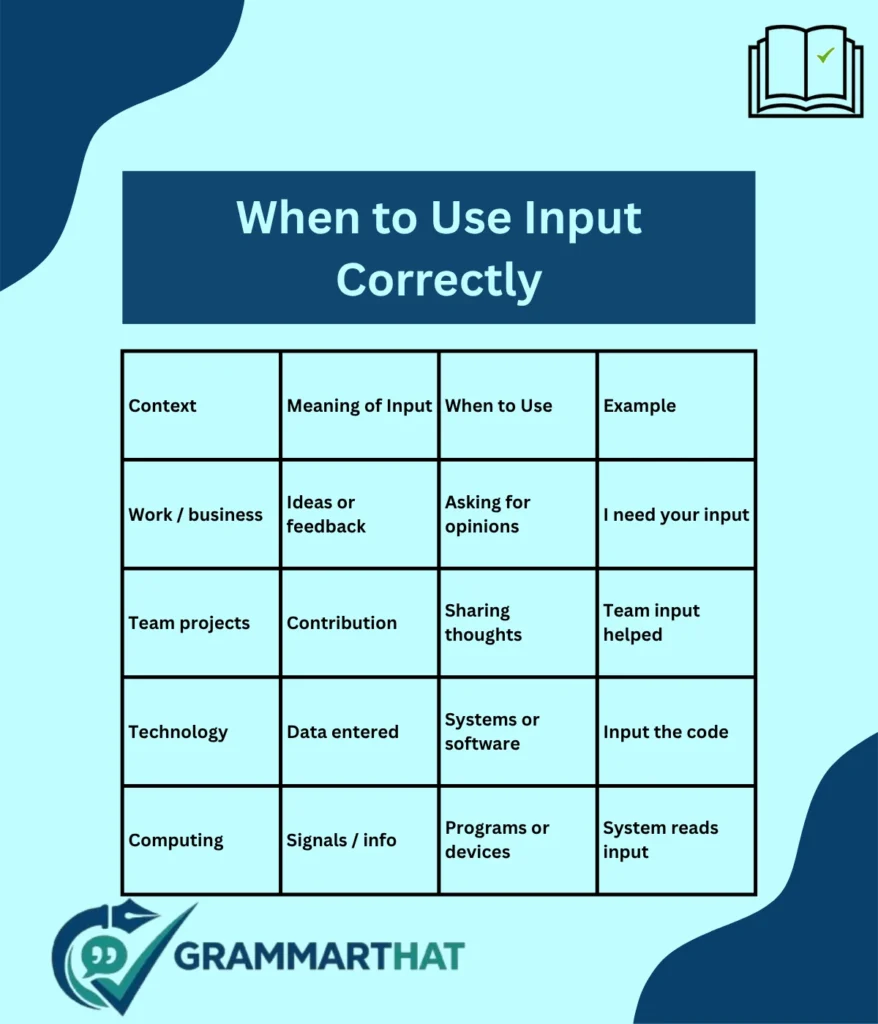
In Professional and Workplace Communication
Input is used constantly in business settings to mean feedback, contribution, or opinion:
- “I’d love your input on the new strategy.”
- “The team’s input shaped the final outcome significantly.”
In Technology and Data Contexts
Input describes data entry, system signals, or user-provided information:
- “Input the tracking number to locate your package.”
- “The program processes input from multiple data sources.”
Common Mistakes to Avoid
Memory trick:
- Input = in + put — you are putting something in — data goes in to a system
- Think of “put it in” → input — the spelling follows the logic perfectly
- If you typed imput — find the m and change it to n → input ✅
FAQs — Input or Imput
What is the difference between input and imputed?
Input means data, contribution, or the act of entering information. Imputed is the past tense of impute — meaning to attribute something, often something negative, to a person or source. They are completely different words with no overlapping meaning.
What does your input mean?
“Your input” means your contribution, feedback, opinion, or advice on a matter. Example: “We value your input and will consider it carefully before making a final decision.”
What does get your input mean?
“Get your input” means to seek your opinion, advice, or feedback on something. Example: “I wanted to get your input before we move forward with the plan.”
Is input a real word?
Yes — input is a fully standard, widely recognized English word found in all major dictionaries. It functions as both a noun and a verb and is used across technology, business, science, and everyday communication.
Conclusion
The correct spelling is always input — never imput. The confusion comes from natural speech patterns where n softens toward m before a p sound — but that phonetic shift never changes the spelling.
Remember the logic: in + put — you are putting something in. Whether you are entering data, sharing an opinion, or contributing to a discussion — input is always the right word. Drop imput entirely and your writing will always be clear, correct, and professional.

Hi, I’m the voice behind GrammarThat.com. I make grammar simple and easy to understand, from basic rules to advanced writing tips. Clear explanations. Practical examples. No confusion.