“She has” is correct. “She have” is not — at least not on its own.
The verb have changes form depending on the subject, and with she, the correct present tense form is always has.
This guide explains the difference between she has and she have, the grammar rule behind it, and the only situations where have can appear with she.
What Does “She Has” Mean?
“She has” is the correct third-person singular present tense of the verb have. Any time the subject is she, he, or it — the verb must be has, not have.
This is a fundamental subject-verb agreement rule in English. It applies in every context — possession, relationships, experience, and perfect tenses.
Example: “She has a wonderful idea that could change everything.”
Three core uses of “she has”:
She Has for Possession
Used to show that someone owns or holds something.
- “She has a new car.”
- “She has three siblings.”
- “She has everything she needs.”
She Has in Present Perfect Tense
Used with a past participle to show a completed action with present relevance.
- “She has finished her report.”
- “She has lived here for ten years.”
- “She has already eaten.”
She Has for Characteristics or States
Used to describe qualities, conditions, or relationships.
- “She has a great sense of humor.”
- “She has a lot of patience.”
- “She has a meeting at noon.”
“She Has” Forms at a Glance
What Does “She Have” Mean?
“She have” is grammatically incorrect as a standalone present tense construction. In standard English, have is reserved for first-person singular (I), second person (you), and all plural subjects (we, they).
Using “she have” on its own is a subject-verb agreement error — one of the most common grammar mistakes in English.
“Have” vs “Has” – Correct Verb Agreement
Incorrect: “She have a new phone.” ❌
Correct: “She has a new phone.” ✅
When “Have” Can Appear With “She”
There are two specific grammatical structures where have — not has — correctly appears alongside she:
She Does Have — For Emphasis or Questions
When does is used as an auxiliary verb, the main verb reverts to its base form — have (not has).
- “She does have a point.” ✅ (emphasis)
- “Does she have enough time?” ✅ (question)
- “She does have the experience required.” ✅
She Has Got — British English
“She has got” is a common British English construction meaning the same as “she has.” In casual American English, it also appears but less formally.
- “She has got a great personality.” ✅
- “She has got no idea what happened.” ✅
Special Cases Summary
The Key Difference Between She Has vs She Have
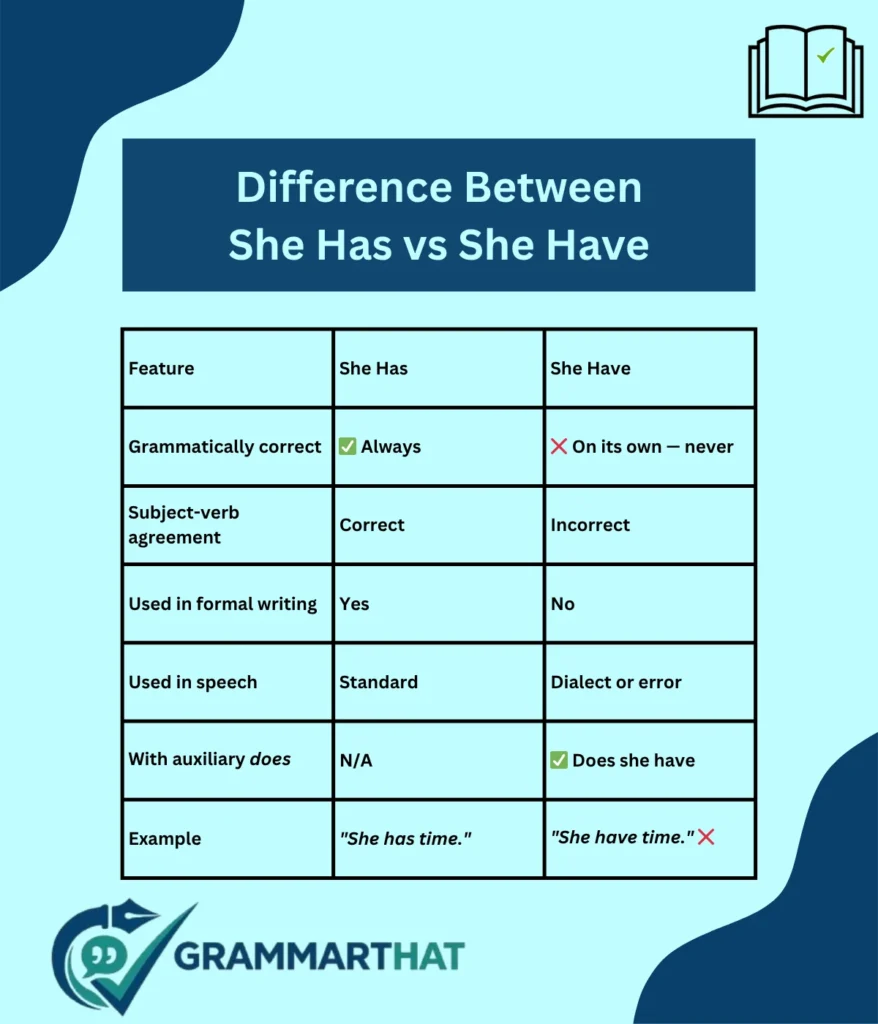
Subject-Verb Agreement Is the Rule
The entire distinction comes down to one grammar rule — subject-verb agreement. The verb must match its subject in person and number.
Have is the base form. Has is the third-person singular present tense form. When the subject is she — always use has.
Why People Write “She Have”
- Speakers carry over the pattern from “I have” or “they have”
- Some regional dialects use have for all persons
- Fast or informal speech blurs the distinction
In standard written English — she has is always the correct form.
When to Use She Has vs She Have
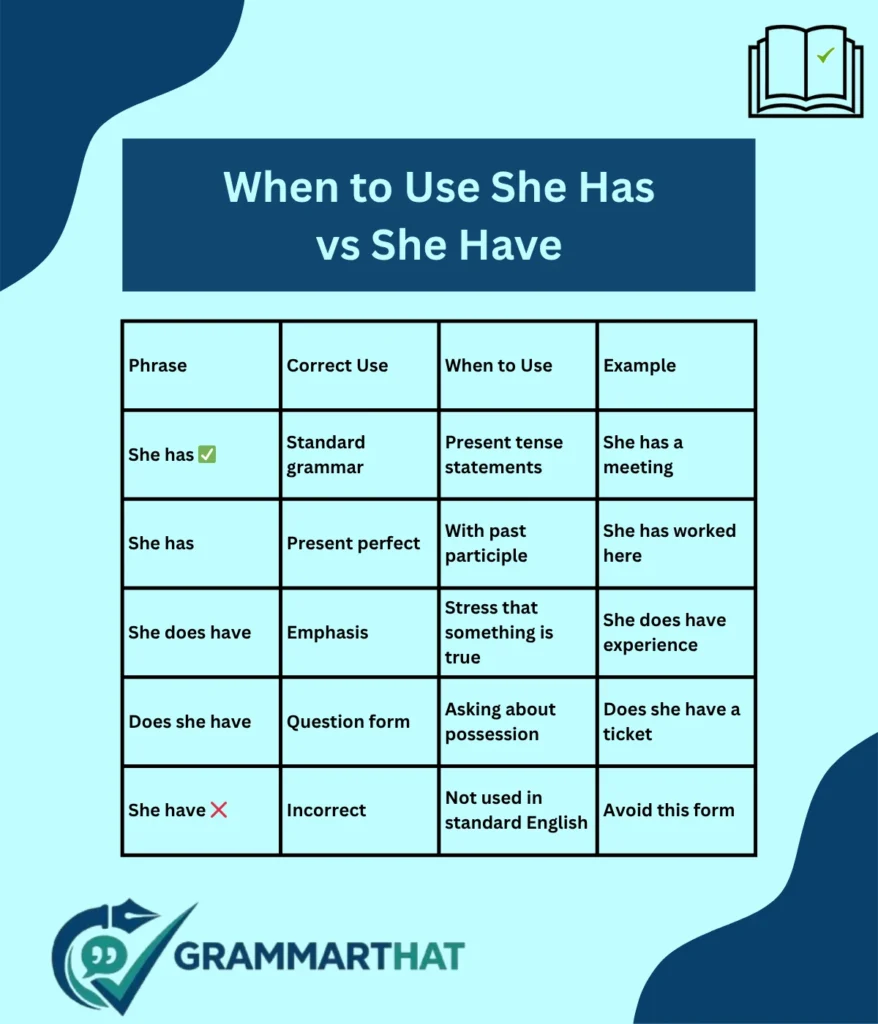
Always Use “She Has” When:
- Making any present tense statement with she as the subject
- Using the present perfect tense (she has + past participle)
- Describing possession, characteristics, or states
- Writing in any formal or informal context
Examples:
- “She has an appointment at 3 PM.”
- “She has worked here for five years.”
Use “Does Have” When:
- Adding emphasis to a statement
- Forming a question with do/does
- The auxiliary does is already present in the sentence
Examples:
- “She does have the qualifications.”
- “Does she have a reservation?”
Common Mistakes to Avoid
Memory trick:
- She, he, it → always has — think of the “s” connection: she ends in e, and has ends in s — the s in has matches the third-person singular
- Does she have → when does appears, the main verb drops back to base form — always have, never has
FAQs — She Has or She Have
Is it correct to say she has or she have?
“She has” is always correct in standard English. “She have” on its own is grammatically incorrect. The only time have appears with she is in structures like “does she have” or “she does have.”
When did she have or has?
In past tense questions, use “did she have” — not “did she has.” When did is the auxiliary verb, the main verb returns to its base form: “Did she have enough time?” ✅
Does she have or has a boyfriend?
“Does she have a boyfriend?” is correct. When does is the auxiliary verb in a question, the main verb must be the base form have — not has. Never say “Does she has.” ❌
Is it correct to say she has a dog?
Yes — “She has a dog” is completely correct and follows standard subject-verb agreement rules. Has is the proper third-person singular present tense form of have.
Conclusion
The rule is simple and consistent. “She has” is always correct when she is the subject of a present tense sentence. “She have” on its own is a subject-verb agreement error — never appropriate in standard written or spoken English.
The only exception is when an auxiliary verb like does appears — then the main verb reverts to its base form and “does she have” becomes correct. Remember that one exception, master the core rule, and your grammar will always be sharp and accurate.

Hi, I’m the voice behind GrammarThat.com. I make grammar simple and easy to understand, from basic rules to advanced writing tips. Clear explanations. Practical examples. No confusion.