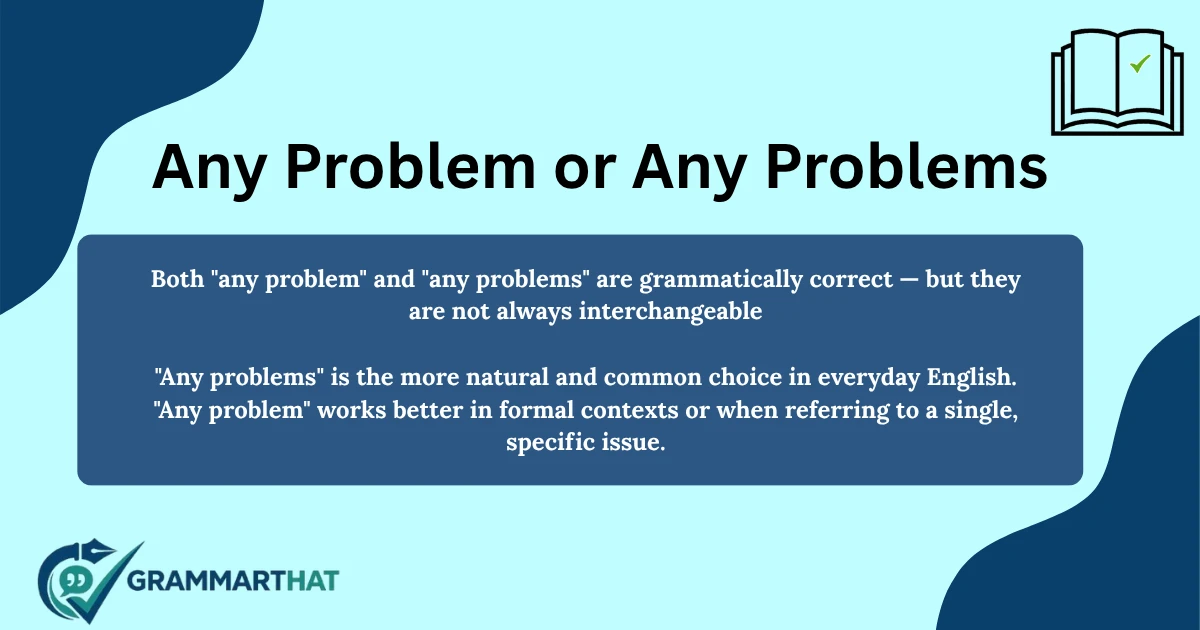
Both “any problem” and “any problems” are grammatically correct — but they are not always interchangeable.
“Any problems” is the more natural and common choice in everyday English. “Any problem” works better in formal contexts or when referring to a single, specific issue.
This guide breaks down the difference between any problem and any problems, when to use each form, and which one sounds more natural in different situations.
What Does “Any Problems” Mean?
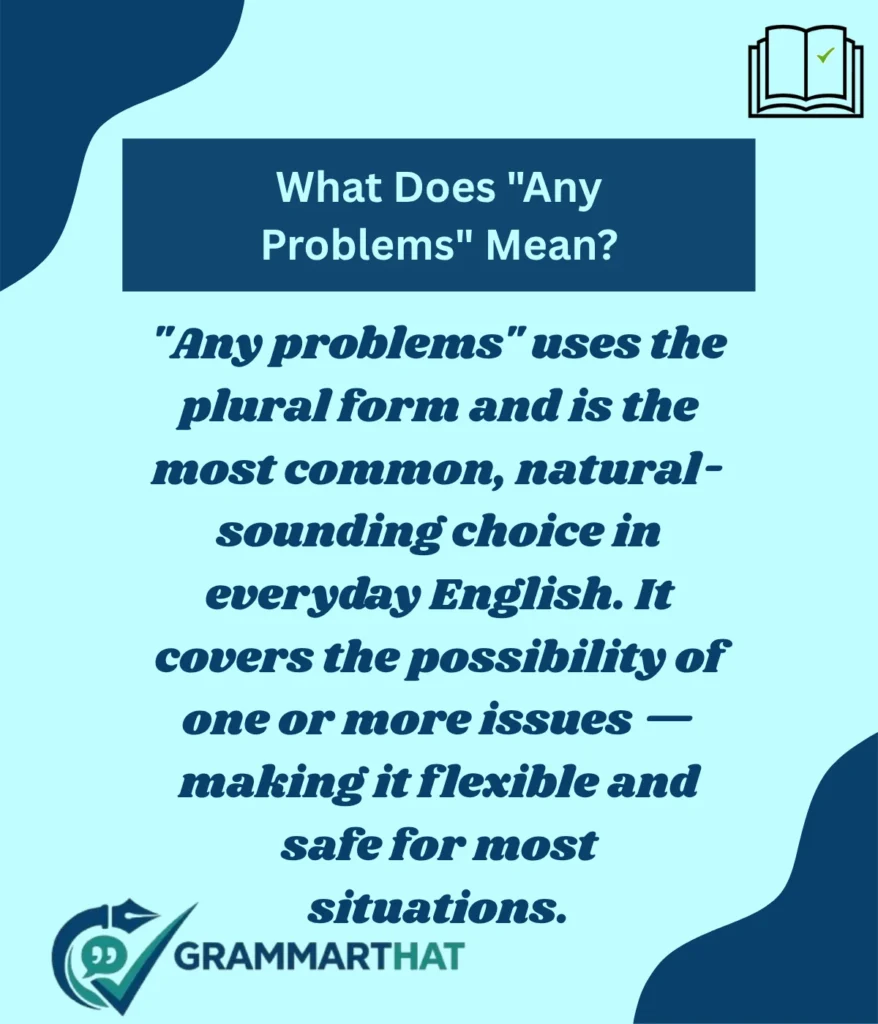
“Any problems” uses the plural form and is the most common, natural-sounding choice in everyday English. It covers the possibility of one or more issues — making it flexible and safe for most situations.
It is the go-to phrase in casual conversation, customer service, workplace communication, and informal writing.
Example: “Let me know if you have any problems with the new software.”
This phrasing feels open and natural. It invites the other person to mention anything — big or small — that might be causing difficulty.
Common uses:
- Checking in after completing a task
- Customer service and support interactions
- Casual workplace communication
- General inquiries about potential issues
Natural Examples in Context
What Does “Any Problem” Mean?
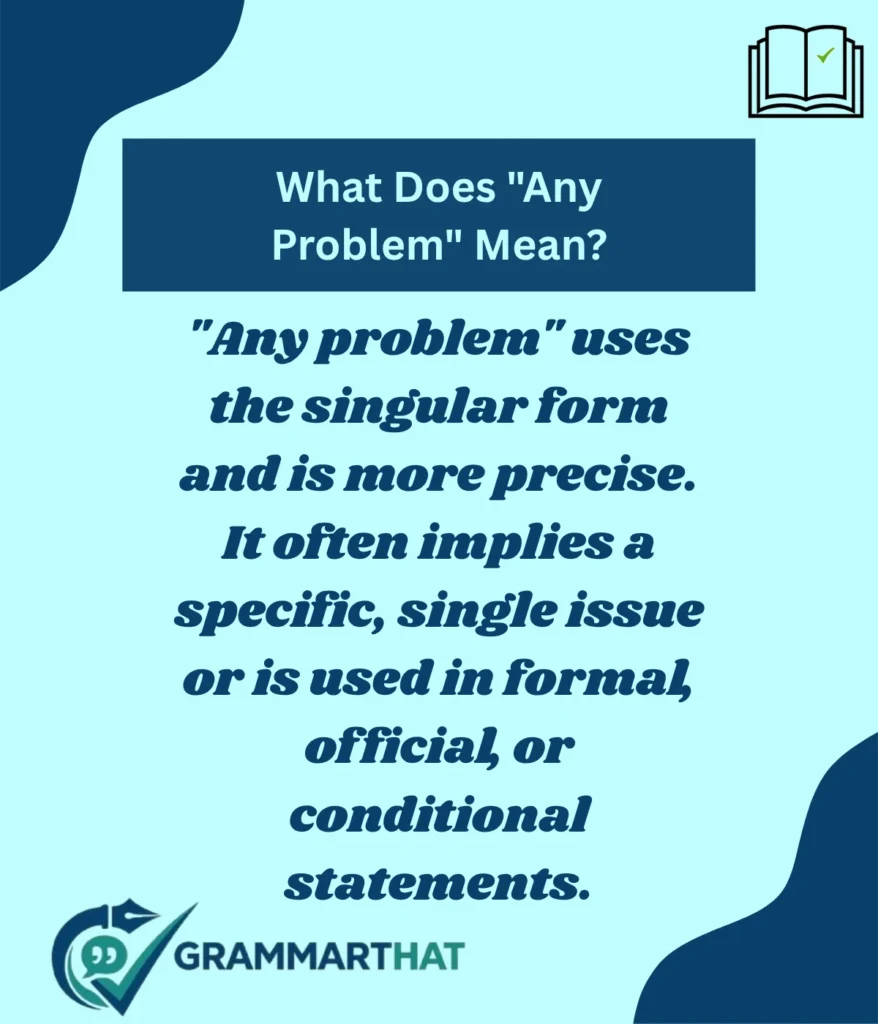
“Any problem” uses the singular form and is more precise. It often implies a specific, single issue or is used in formal, official, or conditional statements.
It sounds slightly more formal and deliberate than the plural form — which is why it appears more often in professional documents, legal language, and formal correspondence.
Example: “If you encounter any problem during the process, please contact support immediately.”
Here the singular form suggests a specific type of issue — not a general range of possible problems. It feels more focused and measured.
Common uses:
- Formal documents and official communication
- Legal or contractual language
- Specific conditional statements
- When referring to a defined, single type of issue
Examples in Context
The Key Difference Between Any Problem or Any Problems
Singular vs Plural — And Why It Matters
In most languages, singular and plural are strictly separate. In English, “any” blurs this line — it can work with both singular and plural nouns depending on the intended nuance.
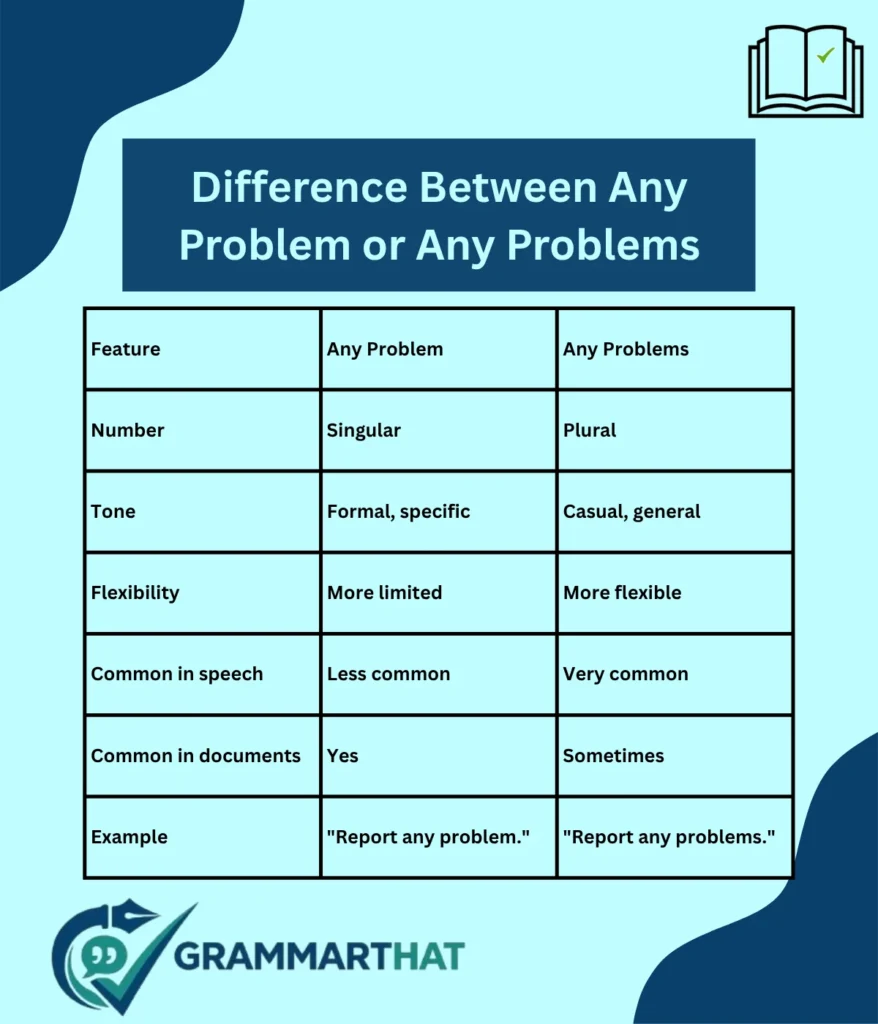
“Any problems” is broader — it covers the full range of possible issues without limiting to one. “Any problem” is narrower — it points to a single, defined issue or uses formal construction.
“Any Problem” or “Any Problems”
The Grammar Behind “Any”
“Any” is a special determiner in English — it works with both countable singular and plural nouns depending on meaning:
- “Any problem” — singular countable noun — specific or formal
- “Any problems” — plural countable noun — general and open
- “Any water” — uncountable noun — no singular/plural distinction
Both are grammatically valid. The choice comes down to register and context — not strict grammar rules.
“Is there any problem?” or “Are there any problems?”
The verb must agree with the noun
Both are correct — but “Are there any problems?” sounds more natural in everyday conversation.
When to Use Any Problem or Any Problems
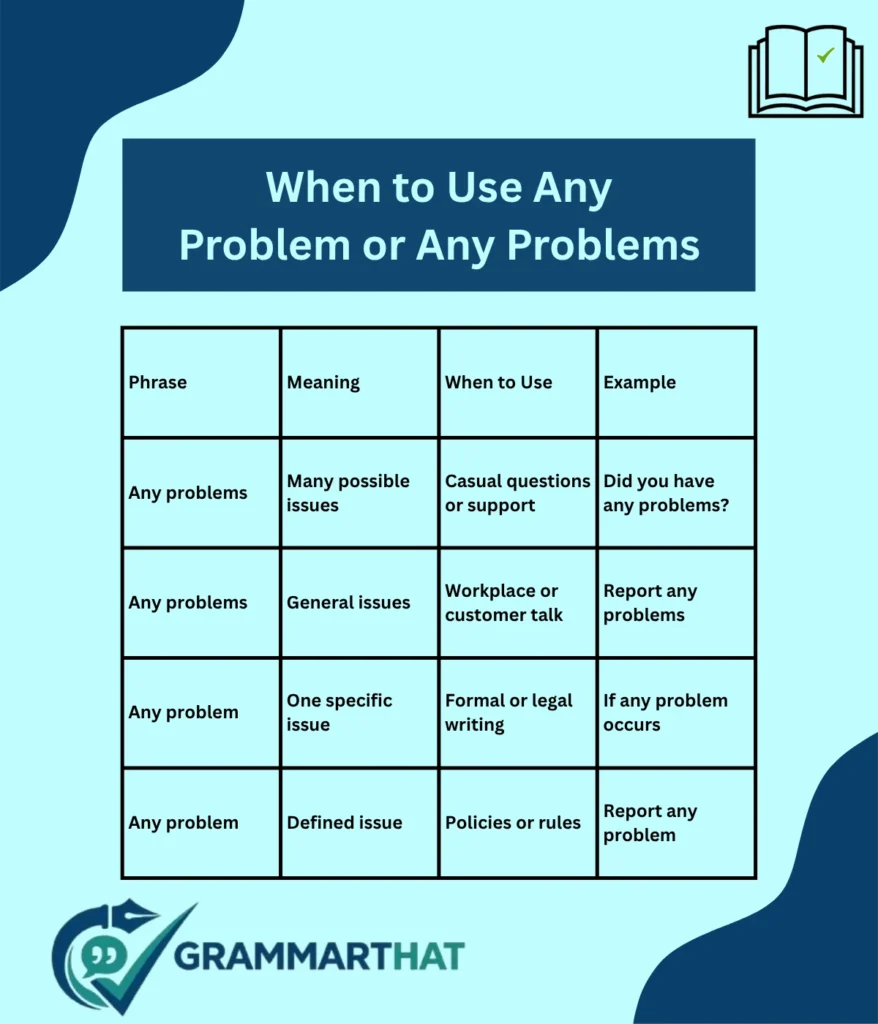
Use “Any Problems” When:
- Asking a general, open question about possible issues
- Communicating in a casual, conversational tone
- Covering multiple potential issues rather than one specific type
- Writing customer-facing or workplace communication
Examples:
- “Did you have any problems setting up your account?”
- “Feel free to reach out if you notice any problems.”
Use “Any Problem” When:
- Writing formal or official documents
- Making a specific conditional statement
- Referring to a defined, single type of issue
- Using legal, contractual, or policy language
Examples:
- “Should any problem occur during transit, the carrier will be liable.”
- “If any problem is identified, it must be reported within 24 hours.”
Common Mistakes to Avoid
Memory trick:
- Any problems → think “anything and everything” → open, casual, general
- Any problem → think “a specific thing” → formal, focused, precise
- When in doubt in everyday writing — any problems is almost always the safer, more natural choice
FAQs — Any Problem or Any Problems
Is there any problem or are there any problems?
Both are correct but serve different purposes. “Is there any problem?” is singular and formal. “Are there any problems?” is plural and more natural in everyday conversation. Match the verb to the noun you choose.
Is any problem grammatically correct?
Yes — “any problem” is grammatically correct. It is commonly used in formal writing and conditional statements where a single, specific issue is implied.
How to face any problem?
This is a different use of “any problem” — meaning “any challenge” in general. In this context, “any problem” works naturally: “Stay calm when facing any problem and break it into smaller steps.”
Is it correct to say “is there a problem”?
Yes — “Is there a problem?” is completely correct and very common in everyday speech. It uses the indefinite article a instead of any — both are natural ways to ask about a single potential issue.
Conclusion
Both “any problem” and “any problems” are correct — but they suit different situations. “Any problems” is the natural, flexible choice for casual conversation and everyday writing. “Any problem” is the more precise and formal option for official documents and conditional statements.
When in doubt — especially in everyday communication — reach for “any problems.” It sounds more natural, covers more ground, and works perfectly in almost every situation you will encounter.

Hi, I’m the voice behind GrammarThat.com. I make grammar simple and easy to understand, from basic rules to advanced writing tips. Clear explanations. Practical examples. No confusion.