Key Takeaways
- Hard water contains dissolved minerals, primarily calcium and magnesium, that can create scale and reduce soap performance.
- Water testing helps determine whether a softener, conditioner, or another treatment approach is appropriate.
- Atlantic Blue Water Services provides installation, repair, maintenance, replacement, and salt delivery for residential and commercial properties.
- A system that leaks, regenerates improperly, uses excessive salt, or no longer produces soft water may need professional service.
- Correct sizing, programming, and routine maintenance can support more efficient operation.
White scale on faucets, cloudy dishes, stubborn soap residue, and a water softener that no longer seems to work can all point to a hard-water problem. water softener installation & repair in Maryland from Atlantic Blue Water Services provides homeowners and businesses with a practical path from water testing through installation, repair, maintenance, replacement, and salt delivery.
Rather than assuming every property needs the same equipment, the right approach starts with the actual water conditions, the water source, and the amount of water the property uses. This is especially important for Maryland homes with private wells, changing household needs, or existing equipment that may be undersized or malfunctioning.
What Does Hard Water Mean for Maryland Properties?
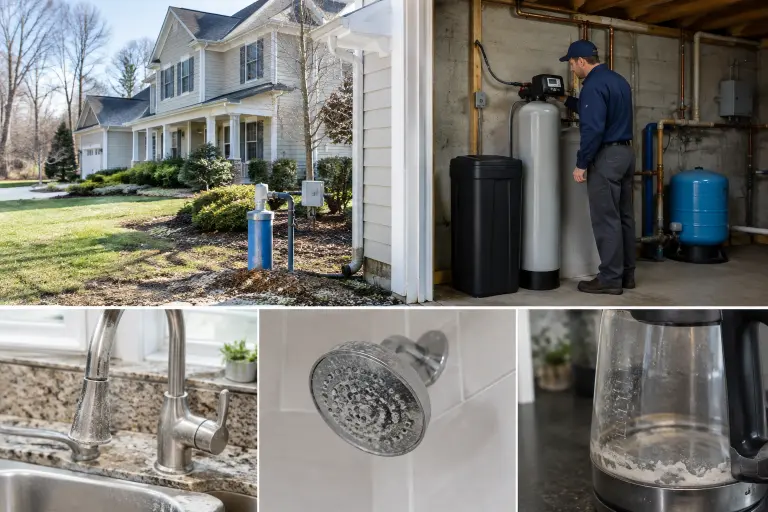
Hardness is commonly associated with dissolved calcium and magnesium. These minerals can make it more difficult for soap to lather and can leave white deposits after water evaporates on shower doors, sinks, fixtures, and dishware. The Maryland Geological Survey explains that hardness can also promote white scale, particularly where water is heated.
Water hardness is generally measured in milligrams per liter as calcium carbonate. According to the Maryland classification of water hardness, water from 0 to 60 mg/L is considered soft, 61 to 120 mg/L is moderately hard, 121 to 180 mg/L is hard, and more than 180 mg/L is very hard. One grain per gallon is approximately 17.1 mg/L. Conditions can vary by water source, well, utility system, and individual property, so a local test is more useful than a broad assumption about an entire county.
For homeowners and businesses seeking a complete water-treatment provider, Atlantic Blue Water Services serves Central Maryland and Southern Pennsylvania with water-softening and conditioning services for residential and commercial needs.
Signs It May Be Time for Water Softener Service
Hard-water symptoms are often easy to see, but they do not identify the exact cause on their own. A shower door may look clean after scrubbing, only for spots and mineral film to return quickly because untreated water continues to flow through the fixtures.
- White scale on faucets, shower doors, sinks, or plumbing fixtures.
- Cloudy glasses and spots on dishes after washing.
- Soap or shampoo that does not lather or rinse as expected.
- Dry-feeling skin or hair after bathing.
- Stiff laundry or recurring mineral buildup around appliances.
- A softener that is not regenerating, is consuming unusual amounts of salt, or is no longer delivering soft water.
- Leaks, error messages, unusual noises, or brine-tank problems.
A professional inspection can separate a hardness concern from equipment trouble, plumbing issues, or other water-quality conditions. Atlantic Blue Water Services offers a free basic water test and treatment evaluation to help customers begin with measured information.
How Water Testing Guides the Right Recommendation
A water-treatment consultation should assess more than visible scale. A technician can check whether the property uses public or well water, test hardness and other conditions, discuss demand, and review space, drainage, and plumbing access. Household size, business use, and peak demand help determine system capacity.
The U.S. Geological Survey notes that hardness varies by location and that scale buildup can restrict plumbing flow. Testing is especially useful for well-water customers, since hardness may accompany odor, acidity, or other treatment needs.
Installation, Repair, and Replacement Options
Water Softener Installation
Atlantic Blue Water Services installs softeners and conditioners for homes and businesses. System selection is based on water quality, treatment goals, demand, and site requirements. A traditional ion-exchange softener is designed to remove hardness minerals, while a broader conditioning solution may address additional concerns depending on the equipment and the water test results.
Water Softener Repair
Service may be needed when a system fails to regenerate, produces hard water, leaks, uses more salt than expected, or has trouble with its valve, controls, fittings, or brine tank. Repair can be the sensible choice when the core system remains dependable, and the issue is limited to a serviceable component.
Water Softener Replacement
Replacement may deserve consideration when repairs become frequent, the equipment no longer meets current demand, controls are outdated, or scale continues despite regular service. Atlantic Blue Water Services can compare repair and replacement options instead of treating replacement as the automatic answer.
Systems and Services for Different Water Needs
Equipment includes TotalCare Well Water Conditioners for hardness, odor, or acidity; Twin Systems for high-demand properties; CareSoft Elite softeners with configurable controls; Elite RC conditioners with softening and carbon filtration; and CareSoft household softeners. Suitability depends on current specifications, water results, and property needs.
Choose scheduled or one-time salt delivery. Technicians supply the right salt and refill the brine tank, avoiding heavy lifting and unexpected shortages.
Maintenance and Efficient Operation
Maintenance can include checking salt levels, reviewing regeneration settings, inspecting operation, and looking for leaks, buildup, or worn components. The U.S. Environmental Protection Agency recommends programming regeneration based on incoming hardness or water flow when possible, rather than regenerating unnecessarily on a fixed schedule. Correct sizing and maintenance can help reduce avoidable water and salt use.
What to Do Before Scheduling Service
- Write down symptoms such as scale, spots, odors, leaks, or poor regeneration.
- Identify whether the property uses municipal water or a private well.
- Record the system’s age, brand, and recent service history.
- Estimate household occupancy or commercial water demand.
- Gather any available water-quality reports.
- Schedule a water test and treatment evaluation.
Frequently Asked Questions
Is hard water dangerous to drink?
Hardness itself is generally considered an aesthetic and operational concern rather than a health hazard. However, a water test may identify separate water-quality conditions that need additional attention.
How often should a water softener be serviced?
Service needs depend on the system’s age, water quality, salt use, water demand, and performance. A professional can recommend maintenance based on the specific property and equipment.
Can Atlantic Blue Water Services help with well water?
Yes. Well-water conditioning options can be evaluated based on concerns about hardness, odor, acidity, and related treatment goals. The recommended solution should follow water testing and a property-specific assessment.
Also Read
- : https://grammarthat.com/how-technology-is-changing-the-way-adults-discover-products-and-follow-cricket/
https://grammarthat.com/which-cyber-security-course-is-best-for-working-professionals-in-bengaluru/
https://grammarthat.com/how-advanced-maths-olympiad-books-develop-strategic-thinking/