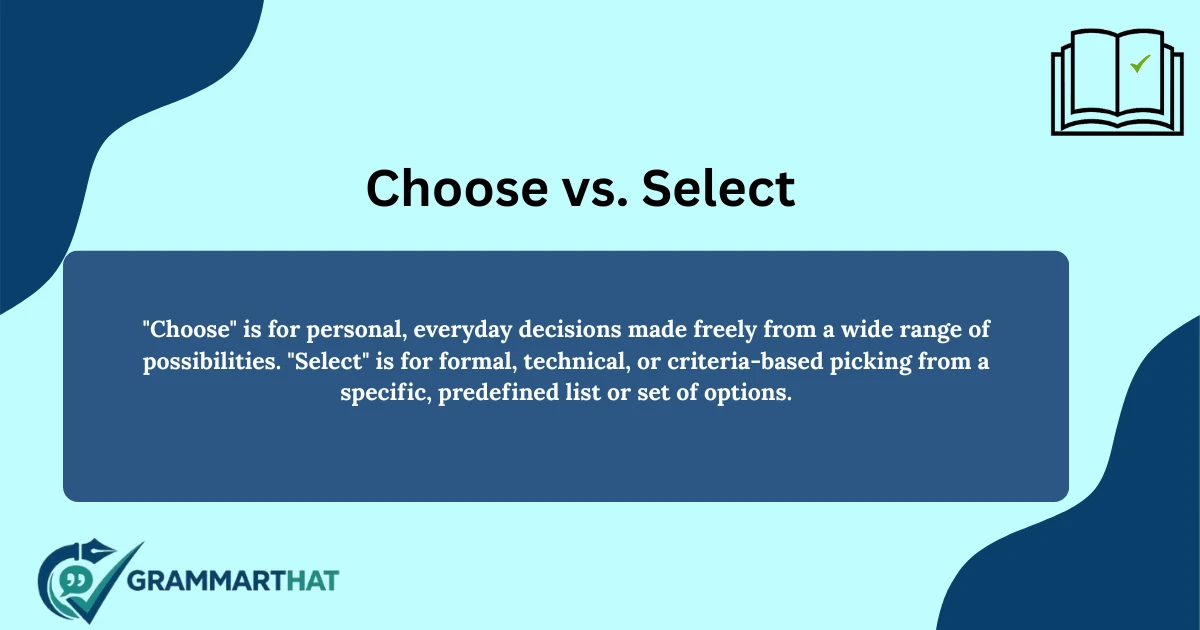
Choose is the everyday word for making personal decisions, while select sounds more formal and deliberate. Both mean to pick something, but select often implies choosing from specific options or criteria.
Both mean to pick something. But the context, formality, and scope of each word are fundamentally different — and using the wrong one in the wrong place produces writing that feels either too stiff or too casual for its purpose.
What Does “Choose” Mean?

“Choose” is a verb describing the act of making a personal decision or preference — freely, broadly, and often based on individual desire, instinct, or values rather than a fixed set of criteria.
Example: “She chose to leave the city and start over somewhere quieter.”
“Choose” implies freedom. There is no predefined list. No formal criteria. The person making the decision has broad latitude — and the choice reflects something personal about who they are or what they want.
Common uses of “choose” in everyday decisions:
- “I could not choose between the two offers — both had real appeal.”
- “She chose her words carefully before responding.”
Common uses of “choose” in life decisions:
- “They chose to adopt rather than pursue other options.”
- “She chose medicine because she wanted work that meant something.”
“Choose” in Different Everyday Contexts
In every case, “choose” describes a decision made with personal agency — from a wide, often unlimited set of possibilities.
What Does “Select” Mean?

“Select” is a verb describing the act of carefully picking from a specific, predefined list or set — often based on precise criteria, formal requirements, or a deliberate evaluation process.
Example: “The committee will select three finalists from the pool of eighty applicants.”
“Select” implies structure. There is a defined pool of options. There are often criteria or requirements. The person selecting is evaluating against a standard — not simply following preference.
Common uses of “select” in technical and system contexts:
- “Select your preferred language from the drop-down menu.”
- “Select all files and click delete to remove them from the folder.”
Common uses of “select” in formal and professional contexts:
- “The panel will select the winning proposal by the end of the quarter.”
- “Candidates are selected based on experience, qualifications, and cultural fit.”
“Select” in Different Formal and Technical Contexts
In every case, “select” describes a deliberate, often criteria-driven pick from a bounded set of options — with a level of formality and precision that “choose” does not carry.
Choose vs. Select — Key Differences
Choose vs Select — The Core Distinction at a Glance
Using “Select” in Different Instruction Types
Using “choose” in UI instructions — “Choose your country from the list” — is not technically wrong, but it reads as informal and is inconsistent with established technical writing standards across the industry.
Everyday Language — Where “Choose” Feels Most Natural
When a person is making a personal decision — what to eat, where to live, who to trust, how to spend their time — “choose” captures the personal agency and freedom of that decision in a way that “select” cannot.
“She selected to study medicine” — technically correct, but sounds clinical and cold.
“She chose to study medicine” — natural, human, and warm.
Side-by-Side Examples: Choose vs. Select in Real Sentences
“Choose” in Personal, Narrative, and Everyday Writing
- “He chose the apartment with the worst view because the rent was the only one he could afford.”
- “She had always chosen kindness — even when it cost her something.
“Select” in Technical, Formal, and Professional Writing
- “Select your billing address from the options saved to your account.”
- “The admissions committee selected forty students from a pool of nearly four thousand applicants.”
Same Situation, Two Words — How the Tone Completely Shifts
Personal decision — natural with “choose”: “She chose the red dress because it made her feel like herself.”
Personal decision — stiff with “select”: ~~”She selected the red dress because it made her feel like herself.”~~ — Technically correct, but clinical and oddly formal for an emotional personal moment.
Technical instruction — correct with “select”: “Select the red colour option from the product customisation menu.”
Technical instruction — informal with “choose”: “Choose the red colour option from the product customisation menu.” — Understood, but inconsistent with standard technical writing convention.
The Difference Between “Choice” and “Selection”
The noun forms follow the same distinction — and are worth addressing separately because they appear frequently in writing where the verb forms have already been covered.
“Choice” describes a personal decision made freely — often with emotional weight or broad options: “It was her choice to leave — no one pressured her.”
“Selection” describes a group of options that has been curated, filtered, or assembled — or the formal act of picking from that group: “The restaurant offers a seasonal selection of locally sourced dishes.”
Choice vs Selection — Core Distinction
Common Mistakes Writers Make with “Choose” and “Select”
Read More:
Frequently Asked Questions
What is the difference between choosing and selecting?
Choosing is making a personal, free decision from a broad or unlimited range of options — based on preference, instinct, or values. Selecting is picking deliberately from a specific, predefined list or set of options. Choosing is personal and open. Selecting is structured and purposeful.
Does “select” mean “choose”?
In general terms, yes — both mean to pick something. But “select” implies a more formal, deliberate, criteria-based process with a defined pool of options. “Choose” implies personal freedom and a broader range of possibilities.
What is the difference between “choice” and “selection”?
A choice is a personal decision made freely — often carrying emotional significance or reflecting individual values. A selection is either a curated, filtered group of options or the formal act of picking from a defined set.
When should I use “choose”?
Use “choose” whenever the decision is personal, broad, or based on individual preference rather than formal criteria. Use it in everyday conversation, personal writing, fiction, and any context where the human dimension of a decision matters.
Conclusion
“Choose” and “select” both mean to pick something — but they belong in different contexts, carry different levels of formality, and signal different things to your reader. Use “choose” when the decision is personal, free, and human. Use “select” when the decision is formal, technical, or drawn from a defined and limited set of options.

Hi, I’m the voice behind GrammarThat.com. I make grammar simple and easy to understand, from basic rules to advanced writing tips. Clear explanations. Practical examples. No confusion.