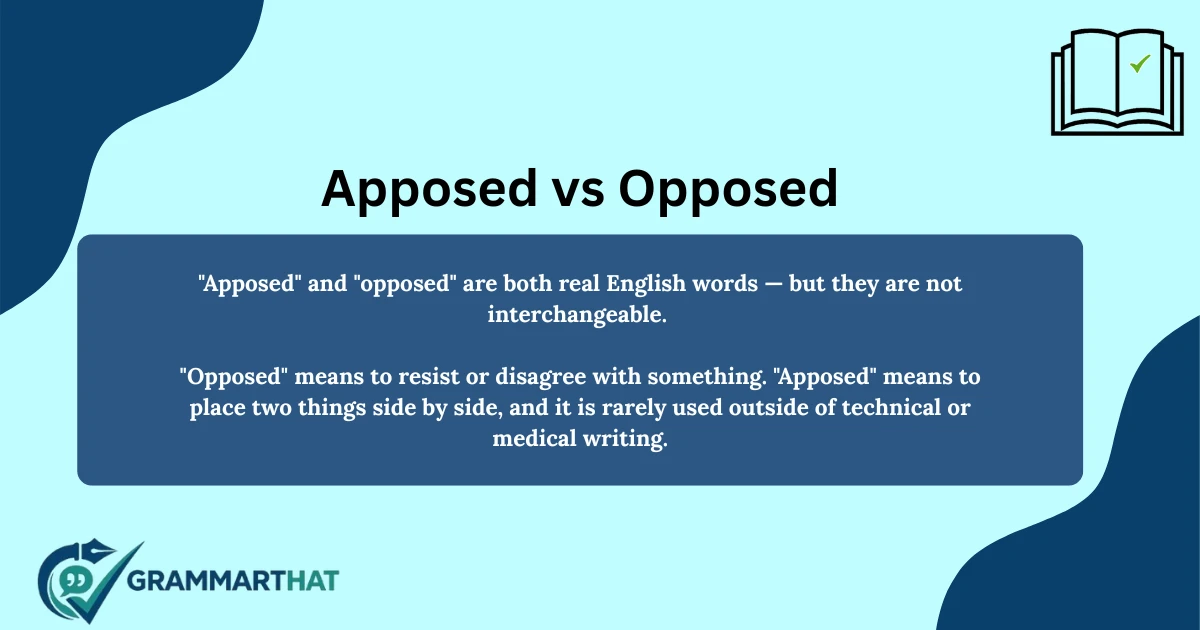
“Apposed” and “opposed” are both real English words — but they are not interchangeable.
“Opposed” means to resist, disagree with, or be against something, while “apposed” means placed side by side and is used mainly in technical, scientific, or medical contexts. One word expresses conflict. The other expresses position.
In nearly every everyday situation, the word you need is “opposed.” Knowing the difference prevents a confusing and uncommon error.
What Does “Opposed” Mean?
“Opposed” is the past tense of the verb oppose. It means to resist, disagree with, or act against something or someone.
It is one of the most common and widely used words in English — appearing in politics, conversation, debate, and everyday writing.
Examples of “Opposed” in a Sentence
- ✅ “The community council plans to oppose the new development.”
- ✅ “She was firmly opposed to the proposed changes.”
- ✅ “Many residents opposed the construction of the highway.”
- ✅ “He opposed the bill during the Senate vote.”
“Opposed” fits naturally in any context involving disagreement, conflict, resistance, or taking a stance against something.
What Does “Apposed” Mean?
“Apposed” is the past tense of the verb appose. It means to place two things side by side or adjacent to each other — with their edges touching or close together.
This word is extremely rare in everyday English. It appears almost exclusively in medical writing, anatomy, biology, and technical scientific contexts.
Examples of “Apposed” in a Sentence
- ✅ “The surgeon began to appose the edges of the wound.”
- ✅ “The tissue layers were carefully apposed during the procedure.”
- ✅ “The two surfaces were apposed to allow proper healing.”
Outside of clinical or scientific writing, “apposed” almost never appears. If you have never heard this word before, that is completely normal — most native English speakers have not either.
Apposed vs Opposed — Side-by-Side Comparison
Why Do People Confuse Apposed and Opposed?
The confusion is almost always a spelling error — not a vocabulary mistake. “Apposed” and “opposed” look nearly identical. One missing letter creates an entirely different word.
Most people who write “apposed” actually mean “opposed.” They simply mistype or misspell the word without realizing it. Spellcheckers do not always catch this because “apposed” is a real, valid English word.
The Key Difference in Spelling
- Opposed → starts with op- (from Latin opponere — to place against)
- Apposed → starts with ap- (from Latin apponere — to place near)
Both come from the Latin root ponere meaning to place — but the prefix changes the meaning entirely. Op- means against. Ap- means near or beside.
How to Use “As Opposed To”
One of the most common phrases using “opposed” is “as opposed to.” It means rather than or in contrast to.
- ✅ “She prefers coffee, as opposed to tea.”
- ✅ “The report focuses on prevention, as opposed to treatment.”
- ✅ “We chose quality as opposed to quantity.”
This phrase is extremely common in both formal writing and casual conversation. It is one of the most practical uses of “opposed” in everyday English.
Common Mistakes With Apposed and Opposed
When to Use Each Word — Simple Rule
Are you writing about resistance, disagreement, or being against something? Use “opposed.”
Are you writing about placing two physical surfaces or objects side by side? Use “apposed” — but only if you are in a medical or scientific context.
If you are not a medical or scientific writer, the word you want is almost certainly “opposed.” Merriam-Webster confirms that appose is a technical term with very limited everyday application.
FAQs — Apposed vs Opposed
What is the difference between “apposed” and “opposed”?
“Opposed” means to resist or disagree with something. “Apposed” means to place two things side by side. They look similar but have completely different meanings.
Is “apposed” a real word?
Yes, “apposed” is a real English word — but it is extremely rare. It is used primarily in medical and scientific writing to describe surfaces or tissue placed adjacent to each other.
Which word is correct — “I am apposed” or “I am opposed”?
“I am opposed” is correct when expressing disagreement or resistance. “I am apposed” is not a standard English expression in everyday use.
What does “as opposed to” mean?
“As opposed to” means rather than or in contrast to. It is a very common phrase in both formal and informal English — for example, “quality as opposed to quantity.”
Why does spellcheck not catch “apposed” when I mean “opposed”?
Because “apposed” is a legitimate English word — so spellcheck has no reason to flag it. Always proofread carefully when using words that look similar but carry different meanings.
Conclusion
“Opposed” is the word you need in everyday English. It means to resist, disagree with, or act against something — and it fits virtually every common situation where these two words are confused.
“Apposed” is a rare technical term used in medical and scientific writing to describe things placed side by side. Unless you work in a clinical or scientific field, you will almost never need it. When in doubt, “opposed” is the right choice.

Hi, I’m the voice behind GrammarThat.com. I make grammar simple and easy to understand, from basic rules to advanced writing tips. Clear explanations. Practical examples. No confusion.