Savor and saver are homophones — they sound identical but mean completely different things.
Savor is a verb (and sometimes a noun) meaning to deeply enjoy or relish something, while saver is a noun referring to a person or thing that saves, preserves, or sets aside resources. One word belongs with pleasure and experience. The other belongs with money and efficiency.
This guide breaks down the difference between savor and saver, what each means, and how to use both correctly every time.
What Does Savor Mean?
Savor (spelled savour in British English) functions primarily as a verb — and occasionally as a noun — relating to the deep, mindful enjoyment of something through taste, smell, or experience.
It comes from the Old French saveur — meaning “flavor, taste, or smell” — which itself comes from the Latin sapor, meaning “taste.”
Savor as a Verb
As a verb, savor means to enjoy something fully, slowly, and mindfully — to relish every aspect of an experience rather than rushing through it.
Example: “Take a moment to savor your morning coffee before the day begins.”
Common Verb Uses of “Savor”
Savor as a Noun
As a noun, savor refers to a distinctive quality of taste, smell, or character — a quality that makes something pleasurable or distinctive.
Example: “The dish had a rich savor of herbs and slow-cooked meat.”
Related Word Forms: Savor
Synonyms (verb): relish, enjoy, appreciate, delight in, treasure, revel in Synonyms (noun): flavor, taste, aroma, quality
What Does Saver Mean?
Saver is a noun referring to a person who saves — particularly money — or a thing that conserves, preserves, or reduces the consumption of a resource.
It is simply the agent noun of the verb save — formed by adding -er to indicate the one who performs the action.
Saver — A Person Who Saves
The most common meaning — a person who regularly sets aside money, builds financial reserves, or avoids unnecessary spending.
Example: “Being a disciplined saver is one of the most important financial habits you can build.”
Common uses:
- “She has always been a careful saver — never spending more than she earns.”
- “First-time home buyers are often encouraged to become consistent savers years before purchasing.”
- “He is a natural saver — he finds it difficult to spend money even when he has it.”
Saver — A Thing That Conserves Resources
Saver — Discounted Programs and Products
In commercial contexts, saver frequently appears in product and service names referring to economical or budget-friendly options:
- “Book on our Saver fare for the lowest available price.”
- “She clipped every coupon — a devoted saver in every sense of the word.”
Synonyms: economizer, thrifty person, conservationist (in resource contexts)
Savor vs Saver — The Key Differences
Savior vs Saver — An Additional Distinction
Saver and savior (or saviour in British English) are also frequently confused:
In religious contexts, Savior (or Saviour) specifically refers to Jesus Christ in Christian theology — a completely different meaning from the financial or resource-saving sense of saver.
When to Use Savor vs Saver
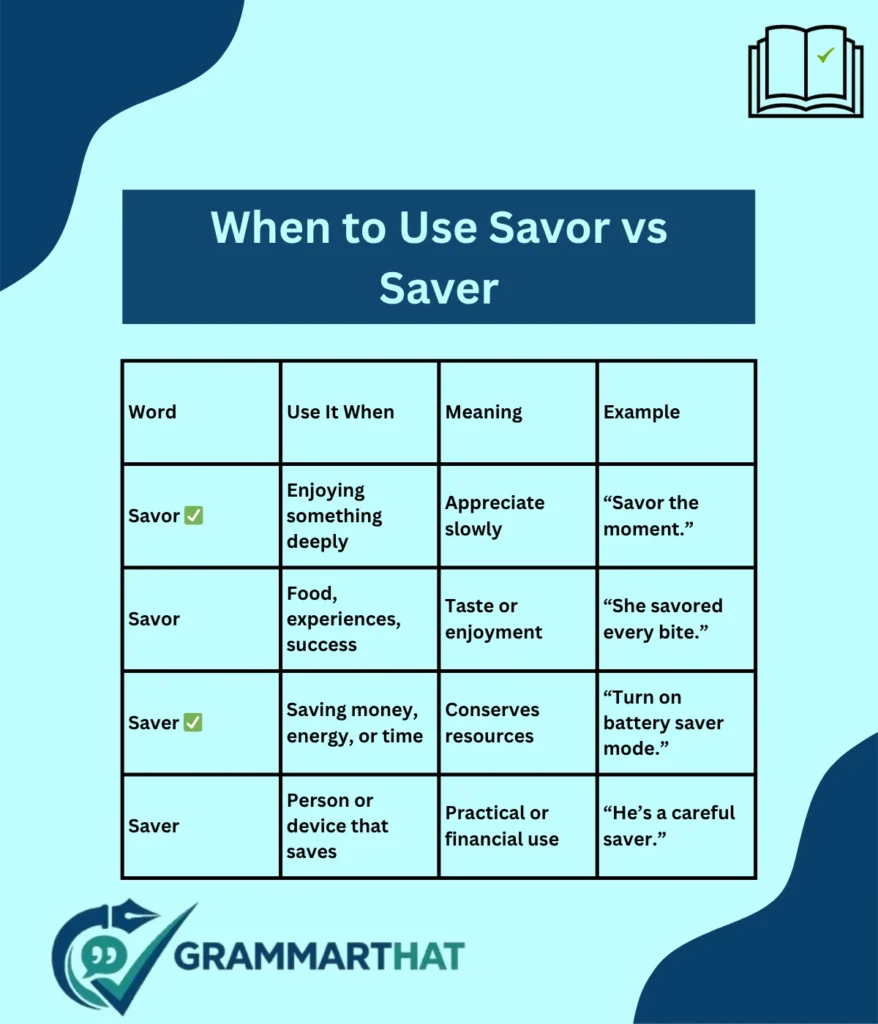
Use “Savor” When:
- Describing the act of enjoying something slowly and fully
- Talking about food, drink, experiences, or fleeting moments
- Encouraging someone to appreciate and not rush through something
- Using it as a noun for a distinctive taste or quality
Examples:
- “Savor every bite — this is a once-in-a-lifetime meal.”
- “She savored the success of years of hard work.”
Use “Saver” When:
- Describing a person who regularly saves money or resources
- Referring to a device, program, or feature that conserves energy or time
- Using compound words like screensaver, battery saver, life saver
- Discussing budget options in commercial or travel contexts
Examples:
- “My grandmother was a lifelong saver — she never wasted a thing.”
- “Enable the battery saver mode to extend your phone’s charge.”
Common Mistakes to Avoid
Memory tricks:
- Savor → think flavor → both contain the av sound → taste and pleasure
- Saver → think savings account → someone building financial reserves
- Ask: “Is this about enjoying something or preserving something?” Enjoying → savor. Preserving → saver.
FAQs — Savor vs Saver
What is the difference between savor and saver?
Savor is a verb meaning to enjoy something fully and mindfully — often related to food, experiences, or fleeting moments. Saver is a noun referring to a person who saves money or a device that conserves resources. They sound identical but serve completely different purposes.
What is the difference between saviour and saver?
Saviour (or savior) refers to someone who rescues or delivers others from harm or danger — with strong religious connotations in Christian theology. Saver refers to someone who saves money or conserves resources — a financial or practical term with no rescue connotation.
What does savor mean?
Savor means to enjoy something deeply, slowly, and mindfully — to relish every aspect of a taste, smell, or experience. Example: “She savored the quiet evening before the busy week ahead.” As a noun, it refers to a distinctive quality of taste or character.
What is the opposite of savor?
The opposite of savor depends on context. For the mindful enjoyment meaning — opposites include rush through, race past, overlook, or take for granted. For the taste meaning — opposites might include distaste, aversion, or disgust.
Conclusion
Savor and saver are perfect homophones — same sound, completely different meanings and parts of speech. Savor invites you to slow down, engage your senses, and fully appreciate an experience or taste. Saver describes the person building financial security or the technology extending your battery life.
One word lives in the world of pleasure and mindfulness. The other lives in the world of prudence and conservation. Keep those two worlds separate in your mind and you will always choose the right word with complete confidence.

Hi, I’m the voice behind GrammarThat.com. I make grammar simple and easy to understand, from basic rules to advanced writing tips. Clear explanations. Practical examples. No confusion.