
Continuous is the only correct spelling. Continous — missing the u — is always a misspelling.
It does not exist in any dictionary and will be flagged as an error by every spell-checker. This guide explains what continuous means, how to use it correctly, and how it differs from the commonly confused word continual.
What Does Continuous Mean?
Continuous is an adjective meaning something that goes on without interruption, pause, or break — in time, space, or sequence. When something is continuous, it flows uninterrupted from start to finish with no gaps.
It comes from the Latin continuus — meaning “hanging together” or “unbroken.”
Example: “The continuous hum of the refrigerator eventually gave me a headache.” (= The hum never stopped — it ran without interruption.)
Common uses of continuous:
Related word forms:
What Is “Continous”?
Continous is simply a misspelling of continuous. It is missing the letter u between the n and the o — a common typographical error caused by fingers moving too quickly across the keyboard.
There is no context in standard English where continous is correct. If you type it, autocorrect or a spell-checker will flag it immediately.
The correct spelling always has the u:
- ❌ Continous
- ✅ Contin-u-ous
Memory trick: Continuous contains the word continue — which also ends in -nue. If you can spell continue, you can spell continuous:
continue → continu → continuous ✅
Continuous vs Continual — An Important Distinction
One of the most common and meaningful confusions in English is between continuous and continual. These words look similar and both relate to repeated events — but they describe fundamentally different situations.
Continuous — No Interruption
Continuous means something happens without any pause or break. It is an unbroken, uninterrupted flow.
“The engine produced a continuous roar throughout the flight.” → The roar never stopped — not even for a moment.
Continual — Repeated With Pauses
Continual means something happens repeatedly but with interruptions between occurrences. It stops and starts — but keeps happening again and again.
“The construction caused continual disruption throughout the neighborhood.” → The disruption happened frequently — but not without any breaks.
Side-by-Side Comparison
A Quick Test
Ask: “Does this thing ever pause or stop?”
- No, it never stops → Continuous
- Yes, it stops and starts repeatedly → Continual
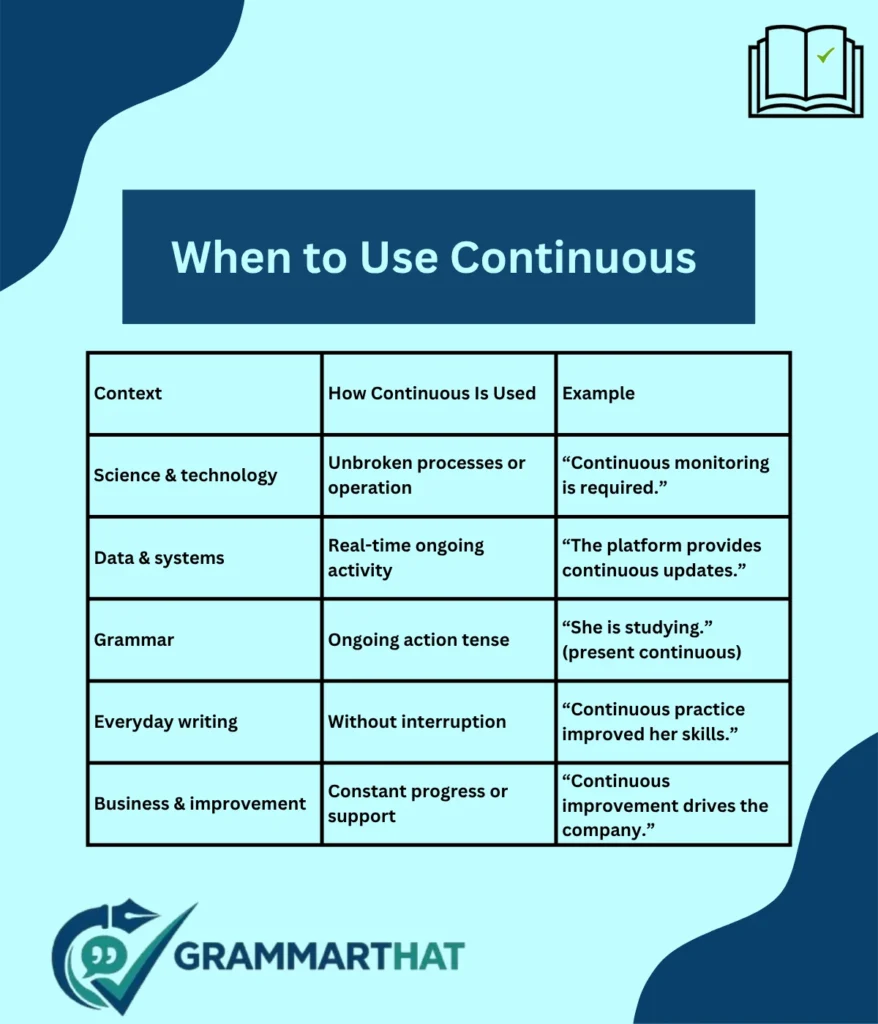
When to Use Continuous
In Science and Technology
Continuous is widely used in technical and scientific writing to describe unbroken processes, measurements, or operations:
- “Continuous monitoring of blood pressure is recommended post-surgery.”
- “The system provides continuous real-time data updates.”
- “A continuous spectrum contains all wavelengths without gaps.”
In Grammar — Continuous Tense
Continuous appears in grammar to describe tenses that show ongoing action at a specific moment:
- “She is running.” — present continuous
- “They were working.” — past continuous
- “He will be studying.” — future continuous
In Everyday Writing
- “Years of continuous practice made her an exceptional musician.”
- “The organization has provided continuous support for over two decades.”
- “Continuous improvement is central to the company’s philosophy.”
Common Mistakes to Avoid
FAQs — Continuous vs Continous
Which is correct — continuous or continous?
Continuous is always correct. Continous is always a misspelling — it is missing the u between n and o. No dictionary recognizes continous as a valid word.
What is the difference between continuous and continuously?
Continuous is an adjective that describes a noun: “a continuous stream.” Continuously is an adverb that describes how an action is performed: “The engine ran continuously.” One modifies nouns, the other modifies verbs and adjectives.
What is an example of continuously?
“Continuously” describes an action performed without interruption. Examples: “The factory operated continuously for 72 hours.” / “She worked continuously until the project was complete.” / “The river flows continuously to the sea.”
What is the difference between continuous and continual?
Continuous means no interruption whatsoever — an unbroken, nonstop action or state. Continual means something happens repeatedly but with pauses between occurrences. “Continuous rain” = it never stopped. “Continual rain” = it kept coming back throughout the period.
Conclusion
Continuous is the only correct spelling — always with the u. Continous without the u is simply a misspelling that no spell-checker will accept and no reader will expect.
Remember: continue → continuous — the u from continue carries right through into continuous. And when choosing between continuous and continual — ask whether the action has any pauses. No pauses at all → continuous. Stops and starts repeatedly → continual. Get those two distinctions right and your writing will always be precise and correct.

Hi, I’m the voice behind GrammarThat.com. I make grammar simple and easy to understand, from basic rules to advanced writing tips. Clear explanations. Practical examples. No confusion.