WDYM is one of the most direct and commonly used clarification abbreviations in everyday texting.
WDYM means “What Do You Mean?” — a quick, casual way of asking someone to explain themselves, provide more context, or clarify a statement that was confusing or unexpected.
It is fast, efficient, and universally understood across all platforms.
This guide breaks down everything about WDYM in text, how it is used, what tone it carries, and how to respond when someone sends it your way.
What Does WDYM Mean in Text?
WDYM stands for “What Do You Mean?” — a clarification request used when someone does not understand a previous message, finds it confusing, or wants more detail before responding. It is one of the most natural questions in conversation — compressed into four letters for digital speed.
Example: “We have to leave in 5 minutes.” “WDYM? I thought we were leaving at 8?” (= What do you mean — that does not match what I understood. Please clarify.)
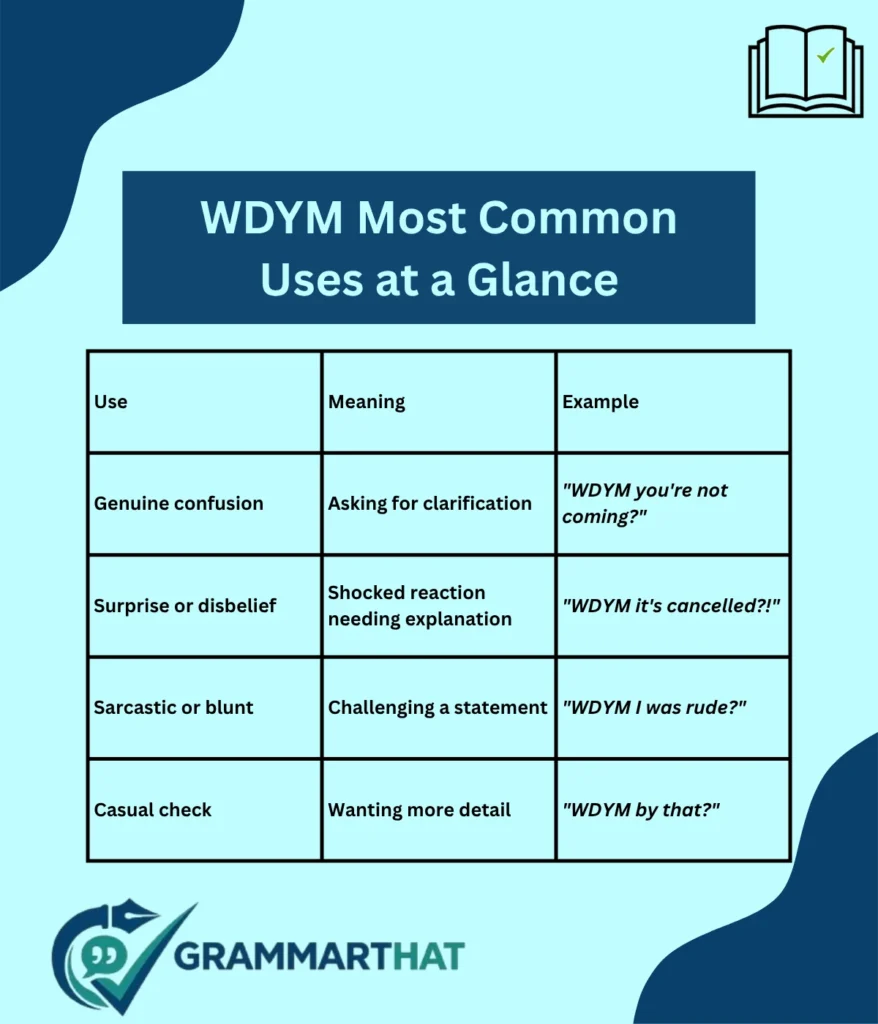
WDYM Most Common Uses at a Glance
How WDYM Is Used in Real Conversations
WDYM appears in a wide range of everyday situations — any time someone needs a message explained, expanded, or clarified before they can respond meaningfully.
WDYM for Genuine Confusion
The most common use — something was unclear and the person genuinely needs it explained:
- “WDYM you already left?” — surprised and confused by unexpected news
- “WDYM by that last message?” — asking for elaboration on something vague
- “WDYM the plan changed?” — seeking clarification about a shift in expectations
- “WDYM it’s not working?” — technical or practical follow-up question
WDYM for Surprise or Shock
When news is unexpected or hard to process — WDYM becomes a shocked reaction before the full response forms:
- “WDYM they broke up?!” — cannot believe what was just said
- “WDYM class was cancelled today?” — pleasantly or unpleasantly surprised
- “WDYM you got the job?!” — excited disbelief at good news
WDYM in a Sarcastic or Challenging Tone
WDYM can carry an edge when used in defensive or confrontational contexts — essentially saying “Excuse me? Explain that.”
- “WDYM I was being dramatic?” — defensive pushback
- “WDYM that was inappropriate?” — challenging someone’s characterization
- “WDYM you’re done with the project?” — skeptical follow-up
The same three letters carry completely different weight depending on context and punctuation. WDYM? is neutral and curious. WDYM?? is surprised or disbelieving. WDYM. (with a period) can feel blunt or challenging.
WDYM vs WYM — What Is the Difference?
WDYM and WYM mean the same thing — “What Do You Mean?” — but differ slightly in form:
Both are widely understood. WDYM is slightly more formal and complete. WYM is more casual and abbreviated. The choice usually comes down to personal texting style.
The Tone of WDYM — Neutral to Confrontational
WDYM is one of those abbreviations where punctuation and context dramatically change the emotional tone:
Reading the punctuation alongside the surrounding conversation always reveals the exact emotional tone the sender intended.
How to Respond to WDYM
When someone sends WDYM, they need clarification. The best response is simply to explain what you meant clearly and directly:
The worst response to WDYM is another vague or unclear message — that creates a loop of confusion. Always aim to resolve the ambiguity with a clear follow-up.
WDYM on Different Platforms
WDYM in Gen Z Communication
For Gen Z, WDYM is one of the most natural and instinctive clarification tools in digital conversation. Gen Z uses it to:
- Quickly flag confusion without writing out “I don’t understand what you’re saying”
- React to unexpected news before processing it fully
- Challenge statements in a direct but not overly aggressive way
- Ask for more context before committing to a response
It fits perfectly into the Gen Z texting style — fast, direct, emotionally expressive, and efficient.
When to Use WDYM — And When Not To
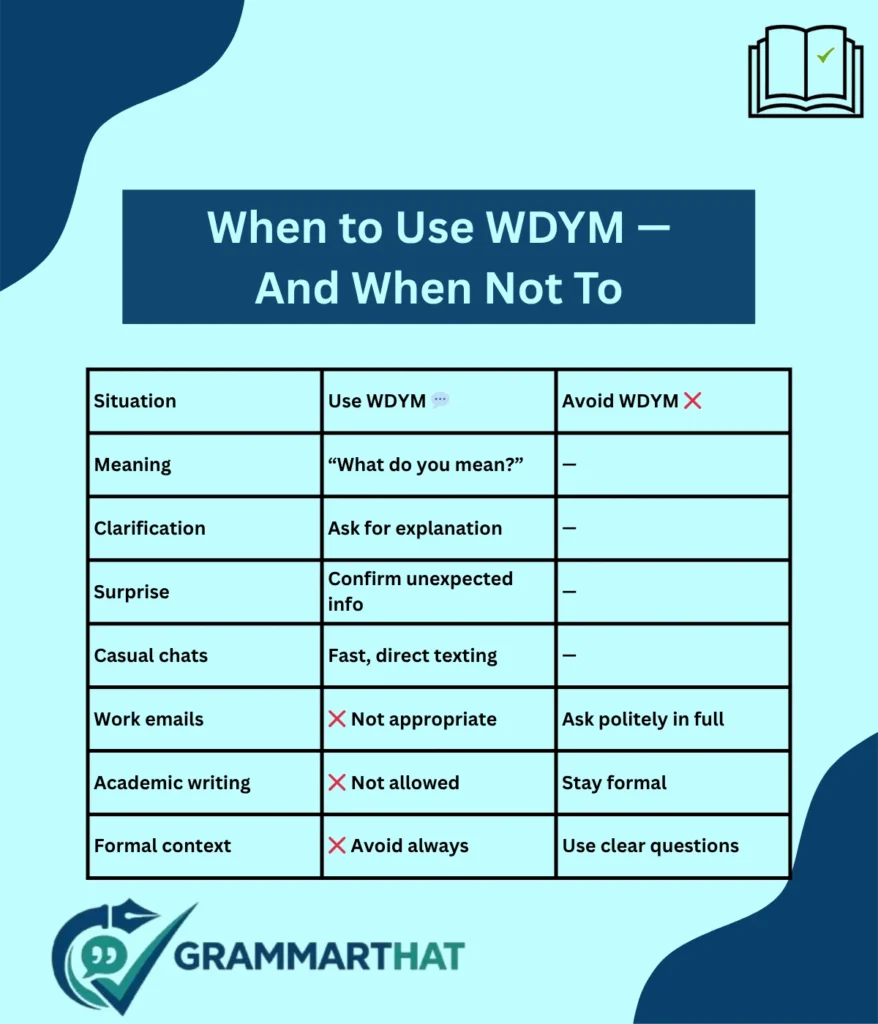
Use WDYM When:
- Something in a message is unclear or ambiguous and you need explanation
- You are surprised by unexpected information and need confirmation
- You want more detail before responding to something
- Keeping communication fast, direct, and clear
Examples:
- “WDYM the event got moved? Nobody told me.”
- “WDYM you’re not sure? I thought this was settled.”
Never Use WDYM In:
- Professional emails or formal workplace communication
- Academic writing or official documents
- Any context where a full, polite question is more appropriate
When to Use WDYM – Quick Guide
FAQs — WDYM Meaning in Text
What does WDYM mean in texting?
WDYM means “What Do You Mean?” in texting — a quick, casual request for clarification or explanation when something is confusing or unclear. Example: “WDYM you’re not going? I thought you were coming.”
What does WDYM mean on Urban Dictionary?
Urban Dictionary confirms WDYM as “What Do You Mean?” — consistently recognized as one of the most standard clarification abbreviations in digital communication. It notes that tone and context determine whether it sounds curious, surprised, or confrontational.
What does WYDM mean?
WYDM is likely a typo or variation of WDYM. It is not a widely standardized abbreviation with its own recognized meaning. When someone types WYDM, they almost certainly mean WDYM — “What Do You Mean?”
What does WYF mean?
WYF means “Where You From?” — a casual question asking about someone’s location or origin. Example: “WYF? I can’t place your accent.” It is completely separate from WDYM in both meaning and use.
Conclusion
WDYM is one of the most universally useful abbreviations in everyday texting — a direct, efficient way to ask “What Do You Mean?” when something needs clarification, explanation, or elaboration. Whether the tone is genuinely curious, pleasantly surprised, or slightly confrontational — the meaning is always the same: I need you to explain that more clearly.
Short, direct, and instantly understood across every platform — WDYM cuts straight to the point. Now that you know exactly what it means and how tone shifts its feeling — you will always use and read it with complete confidence.

Hi, I’m the voice behind GrammarThat.com. I make grammar simple and easy to understand, from basic rules to advanced writing tips. Clear explanations. Practical examples. No confusion.