Unregister and deregister both mean removing something from a registered state — but they are not always used the same way.
Deregister is the preferred, more precise term in formal and technical contexts. Unregister is widely understood but considered less standard in professional and official writing.
This guide breaks down the difference between unregister and deregister, when each is appropriate, and which one to choose for your specific context.
What Does Deregister Mean?
Deregister means to formally remove something or someone from a registration system. The prefix de- signals a deliberate reversal of a previous action — in this case, undoing a prior registration.
It is the preferred term in technical, legal, official, and corporate contexts. Major platforms and institutions use deregister when describing the process of removing a registered entity from their systems.
Example: “You need to deregister your old phone number from iMessage before switching devices.”
Common uses:
- Removing a device from a platform or account
- Canceling a company’s official registration
- Unlinking an account from a service
- Removing a user from a system or database
Real-world examples of deregister in action
Related word forms:
- Deregistered — “The device was deregistered successfully.”
- Deregistering — “She is deregistering her old account.”
- Deregistration — “The deregistration process takes 24 hours.”
What Does Unregister Mean?
Unregister means to cancel or remove a registration — making something no longer registered. The prefix un- suggests a state of being without registration, or simply reversing the registered condition.
It is widely understood and commonly used — especially in software development, app interfaces, and informal technical writing. However, it is generally considered less formal than deregister in official documentation.
Example: “Click here to unregister your device from the network.”
Common uses:
- Removing a software component or service from a system
- Canceling a user account registration
- Informal technical documentation and developer guides
- App and software settings interfaces
Related word forms:
- Unregistered — “The device is currently unregistered.”
- Unregistering — “Unregistering takes only a few seconds.”
- Unregistration — rarely used and considered informal
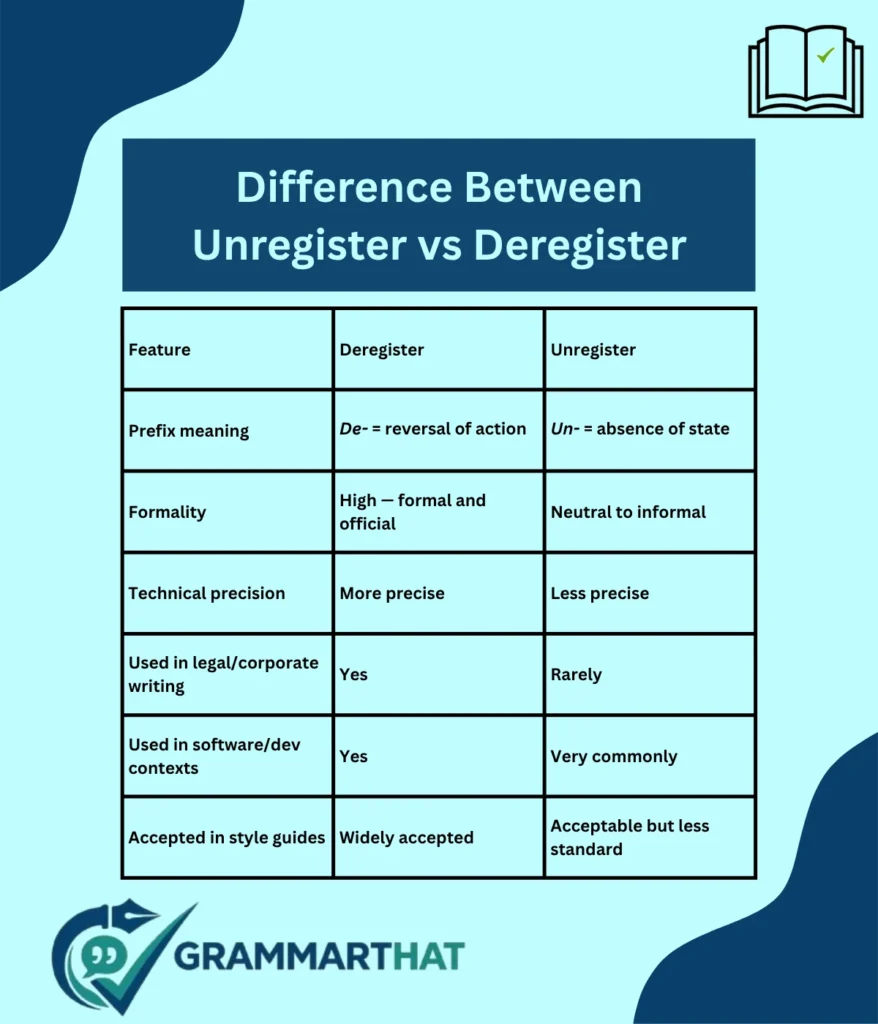
Unregister vs Deregister Comparison Table
The Key Difference Between Unregister vs Deregister
It Comes Down to Precision and Formality
Both words describe the same general action — removing a registration. The difference lies in how precise and formal that action needs to sound.
Deregister emphasizes a formal, deliberate reversal of a previously completed registration. It implies that a structured process was followed both to register and to undo it.
Unregister simply describes the state change — moving from registered to not registered. It is less precise about the process involved.
How the Prefixes Change the Meaning
Understanding the prefixes makes everything clearer:
- De- implies actively undoing or reversing something that was done. Deregister = undo the registration process deliberately.
- Un- implies a state of not being something. Unregister = no longer in a registered state.
In practice, the end result is identical — the registration is gone. But deregister sounds more intentional and process-driven, while unregister sounds more like a simple on/off switch.
When to Use Deregister vs Unregister
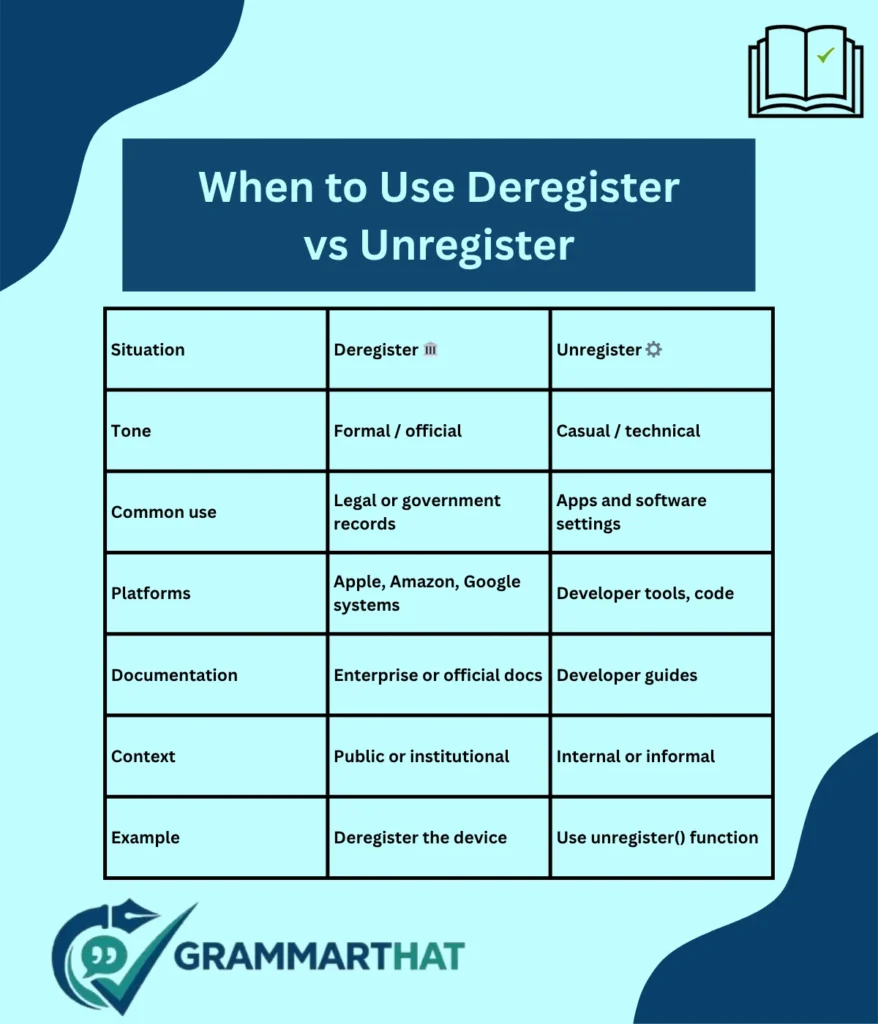
Use “Deregister” When:
- Writing official documentation or legal content
- Referring to government, corporate, or institutional registration removal
- Working with major platforms like Apple, Amazon, or Google
- The context requires formal, precise language
- Writing technical specifications or enterprise-level software docs
Examples:
- “You must deregister the business before applying for a new license.”
- “Please deregister your device before transferring ownership.”
Use “Unregister” When:
- Writing developer guides or informal technical documentation
- Working with app interfaces and software settings
- The context is casual or internal rather than public-facing
- Following existing codebase conventions that already use unregister
Examples:
- “Call the unregister() function to remove the service from the listener.”
- “Tap ‘Unregister’ in the app settings to disconnect your account.”
Common Mistakes to Avoid
Memory trick: Think of de- as “deliberately undo” — formal and structured. Think of un- as “simply not” — informal and straightforward. Match the word to the level of formality your writing requires.
FAQs — Unregister vs Deregister
What does “deregister” mean?
Deregister means to formally remove something or someone from a registered system — deliberately reversing a prior registration. It is used in legal, corporate, and technical contexts.
What is the opposite of deregister?
The opposite of deregister is register — the act of formally enrolling or adding something to a system, database, or official record.
How do you spell deregister?
The correct spelling is deregister — one word, no hyphen. The related noun form is deregistration. Both are standard in formal and technical writing.
Is unregistration a word?
Unregistration is rarely used and considered informal. In formal writing, the correct noun form is deregistration. Avoid unregistration in any official or professional document.
Conclusion
Both unregister and deregister describe the same outcome — removing something from a registered state. The difference is about formality and precision. Deregister is the stronger, more deliberate choice for official, legal, and corporate contexts. Unregister is practical and widely accepted in software and informal technical writing.
When your context is formal or public-facing, deregister is always the safer and more professional choice. In developer tools and code-level documentation, unregister fits naturally. Match the word to the context — and your writing will always land correctly.

Hi, I’m the voice behind GrammarThat.com. I make grammar simple and easy to understand, from basic rules to advanced writing tips. Clear explanations. Practical examples. No confusion.