Hm is one of the most human and natural sounds to appear in texting — a written version of something people say out loud every day.
Most commonly, hm signals thinking, hesitation, or mild curiosity — the text equivalent of pausing before you respond. It is simple, but the meaning shifts depending on tone and context.
This guide breaks down every meaning of hm in text, how each is used in real conversations, and what someone is really communicating when they send it.
What Does Hm Mean in Text?
Hm is an informal, conversational sound written out in text — similar to “hmm,” “hmmm,” or “um.” It represents a thinking pause, mild curiosity, hesitation, or low-key acknowledgment. It does not have one fixed meaning — it reads differently depending on the conversation around it.
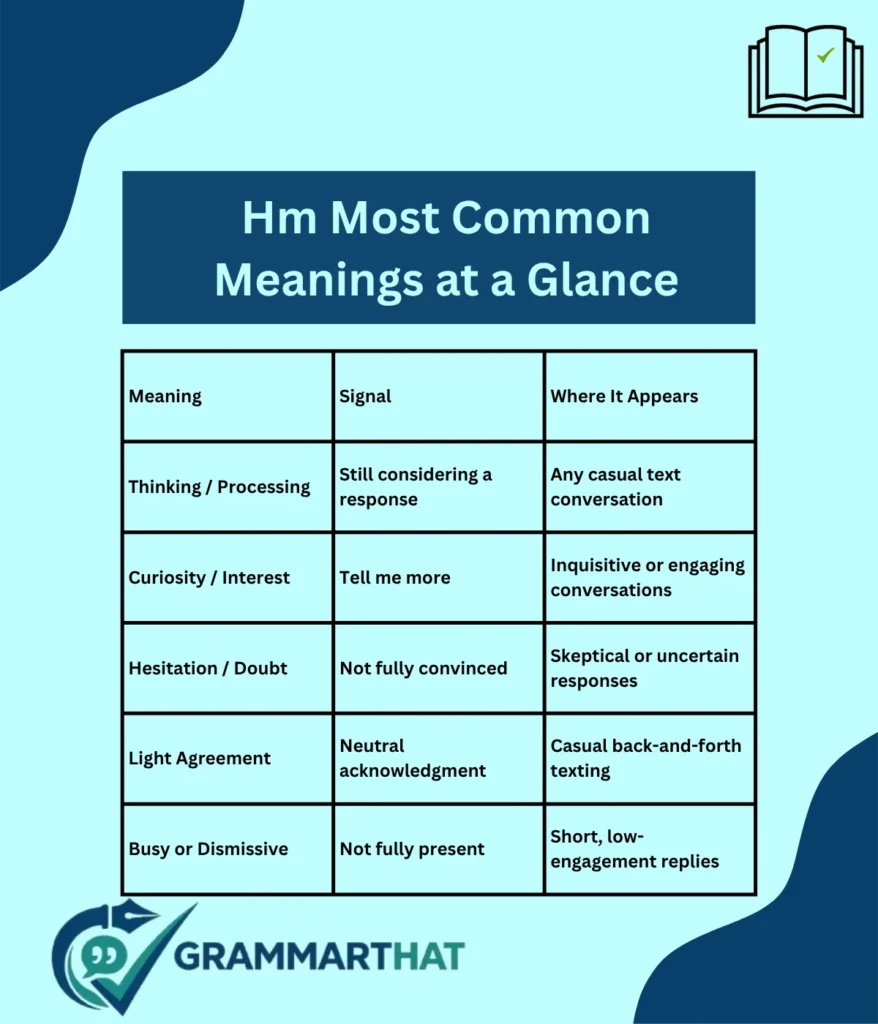
Hm Most Common Meanings at a Glance
Hm Meaning — Thinking or Processing
The most common use of hm in texting is to signal that the sender is thinking, considering, or processing what was said before responding. It is the written equivalent of pausing mid-conversation while you work something out.
Example: “Do you want to go to the beach or the mountains?” “Hm… probably the mountains.”
Here, hm shows the person is genuinely weighing their options — not brushing off the question.
Common ways hm appears in this context:
- “Hm, that’s actually a good point.” — reconsidering after hearing something new
- “Hm… let me think about it.” — not ready to answer yet
- “Hm, I didn’t look at it that way.” — processing a new perspective
- “Hm, okay. Give me a sec.” — buying a moment to think
Hm Meaning — Curiosity or Interest
When hm is paired with a question mark — “Hm?” — it shifts from thinking to curiosity or mild confusion. It is an invitation for more information — the text version of raising an eyebrow.
Example: “I heard something interesting about you.” “Hm? What did you hear?”
This signals genuine interest — the person wants to know more without fully committing to a reaction yet.
Common ways hm appears in this context:
- “Hm? Say that again.” — asking for clarification
- “Hm, interesting. Tell me more.” — genuinely curious
- “Hm? When did that happen?” — surprised and wanting details
Hm Meaning — Hesitation or Skepticism
Hm also signals doubt, hesitation, or mild skepticism — when someone is not fully convinced by what they just heard but is not outright disagreeing either.
Example: “I think we should trust him.” “Hm. I don’t know about that.”
The hm here carries doubt — it is the polite version of “I’m not so sure.” It introduces caution without direct confrontation.
Common ways hm appears in this context:
- “Hm. That doesn’t sound right.” — quiet doubt
- “Hm, are you sure?” — gentle skepticism
- “Hm… something feels off about this.” — uncertain and cautious
Hm Meaning — Light Agreement or Acknowledgment
Sometimes hm is simply a neutral, low-effort acknowledgment — confirming that the message was received without adding much in return. It is the text version of a quiet nod.
Example: “I’ll be home by 7.” “Hm, okay.”
This is not enthusiastic — but it is not negative either. It is simply a casual confirmation that the information landed.
Common ways hm appears in this context:
- “Hm, got it.” — acknowledged
- “Hm, makes sense.” — following along without strong feeling
- “Hm, alright then.” — low-key acceptance
Hm Meaning — Busy, Upset, or Disengaged
In some conversations — especially when someone sends just “hm” with no follow-up — it can signal that the person is busy, distracted, or giving the silent treatment. Context and relationship between the two people determines which it is.
Example: “How was your day?” “Hm.”
A one-word hm with no elaboration can mean:
The surrounding conversation — and what happened before the hm — reveals which reading is correct.
All Hm Meanings Side by Side
Hm vs Hmm — Is There a Difference?
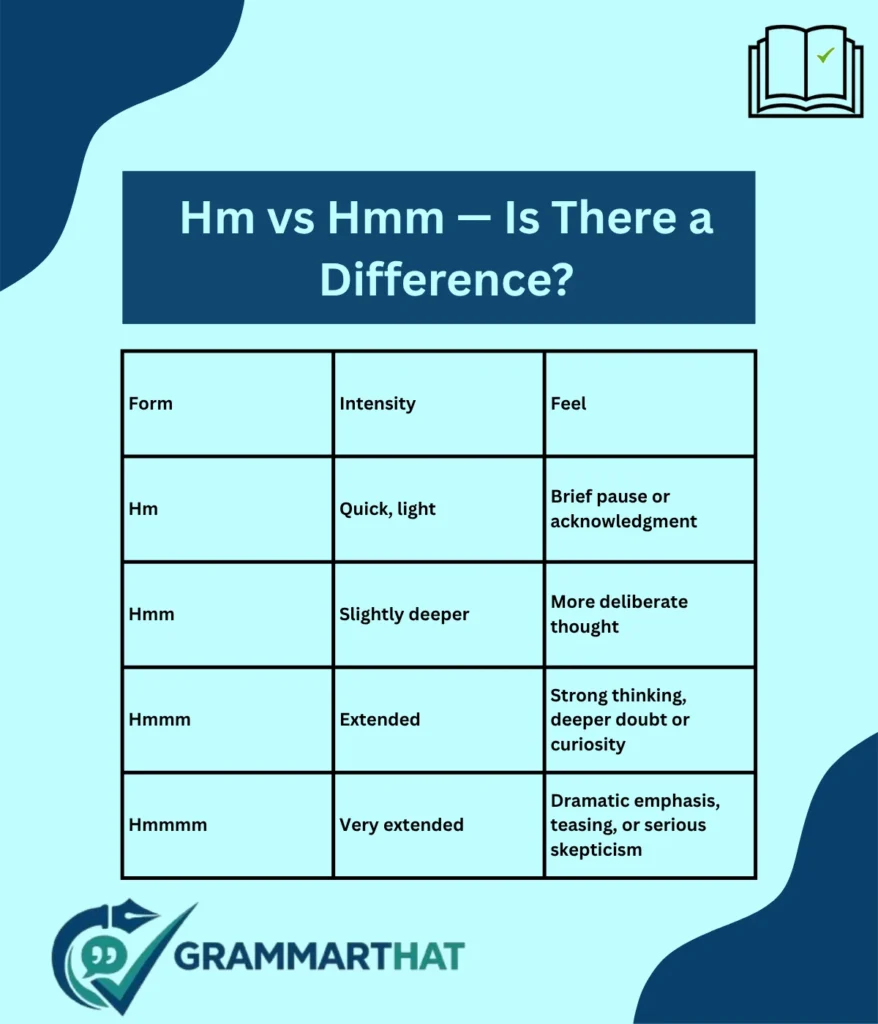
Hm and hmm carry the same general meaning — the only difference is length and intensity.
The more m’s added — the more weight the sound carries. A single “Hm” is a light pause. “Hmmm” signals something deeper is being considered.
HM in All Caps — A Different Meaning
When HM appears in all capital letters, it often carries a completely different meaning from the lowercase version:
Example (How Much): “HM for the jacket?” (= How much are you selling the jacket for?)
This meaning is entirely separate from the thoughtful “hm” sound — context makes it instantly clear which one is intended.
How to Tell What Hm Means
FAQs — Hm Meaning in Text
What does HM mean in a text?
Hm in a text signals thinking, hesitation, or mild curiosity — the written version of a thoughtful pause. In all caps, HM can mean “How Much” in buying or trading contexts. The lowercase version always reflects a conversational, emotional, or thoughtful tone.
How is HM used on social media?
On social media, hm appears in comments and replies to signal curiosity, skepticism, or thoughtful engagement. Example: “Hm, never thought of it that way.” It adds a human, conversational quality to digital responses.
What is the meaning of the HM?
Hm represents a vocalized thinking sound put into text — conveying that the sender is processing, considering, doubting, or casually acknowledging something. Its meaning is shaped entirely by the tone and context of the surrounding conversation.
What does HM ok mean in text?
“Hm okay” typically signals neutral acknowledgment — the person heard and accepted what was said without strong enthusiasm or objection. Depending on tone, it can also suggest mild hesitation — “I’m not fully sure but I’ll go with it.”
Conclusion
Hm is one of the most human abbreviations in texting — a written sound that carries real emotional and conversational weight. Most commonly it signals thinking, hesitation, or curiosity — a brief pause before the sender decides what to say next.
The meaning shifts with context — from genuine curiosity to quiet skepticism to disengaged short replies. Reading what surrounds the hm always reveals what the person is really communicating. Now that you know every nuance of hm in text, you will always understand exactly what someone means when they send it.

Hi, I’m the voice behind GrammarThat.com. I make grammar simple and easy to understand, from basic rules to advanced writing tips. Clear explanations. Practical examples. No confusion.