Propose and purpose look almost identical — but they play completely different roles in a sentence.
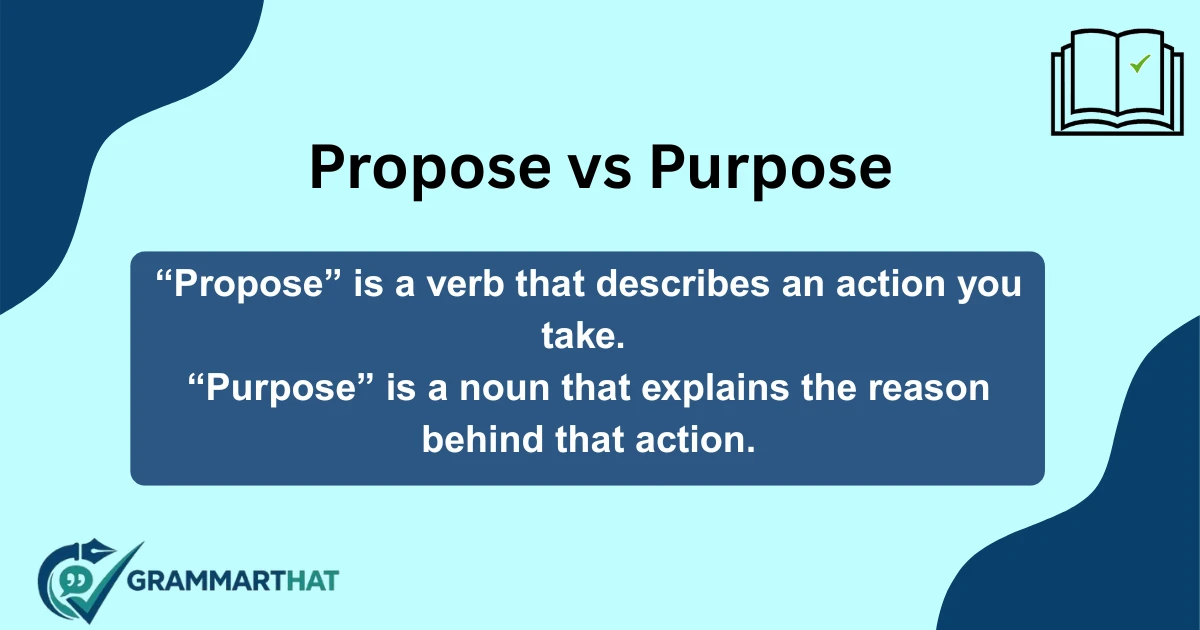
Propose is a verb that describes an action you take. Purpose is a noun that explains the reason behind that action.
This guide breaks down the difference between propose and purpose in simple terms. You will see clear definitions, real examples, and memory tricks that actually stick.
What Do Propose and Purpose Mean?

Propose Meaning (Verb)
Propose means to suggest or put forward an idea, plan, or offer. When you propose something, you are taking action — offering something for others to consider.
It comes from the Latin word proponere, meaning “to put forth.”
Example: “I propose we start the project next Monday.”
Related forms: proposed, proposing, proposal Synonyms: suggest, recommend, offer, submit
Purpose Meaning (Noun)
Purpose means the reason or goal behind something. It answers the question “why?” — not “what do you suggest?”
It comes from Old French purpos, meaning “aim or intention.”
Example: “The purpose of this meeting is to review the budget.”
Related forms: purposeful, purposeless, purpose-driven Synonyms: reason, goal, aim, objective, intent
Quick Comparison Table
| Word | Part of Speech | Core Meaning | Example |
| Propose | Verb | To suggest or offer | I propose a new plan. |
| Purpose | Noun | The reason or goal | The purpose is clear. |
The Key Difference Between Propose vs Purpose

Propose = Action | Purpose = Reason
This single rule clears up almost all the confusion:
Propose → you are doing something — suggesting, offering, putting forward. Purpose → you are explaining something — the reason, the goal, the intention.
You propose a plan. You have a purpose for that plan. They are connected — but never interchangeable.
Word Origins
| Word | Origin | Core Idea |
| Propose | Latin proponere | To put forward |
| Purpose | Old French purpos | Aim or intention |
One word pushes an idea forward. The other explains why it matters.
Side-by-Side Comparison
| Feature | Propose | Purpose |
| Type | Verb | Noun |
| Function | Suggest or offer | Reason or goal |
| Answers | What do you suggest? | Why does it exist? |
| Common mistake | Used as a noun ❌ | Used as a verb ❌ |
How to Use Propose and Purpose Correctly

Propose — Patterns and Examples
Propose follows three simple grammar patterns:
- Propose + noun → “I propose a solution.”
- Propose + that + clause → “She proposed that we revise the plan.”
- Propose + to + verb → “We propose to launch next quarter.”
Contexts where propose is used:
- Suggesting a plan at work
- Making a formal recommendation
- Asking someone to marry you
- Stating a future intention
Purpose — Patterns and Examples
Purpose follows these common structures:
- Purpose of + noun → “The purpose of this rule is safety.”
- On purpose → “He did it on purpose.”
- With the purpose of → “She studied with the purpose of improving her score.”
Contexts where purpose is used:
- Explaining why something exists
- Describing a personal goal or mission
- Using “on purpose” to mean deliberately
Real-Life Contexts
Business writing:
- “We propose a new marketing strategy.”
- “Our company’s purpose is to make technology simple.”
Academic writing:
- “This study proposes a new framework.”
- “The purpose of this research is to identify learning gaps.”
Common Mistakes — Propose vs Purpose

Wrong vs Right Examples
These are the most common errors people make:
| Wrong ❌ | Correct ✅ |
| “I purpose a new idea.” | “I propose a new idea.” |
| “The propose of this meeting is…” | “The purpose of this meeting is…” |
| “For this propose, we studied…” | “For this purpose, we studied…” |
Why this happens: Both words relate to plans and goals — so the brain swaps them easily. The fix is simple: check whether you need a verb or a noun.
Memory Tricks That Stick
Trick 1 — The Swap Test: Try replacing the word with “suggest” or “reason.”
- Fits with “suggest”? → Use propose
- Fits with “reason”? → Use purpose
Trick 2 — Word Association:
- ProPOSE → “pose an idea” → you are putting something forward
- PURpose → “the point” → it is the reason behind something
FAQ’s — Propose vs Purpose
What is the difference between purpose and propose?
Propose is a verb meaning to suggest or offer something. Purpose is a noun meaning the reason or goal behind something. You propose a plan; you have a purpose for it.
What is the difference between Propose vs Purpose?
Propose describes an action — putting an idea forward. Purpose describes a reason — the why behind something. They work together but cannot replace each other.
What’s the difference between Propose vs Purpose?
The simplest rule: propose = action, purpose = reason. One is what you do. The other is why you do it.
When to use propose in a sentence?
Use propose when you are suggesting a plan, making a formal recommendation, or stating an intention. Example: “I propose we finalize the report today.”
What is a Propose vs Purpose?
Propose is a verb used to suggest or offer something. Purpose is a noun that explains the reason behind an action. Different grammar roles — different meanings — never swappable.
Conclusion
The difference between propose and purpose is simpler than it looks. Propose is a verb — you use it when you are suggesting, offering, or putting an idea forward. Purpose is a noun — you use it when you are explaining the reason or goal behind something.
Once you understand that propose = action and purpose = reason, the confusion disappears completely. These two words work together in sentences but never replace each other. Keep that one rule in mind and you will never mix them up again.

Hi, I’m the voice behind GrammarThat.com. I make grammar simple and easy to understand, from basic rules to advanced writing tips. Clear explanations. Practical examples. No confusion.